1. Chemical Complexity of Fermented Foods
Fermented food products represent some of the most analytically challenging matrices in food science. From wine and beer to cheese, yogurt, kimchi, and soy sauce, these products contain a complex mixture of compounds generated through microbial metabolism. The fermentation process transforms raw materials into products containing organic acids (lactic, acetic, citric, malic), alcohols, esters, aldehydes, ketones, biogenic amines, pigments, and various microbial metabolites.
According to Simpson and Wynne (2000), SPE applications for food and beverages are typically developed for quality control purposes, including analysis of hop acids in beer, pigments, sugars, and acids in wine, and micro-nutrients in infant foods. The chemical complexity arises not only from the fermentation metabolites themselves but also from the original substrate components that may persist through the fermentation process.
Wine analysis exemplifies this complexity, requiring examination of volatile and semivolatile species responsible for bouquet, along with sugar acids that contribute to flavor. Solid-supported liquid-liquid extraction (LLE) and SPE have been extensively used for this purpose, with SPE offering the advantage of class fractionation into acid, base, and neutral fractions while concentrating target analytes for enhanced sensitivity.
2. Interference from Organic Acids and Pigments
Two major classes of interferents in fermented food analysis are organic acids and pigments. Organic acids like lactic acid, acetic acid, citric acid, and malic acid are abundant in fermented products and can cause significant ionization suppression in LC-MS analysis. These acids compete for ionization sites in the electrospray interface, reducing the signal intensity of target analytes.
Pigments, particularly anthocyanins in wine and other fruit-based fermentations, present another challenge. As noted in the literature, wine has been fractionated using SPE on a C18 bonded phase to extract pigments (anthocyanins) while leaving sugars in the effluent. These colored compounds can foul LC columns and MS interfaces, leading to reduced column lifetime and increased maintenance requirements.
The presence of dissolved organic carbon (DOC) from fermentation byproducts can further complicate analysis. Research by Nakamura et al. (1996) established guidelines showing that analytes with log Pow values above 4 when using alkyl-bonded silicas for SPE, or above 3 when using polystyrene sorbents, may experience reduced recovery in the presence of humic acid-like substances that are common in fermented matrices.
3. SPE Sorbent Selection for Fermentation Metabolites
3.1 Reversed-Phase Sorbents (C18, C8, HLB)
For general cleanup of fermented food extracts, reversed-phase sorbents like C18, C8, and hydrophilic-lipophilic balanced (HLB) materials are often the first choice. These sorbents effectively retain non-polar to moderately polar fermentation metabolites while allowing polar interferents like sugars and some organic acids to pass through. The Oasis HLB cartridge, containing poly(divinylbenzene-co-N-vinylpyrrolidone) sorbents, is particularly effective for medium-polar and non-polar organic compounds from mixtures of water and organic solvent.
In wine analysis, C18 cartridges have been successfully used to extract dansyl derivatives of biogenic amines, providing a 50-fold concentration effect that brings analytes into the linear response range of detectors.
3.2 Ion Exchange Sorbents (SAX, WAX, WCX)
For targeted removal of organic acids, strong anion exchange (SAX) and weak anion exchange (WAX) sorbents are invaluable. These materials can selectively retain acidic compounds while allowing neutral and basic analytes to pass through. A two-cartridge extraction system using C8 and SCX (strong cation exchange) has been demonstrated for soft drink cleanup, removing caffeine, aspartame, sodium benzoate, and caramel color acids.
For fermented products rich in organic acids, passing the sample through an anion exchanger can trap wine acids while allowing other components to pass through. This approach is particularly useful when analyzing neutral or basic fermentation metabolites.
3.3 Mixed-Mode Sorbents
Mixed-mode sorbents combining reversed-phase and ion-exchange properties offer superior selectivity for complex fermented matrices. These materials can simultaneously remove both hydrophobic interferents and ionic compounds like organic acids. The Certify mixed-mode phases have been successfully applied to isolate diverse ranges of acidic and neutral drugs from biological matrices, with similar principles applicable to food analysis.
3.4 Specialized Sorbents for Specific Applications
For lipid-rich fermented products like cheese and butter, aminopropyl (NH2) sorbents have been used for fatty acid analysis. The classic method by Kaluzny et al. (1985) separates chloroform extracts of lipid tissue into seven principle fractions with high efficiency and purity, with modifications used for dairy product analysis.
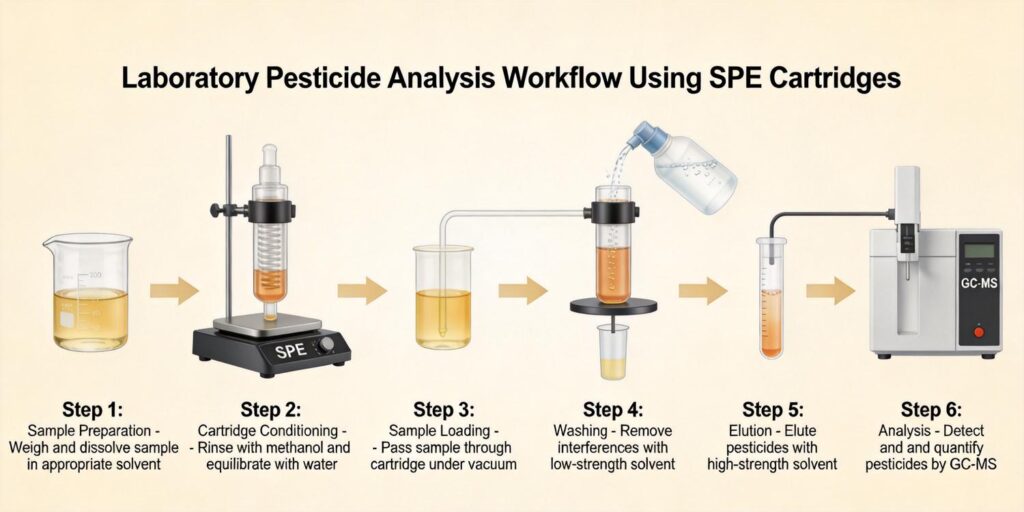
4. Example Extraction and SPE Purification Workflow
4.1 Sample Preparation
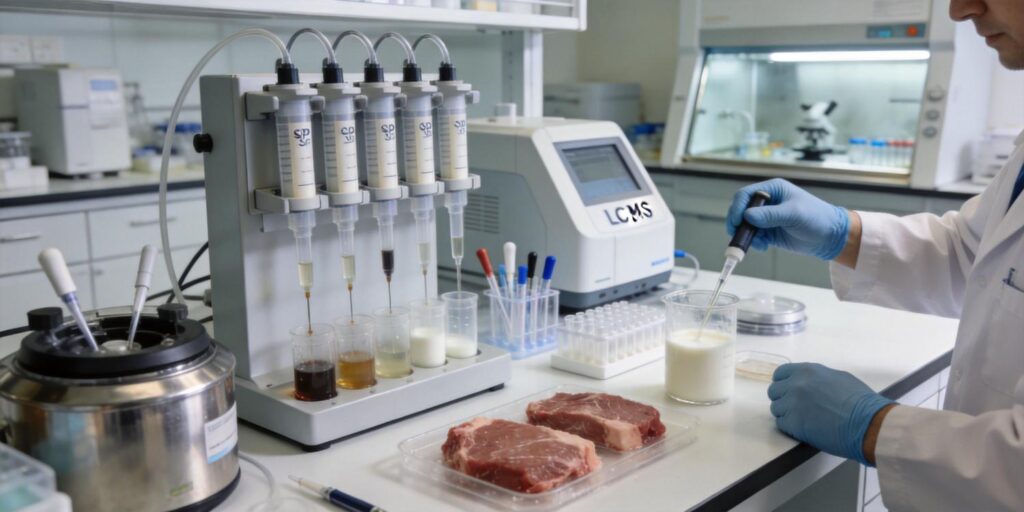
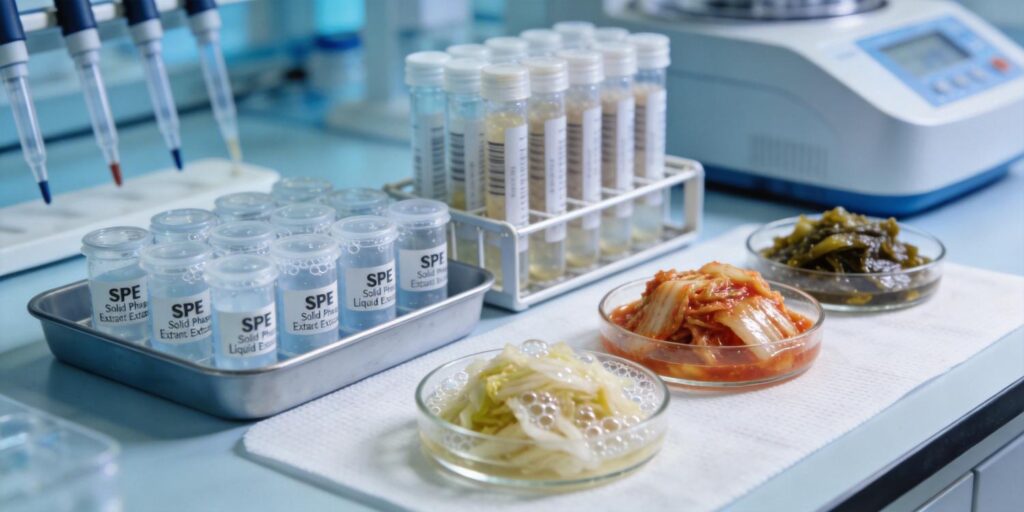
Begin with appropriate sample homogenization. For solid fermented foods like cheese or fermented vegetables, grinding with anhydrous salt may be necessary. For liquid samples like wine or beer, simple dilution or pH adjustment may suffice. Pre-filtration through 0.45 μm glass-fiber filters is recommended to remove particulates that could clog SPE cartridges.
4.2 SPE Procedure for Wine Analysis (Example)
- Conditioning: Activate a C18 cartridge with 5 mL methanol followed by 5 mL acidified water (pH 2-3).
- Loading: Apply 10-50 mL of wine sample (acidified to pH 2-3) at a flow rate of 5-10 mL/min.
- Washing: Rinse with 5 mL of acidified water (pH 2-3) followed by 5 mL of 5-10% methanol in water.
- Drying: Apply vacuum or positive pressure to remove residual water (5-10 minutes).
- Elution: Elute with 5-10 mL of methanol or acetonitrile, possibly with acid or base modifiers depending on target analytes.
- Concentration: Evaporate eluate to dryness under gentle nitrogen stream and reconstitute in mobile phase compatible with LC-MS analysis.
4.3 Two-Cartridge System for Comprehensive Cleanup
For particularly complex matrices, a tandem cartridge approach can be employed:
- First cartridge: SAX or WAX to remove organic acids
- Second cartridge: C18 or HLB to concentrate target analytes
This approach was demonstrated by Saito et al. (1989) for soft drink analysis and can be adapted for fermented beverages.
4.4 pH Optimization
pH control is critical for successful SPE of fermented products. For acidic analytes, sample acidification to pH 2-3 ensures they remain in protonated form for better retention on reversed-phase sorbents. For basic compounds, alkaline conditions (pH 8-10) may be preferable. Research has shown that changing the starting pH from 6.0 to 2.2 significantly improves recovery of polar acidic compounds like salicylic acid and paracetamol.
5. LC-MS Analysis Improvements
5.1 Reduction of Ionization Suppression
Proper SPE cleanup dramatically reduces matrix effects in LC-MS analysis. Organic acids and pigments that cause ionization suppression are removed, leading to more consistent analyte response and improved quantitative accuracy. Studies have shown that co-extracted endogenous interferences from biofluids can suppress atmospheric pressure ionization-MS analyses, necessitating selective SPE extraction applications.
5.2 Enhanced Sensitivity
SPE provides concentration factors of 50-100 times or more, bringing trace-level fermentation metabolites into detectable ranges. This is particularly important for quality control applications where contaminants or process indicators may be present at ppb levels.
5.3 Extended Instrument Lifetime
By removing pigments, lipids, and other fouling agents, SPE cleanup protects expensive LC columns and MS interfaces from contamination and degradation. Electrospray, thermospray, and particle beam instruments are all susceptible to overloading or clogging, which SPE effectively prevents.
5.4 Improved Chromatographic Performance
Cleaner extracts result in better peak shapes, reduced baseline noise, and improved resolution in chromatographic separations. This is particularly important for complex mixtures of fermentation metabolites that may have similar retention times.
6. Applications in Food Quality Control
6.1 Fermentation Process Monitoring
SPE-LC-MS enables precise monitoring of key fermentation metabolites, allowing for real-time process control. Parameters like organic acid profiles, alcohol content, and flavor compound concentrations can be tracked to ensure consistent product quality.
6.2 Contaminant Screening
Fermented foods can be contaminated with mycotoxins, pesticide residues, or unauthorized additives. SPE cleanup followed by LC-MS analysis provides sensitive detection of these contaminants. Examples include extraction of daminozide (Alar) in apple juice and vinclozolin on grapes for residue analysis.
6.3 Authentication and Adulteration Detection
Specific metabolite profiles can serve as fingerprints for authentic products. SPE-LC-MS can detect adulteration through comparison of these profiles, protecting both consumers and producers.
6.4 Shelf-Life and Stability Studies
Monitoring changes in fermentation metabolites over time provides insights into product stability and optimal shelf-life. SPE cleanup ensures that degradation products are accurately quantified without interference from matrix components.
6.5 Regulatory Compliance
Many fermented food products have regulatory limits for specific compounds (e.g., biogenic amines in wine, histamine in fish products). SPE-LC-MS provides the sensitivity and selectivity needed for compliance testing at regulatory limits.
6.6 Nutritional Labeling
Accurate quantification of vitamins, amino acids, and other nutrients in fermented foods requires effective sample cleanup. SPE methods have been developed for fat-soluble vitamins in animal feeds using Oasis HLB cartridges, with similar approaches applicable to fermented food products.
Conclusion
SPE cleanup is an indispensable tool for LC-MS analysis of fermented food products. The chemical complexity of these matrices, particularly interference from organic acids and pigments, necessitates robust sample preparation strategies. Proper sorbent selection—whether reversed-phase, ion-exchange, mixed-mode, or specialized materials—combined with optimized workflows can dramatically improve analytical outcomes.
The benefits extend beyond simple cleanup to include enhanced sensitivity, reduced matrix effects, extended instrument lifetime, and improved chromatographic performance. For food quality control applications, SPE-LC-MS enables precise monitoring of fermentation processes, contaminant screening, authentication, stability studies, regulatory compliance, and accurate nutritional labeling.
As fermentation science continues to advance and new fermented products enter the market, SPE methodologies will remain essential for ensuring product safety, quality, and consistency. The principles outlined here provide a foundation for developing effective SPE protocols tailored to specific fermented food matrices and analytical requirements.