
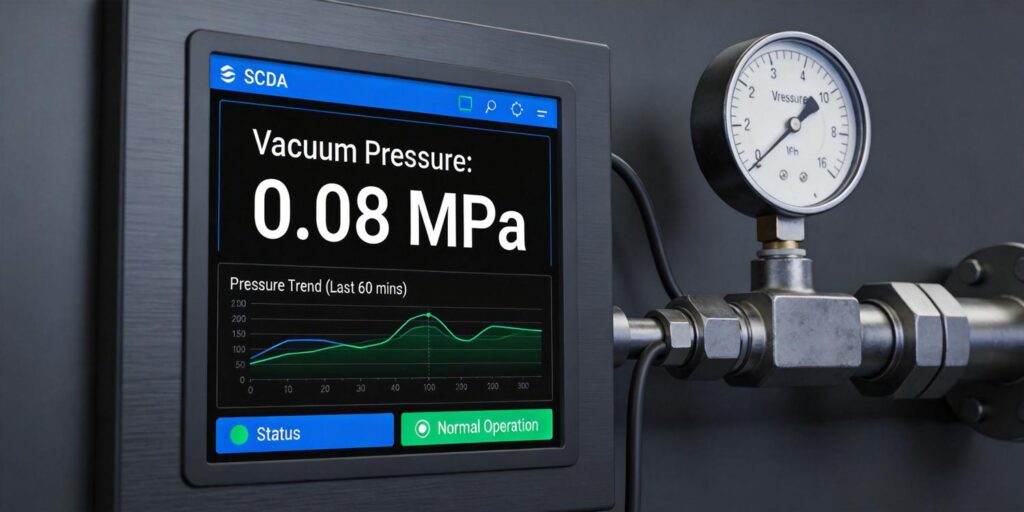
Overview of SCADA Communication Architecture
Modern vacuum systems increasingly rely on SCADA (Supervisory Control and Data Acquisition) platforms to provide centralized monitoring, real-time control, and historical data for process optimization. A typical architecture consists of field devices (gauges, pumps, valves), programmable logic controllers (PLCs) or remote terminal units (RTUs), a communications network, human-machine interface (HMI) stations, and an historian database. For vacuum metallizing, heat-treatment furnaces, or large coating chambers, the vacuum gauges serve as the primary sensors feeding pressure data into this hierarchy.
At Poseidon Scientific, both the VG-SP205 Pirani Vacuum Transmitter and VG-SM225 Cold Cathode Vacuum Gauge were designed with SCADA integration in mind. They deliver dual-output capability—industry-standard 0–10 V analog plus RS232 digital—allowing seamless connection to virtually any PLC brand. The gauges’ compact size and low-cost architecture further reduce the total system footprint while maintaining the reliability engineers demand in production environments.
Analog vs Modbus Gateway Solutions
Engineers face a clear choice when integrating vacuum gauge data: analog signaling for simplicity or digital protocols for richer diagnostics and reduced wiring. The VG-SP205 and VG-SM225 support both approaches natively.
Analog (0–10 V) integration remains the most straightforward option for legacy PLCs or applications requiring sub-second response. The gauges output a linear 2–8 V signal across their operating range (effective full scale), with the remaining band reserved for status and error codes. Shielded twisted-pair cable and proper grounding keep noise below 10 mV even over 30 m runs—sufficient for most vacuum systems. No additional hardware is required, keeping integration costs minimal.
Digital Modbus gateway solutions offer significant advantages in new or expanded SCADA installations. The gauges’ built-in RS232 port supports fully customizable protocols at the hardware level (minimum 5–10 unit order). A low-cost RS232-to-Modbus RTU gateway converts the native stream into standard Modbus registers, exposing pressure, status, error codes, and firmware version in engineering units. For multi-gauge systems, the optional RS485 board revision allows daisy-chaining up to 32 devices on a single pair, dramatically reducing cabinet wiring. Digital integration also enables bidirectional commands—such as forcing high-voltage disable on the VG-SM225 during venting—directly from the SCADA master.
Procurement teams typically select analog for simple retrofit projects and Modbus for greenfield systems where data integrity, alarm acknowledgment, and predictive maintenance are priorities. Poseidon’s protocol customization service ensures the register map matches your existing PLC logic, eliminating custom programming on the controller side.
Signal Scaling and Engineering Units
Correct scaling prevents misinterpretation of vacuum data and ensures consistent alarms across the SCADA system. For the VG-SP205 Pirani (atmosphere to 10⁻³ Torr), the 0–10 V output maps linearly such that 2 V equals atmosphere (760 Torr) and 8 V equals 10⁻³ Torr, with intermediate values following the calibrated power-to-pressure curve. The VG-SM225 Cold Cathode follows a similar 2–8 V mapping across 10⁻³ to 10⁻⁷ Torr.
In the PLC or SCADA historian, apply the linear transformation:
Pressure (Torr) = 10^((8 – V_out) / 1.5) for Pirani linear region (full curve uses factory-provided polynomial for non-linear zones). Equivalent Pa or mbar scaling is available via simple multiplier constants. Both gauges ship with a factory calibration certificate that includes the exact voltage-to-pressure lookup table for the specific serial number.
Modern SCADA packages (Wonderware, Ignition, WinCC) allow direct import of these tables as scaling blocks or function calls. Poseidon provides sample ladder logic and function-block libraries for Allen-Bradley, Siemens, and Schneider platforms, ensuring engineering units appear natively on HMIs without manual conversion.
Alarm Hierarchy Setup
Effective vacuum process control depends on a clear alarm hierarchy that distinguishes between advisory, warning, and critical events. Typical tiers for a metallizing or heat-treatment system include:
- Level 1 (Advisory): Pressure above 10⁻² Torr during roughing—indicates slow pump-down or minor leak.
- Level 2 (Warning): Cold-cathode ignition delay exceeds 2 minutes at 10⁻⁴ Torr—signals potential contamination.
- Level 3 (Critical): Pressure rises above 5×10⁻⁵ Torr during evaporation—triggers immediate source shutdown to protect film quality.
The VG-SM225’s digital status byte and flashing LED output feed directly into the PLC’s alarm matrix, while the VG-SP205’s analog band outside 2–8 V can flag sensor faults or over-range conditions. SCADA historians log both the raw signal and the interpreted alarm state, enabling root-cause analysis. Poseidon’s customizable protocol includes dedicated registers for alarm thresholds, allowing operators to adjust setpoints remotely without touching the gauge firmware.
Data Logging and Historical Trend Analysis
Historical pressure trends are invaluable for process validation, predictive maintenance, and regulatory compliance. Both Poseidon gauges output pressure and status at up to 1 Hz via RS232, easily captured by any SCADA historian. In a typical 1500 L chamber, engineers can overlay Pirani and cold-cathode curves to identify the exact crossover moment, quantify outgassing rates, and correlate pressure stability with film adhesion results.
Trend analysis reveals subtle issues before they affect yield—for example, gradual increase in cold-cathode start-up time indicating electrode contamination, or Pirani drift signaling filament aging. Data logged at 10-second intervals over a 24-hour campaign occupies negligible historian storage yet provides months of forensic value. Poseidon recommends storing raw voltage alongside scaled pressure; this allows post-processing with updated calibration curves if gauges are later serviced or replaced.
Redundant Measurement Design
For mission-critical vacuum systems, redundant measurement eliminates single-point failure. The recommended architecture pairs the VG-SP205 and VG-SM225 in overlapping pressure zones:
| Gauge | Primary Range | Redundant Role | Failover Trigger |
|---|---|---|---|
| VG-SP205 Pirani | Atm to 10⁻³ Torr | Backup confirmation at 10⁻³ Torr crossover | Cold-cathode ignition failure |
| VG-SM225 Cold Cathode | 10⁻³ to 10⁻⁷ Torr | Cross-check Pirani at transition | Pirani over-range or filament fault |
The SCADA logic compares the two readings in the overlap band (≈10⁻³ Torr) and flags any discrepancy greater than 20 % as a maintenance alert. This design also satisfies many quality standards requiring dual independent sensors for high-vacuum verification. Because both gauges share identical mechanical interfaces and RJ45 connectors, stocking a single spare type simplifies inventory.
Practical Integration Workflow
Successful SCADA integration follows a repeatable seven-step workflow:
- Define requirements: Map pressure setpoints, alarm priorities, and required update rate.
- Select output mode: Choose analog, RS232, or Modbus based on existing PLC I/O capacity.
- Mechanical installation: Mount gauges at representative chamber locations (KF16/KF25) with isolation valves where rapid venting occurs.
- Electrical wiring: Use shielded cable; terminate RS232 at the gateway or PLC serial port.
- PLC configuration: Import Poseidon scaling blocks and register maps; test analog/digital signals in simulation mode.
- HMI and historian setup: Create trending screens and alarm banners; enable data logging with timestamps.
- Commissioning and validation: Perform pump-down cycle, compare gauge readings against certified reference, and verify alarm response.
Poseidon’s engineering team can supply pre-configured sample projects and on-site support for the first integration, reducing commissioning time from days to hours.
Conclusion and Integration Consultation CTA
Integrating vacuum gauge data into SCADA systems transforms raw pressure signals into actionable process intelligence. Whether using simple analog loops or full Modbus networks, the VG-SP205 and VG-SM225 deliver the accuracy, stability, and protocol flexibility required by today’s vacuum engineers—at a cost that keeps the instrumentation budget well below 10 % of total system value.
Our team has supported SCADA integrations across metallizing lines, vacuum furnaces, and research coating tools worldwide. We offer free consultation to review your PLC brand, existing I/O count, and target historian configuration, then provide a complete integration package including custom protocol files, wiring diagrams, and sample code.
Contact Poseidon Scientific today for a no-obligation SCADA integration review. Download our integration handbook or request a live demo of the gauges in your preferred protocol. Let us help you achieve seamless, reliable vacuum data visibility across your entire operation.
Product pages for detailed specifications: VG-SP205 Pirani Vacuum Transmitter and VG-SM225 Cold Cathode Vacuum Gauge.


