Importance of Flavor Compound Profiling in Beverage Analysis
Flavor compound profiling represents a critical analytical frontier in beverage science, where subtle aromatic nuances define product identity, quality, and consumer acceptance. The volatile and semivolatile species responsible for a beverage’s bouquet—such as esters, aldehydes, terpenes, and phenolic compounds—exist at trace levels yet exert profound sensory impact. As Simpson and Wynne note in their comprehensive SPE text, “Wine requires analysis for volatile and semivolatile species, which are largely responsible for the wine’s bouquet, and sugar acids, which contribute to the flavor.” This observation extends to diverse beverages including tea, coffee, beer, and spirits, where flavor profiling serves multiple purposes: authenticity verification, quality control, process optimization, and new product development.
Challenges in Detecting Trace Aromatic Compounds
The analytical detection of trace flavor compounds presents significant technical hurdles. These analytes typically exist at parts-per-billion (ppb) or even parts-per-trillion (ppt) concentrations within complex matrices containing sugars, acids, pigments, tannins, and other interfering substances. The high alcohol content in wines and spirits further complicates extraction efficiency, while variable sugar concentrations in soft drinks and juices affect sorbent capacity. Traditional liquid-liquid extraction (LLE) methods often prove inadequate, yielding unpredictable recoveries, emulsion formation, and excessive matrix interference. As noted in forensic SPE applications, “Biological samples are notoriously dirty; injecting them with minimum cleanup onto very sensitive and expensive instruments makes very little sense.” This principle applies equally to beverage matrices, where co-extracted compounds can obscure target analytes and degrade instrument performance.
SPE Sorbent Selection for Flavor Analytes
Strategic sorbent selection forms the cornerstone of successful flavor compound extraction. The diverse chemical nature of flavor compounds—ranging from non-polar terpenes to polar phenolic acids—demands careful consideration of sorbent chemistry and extraction mechanisms.
Reversed-Phase Sorbents (C18, C8, HLB)
Hydrophobic reversed-phase sorbents excel at trapping non-polar to moderately polar flavor compounds from aqueous matrices. C18 sorbents, with their high carbon load and hydrolytic stability, provide excellent retention for esters, aldehydes, and terpenes. The hydrophilic-lipophilic balance (HLB) sorbents offer enhanced water wettability and superior recovery of polar compounds like certain phenolic acids. As documented in SPE literature, “C18… strong hydrophobic sorbent used to adsorb analytes of even weak hydrophobicity from aqueous solutions… typical applications include… organic acids in beverages.”
Mixed-Mode and Ion-Exchange Sorbents (MCX, WAX, WCX)
For charged flavor compounds, mixed-mode sorbents combining hydrophobic and ion-exchange interactions provide superior selectivity. Cation-exchange sorbents (MCX) effectively trap basic compounds like certain alkaloids in tea, while anion-exchange sorbents (WAX) capture acidic species including phenolic acids and organic acids. This dual-interaction approach enables class fractionation—separating acids, bases, and neutrals—as demonstrated in wine analysis where “class fractionation into acid, base, and neutral fractions is simple and the opportunity to concentrate the target analytes offers enhanced sensitivity.”
Specialty Sorbents for Specific Applications
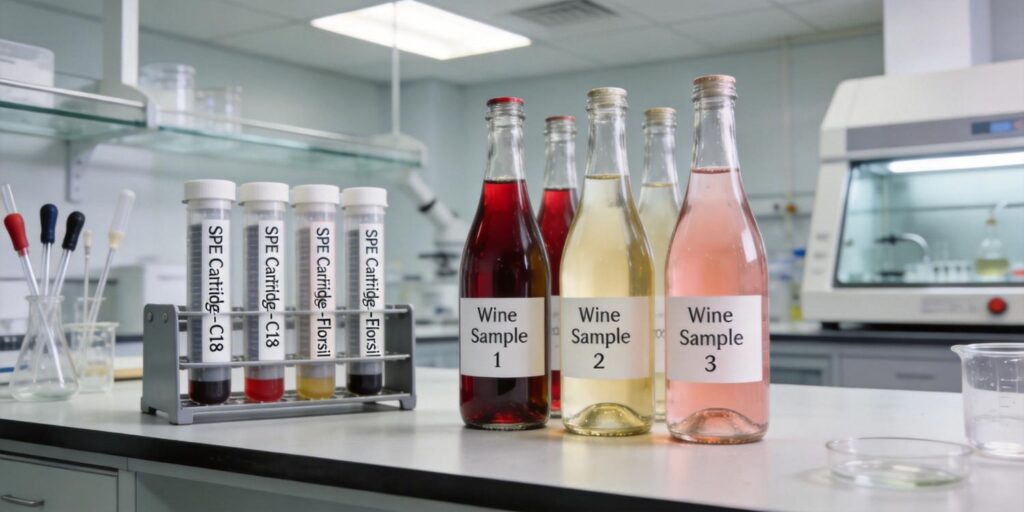
Florisil and silica sorbents serve specific needs in flavor analysis. Florisil effectively removes pigments and other polar interferences, while unmodified silica provides polar interactions for isolating flavor compounds from non-polar solvents. The Waters catalog notes that “Silica… a polar sorbent for analyte isolation from non-polar solvents like hydrocarbons and less polar esters and ethers… provides a slightly acidic surface for moderate cation-exchange interactions in aqueous samples.”
Example Extraction Workflow for Wine or Tea Analysis
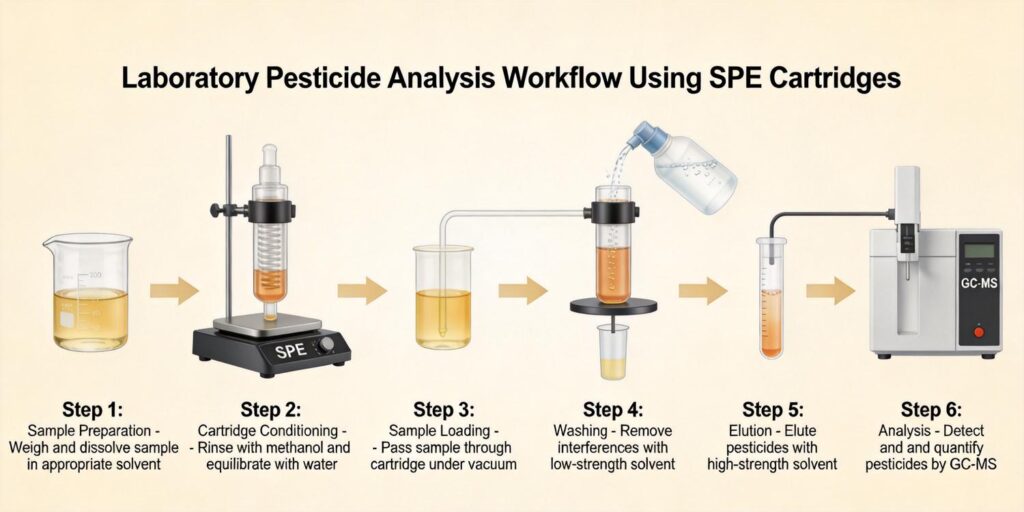
A robust SPE workflow for flavor compound extraction follows systematic conditioning, loading, washing, and elution steps, optimized for specific beverage matrices.
Wine Volatile Compound Extraction
- Sample Preparation: Dilute wine sample 1:10 with acidified water (pH 3.0) to reduce alcohol content and improve sorbent retention.
- SPE Cartridge Conditioning: Condition HLB cartridge (200 mg) sequentially with 3 mL methanol followed by 3 mL acidified water.
- Sample Loading: Load 10 mL diluted sample at 1-2 mL/min flow rate.
- Washing: Wash with 3 mL 5% methanol in water to remove sugars and polar interferences.
- Drying: Apply vacuum for 5 minutes to remove residual water.
- Elution: Elute flavor compounds with 3 mL ethyl acetate, collecting in a concentrator tube.
- Concentration: Evaporate to dryness under gentle nitrogen stream and reconstitute in 100 µL ethyl acetate for GC-MS analysis.
Tea Polyphenol Extraction
- Sample Preparation: Brew tea according to standard protocol, cool, and filter through 0.45 µm membrane.
- SPE Cartridge Conditioning: Condition WAX cartridge (500 mg) with 3 mL methanol followed by 3 mL acidified water (pH 2.0).
- Sample Loading: Load 5 mL tea infusion adjusted to pH 2.0.
- Washing: Wash with 3 mL acidified water followed by 3 mL methanol/water (20:80).
- Elution: Elute phenolic acids with 3 mL methanol containing 2% formic acid.
- Concentration: Evaporate and reconstitute in mobile phase for LC-MS analysis.
These workflows exemplify how SPE enables “matrix removal and concentration of the target analytes,” as noted in food and beverage applications, providing clean extracts suitable for sensitive detection.
GC-MS and LC-MS Detection of Flavor Compounds
The choice between GC-MS and LC-MS detection depends on analyte volatility, polarity, and thermal stability.
Gas Chromatography-Mass Spectrometry (GC-MS)
GC-MS remains the gold standard for volatile flavor compound analysis, offering exceptional separation efficiency and sensitive detection. The technique’s “high sensitivity and resolution” combined with mass spectral fingerprinting provides definitive compound identification. For SPE extracts, GC-MS compatibility requires complete removal of water and exchange to volatile organic solvents. As documented in SPE-GC integration, “SPE is, by its nature, a trace enrichment step and because it is a convenient way of achieving solvent exchange, stripping away the aqueous matrix as the SPE extraction proceeds.” Modern injector technology allows loading of concentrated SPE eluates (up to 160 µL in some systems), enhancing detection limits for trace flavor compounds.
Liquid Chromatography-Mass Spectrometry (LC-MS)
LC-MS excels for polar, thermally labile, or non-volatile flavor compounds including polyphenols, glycosides, and certain acids. The technique’s compatibility with aqueous samples makes it ideal for SPE extracts, though effective clean-up remains crucial to prevent source contamination. As noted in veterinary drug applications, “The LC interface allows the introduction of aqueous samples into the mass spectrometer and may reduce the need for derivatization of some compounds.” For flavor analysis, LC-MS enables detection of compounds like tea catechins and wine anthocyanins that would degrade under GC conditions.
Derivatization Strategies
For compounds requiring enhanced volatility or detection characteristics, on-cartridge derivatization offers advantages. “Solid-phase derivatization has been demonstrated in many systems where the analytes are adsorbed onto the surface of sorbent particles,” concentrating reactants and facilitating reaction completion. This approach proves valuable for aldehydes and other reactive flavor compounds that benefit from chemical modification prior to analysis.
Applications in Quality Control and Process Optimization
SPE-based flavor analysis supports comprehensive quality control programs across the beverage industry, addressing multiple analytical needs.
Authenticity and Adulteration Detection
Flavor profiling establishes characteristic “fingerprints” for premium products, enabling detection of adulteration or substitution. The concentration effect of SPE—”the 50-fold concentration effect of the SPE step” noted in wine amine analysis—enhances detection of marker compounds that distinguish authentic products from imitations.
Batch Consistency Monitoring
Regular SPE extraction and analysis of flavor compounds ensures product consistency across production batches. By monitoring key aroma compounds, manufacturers can identify process variations and maintain sensory specifications.
Raw Material Quality Assessment
SPE extraction of flavor compounds from raw materials (tea leaves, coffee beans, hops, grapes) supports quality grading and purchasing decisions. The technique’s ability to handle diverse matrices—from “fruits and vegetables” to “oils and other lipidic material”—makes it versatile for raw material analysis.
Shelf-Life and Stability Studies
Monitoring flavor compound degradation during storage helps establish shelf-life specifications and optimize packaging. SPE’s mild extraction conditions—”extraction under mild conditions of pH, thereby limiting the incidence of decomposition or rearrangement of labile compounds”—preserves native compound profiles for accurate stability assessment.
Process Optimization
Tracking flavor compound evolution during fermentation, aging, or thermal processing informs process optimization. SPE enables analysis of intermediate samples with complex matrices that would challenge direct injection methods.
Conclusion
Solid-phase extraction has revolutionized flavor compound analysis in beverages by providing robust, reproducible sample preparation that addresses the unique challenges of trace analysis in complex matrices. Through strategic sorbent selection and optimized workflows, SPE delivers the clean, concentrated extracts required for sensitive GC-MS and LC-MS detection. As beverage quality standards continue to elevate and analytical demands grow more sophisticated, SPE remains an indispensable tool for flavor chemists seeking to understand, control, and optimize the sensory characteristics that define their products. The technique’s versatility across beverage types—from “wine and other alcoholic beverages” to teas, juices, and soft drinks—ensures its continued relevance in an industry where flavor excellence represents both art and science.