Overview of Lipid Mediators: Prostaglandins and Leukotrienes
Lipid mediators represent a crucial class of bioactive molecules derived from polyunsaturated fatty acids, primarily arachidonic acid, that play essential roles in inflammation, immune response, and cellular signaling. Prostaglandins and leukotrienes constitute two major families of these mediators, each with distinct biological functions and analytical challenges.
Prostaglandins are eicosanoids produced via the cyclooxygenase pathway, functioning as potent regulators of inflammation, pain perception, and vascular tone. Leukotrienes, generated through the lipoxygenase pathway, are particularly significant in allergic responses and asthma pathogenesis. Both classes exist at extremely low concentrations in biological matrices—typically in the picogram to nanogram per milliliter range—making their accurate quantification challenging yet essential for understanding inflammatory diseases and developing targeted therapies.
Challenges of Plasma Lipid Mediator Analysis
Plasma presents a particularly complex matrix for lipid mediator analysis due to several inherent challenges:
Low Abundance and Instability
Lipid mediators circulate at trace levels (pg/mL to ng/mL) and are chemically labile, requiring careful sample handling to prevent degradation during collection, storage, and processing. Their rapid metabolism and susceptibility to oxidation necessitate immediate stabilization with appropriate inhibitors.
Matrix Complexity
Plasma contains high concentrations of proteins, lipids, and other endogenous compounds that can interfere with analysis. As noted in SPE literature, “protein binding of isolates may be a problem and should be considered if recoveries of isolate standards are high but recoveries from sample are low” (Simpson & Wells, 2000). The presence of phospholipids and triglycerides further complicates extraction efficiency.
Structural Diversity
Lipid mediators encompass numerous structurally similar isomers and metabolites that require high-resolution separation. Their amphiphilic nature, containing both hydrophobic fatty acid chains and polar functional groups, creates challenges for selective extraction.
SPE Sorbents Designed for Lipid Mediators
Selecting appropriate SPE sorbents is critical for successful lipid mediator extraction from plasma. Different sorbent chemistries offer distinct advantages:
Mixed-Mode Sorbents
Mixed-mode sorbents combining hydrophobic and ion-exchange interactions provide superior selectivity for lipid mediators. These sorbents can retain analytes through multiple mechanisms, allowing for more effective removal of interfering compounds while maintaining high recovery of target molecules.
Polymeric Sorbents
Hydrophilic-lipophilic balanced (HLB) polymeric sorbents offer excellent retention for a wide range of lipid mediators regardless of their ionization state. Their high capacity and ability to handle large sample volumes make them particularly suitable for trace analysis.
Specialized Lipid Sorbents
Specific sorbents designed for lipid class separation, such as aminopropyl (NH2) phases, have demonstrated effectiveness in fractionating lipid extracts. As documented in SPE applications, “the NH2 extraction draws on a classic application by Kaluzny et al. (1985)… This extraction separates a chloroform extract of lipid tissue into seven principle fractions with high efficiency and purity” (Simpson & Wynne, 2000).
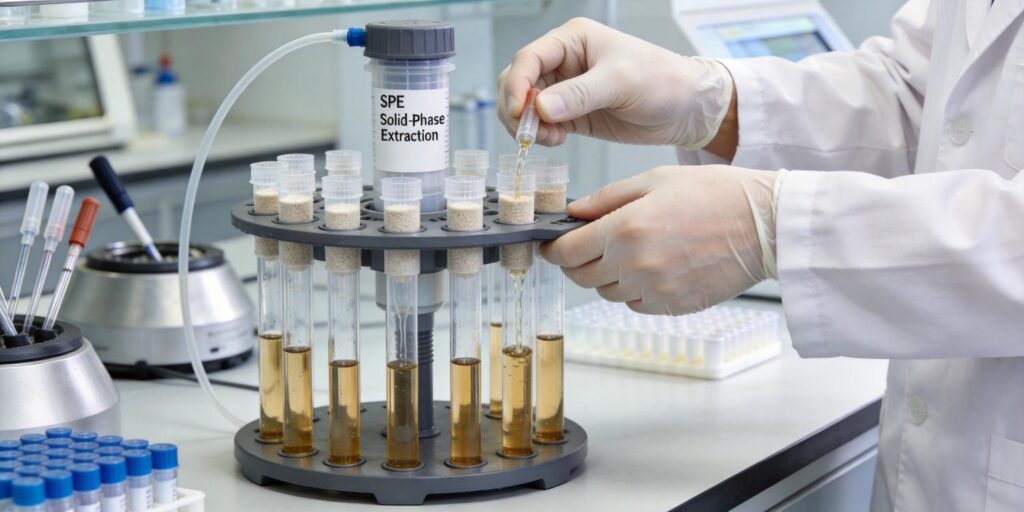
Example Plasma Extraction and SPE Cleanup Workflow
A robust SPE workflow for plasma lipid mediator analysis typically follows these optimized steps:
Sample Preparation
Begin with immediate stabilization of plasma samples using appropriate enzyme inhibitors (COX/LOX inhibitors) and antioxidants. Protein precipitation with cold methanol or acetonitrile (typically 2:1 organic:plasma ratio) effectively removes proteins while maintaining analyte stability. Centrifuge at 4°C to pellet proteins and transfer supernatant for SPE processing.
SPE Cartridge Conditioning
Condition HLB or mixed-mode cartridges (30-60 mg bed mass) sequentially with methanol (3-5 mL) followed by water or aqueous buffer (3-5 mL). Maintain a flow rate of 1-2 mL/min to ensure proper sorbent activation without drying.
Sample Loading
Dilute the protein-free supernatant with aqueous buffer (typically 0.1% formic acid or ammonium acetate) to reduce organic content to <10%. Load at controlled flow rates (1-3 mL/min) to maximize analyte retention while minimizing breakthrough.
Wash Steps
Implement sequential washing with 5-10% methanol in water (3-5 mL) to remove polar interferences, followed by hexane or ethyl acetate washes (2-3 mL) to eliminate non-polar lipids. These steps significantly reduce matrix effects in subsequent LC-MS/MS analysis.
Elution Optimization
Elute lipid mediators using optimized solvent mixtures. For prostaglandins and leukotrienes, methyl tert-butyl ether:methanol:acetic acid (90:10:0.1) or ethyl acetate:methanol (95:5) typically provides excellent recovery (>85%). Collect eluates in silanized glass vials to minimize adsorption losses.
Sample Concentration
Gently evaporate eluates under nitrogen stream at 30-35°C to near dryness. Reconstitute in LC-MS compatible solvent (typically methanol:water 50:50 with 0.1% formic acid) at appropriate concentration factor (10-50×) for optimal detection sensitivity.
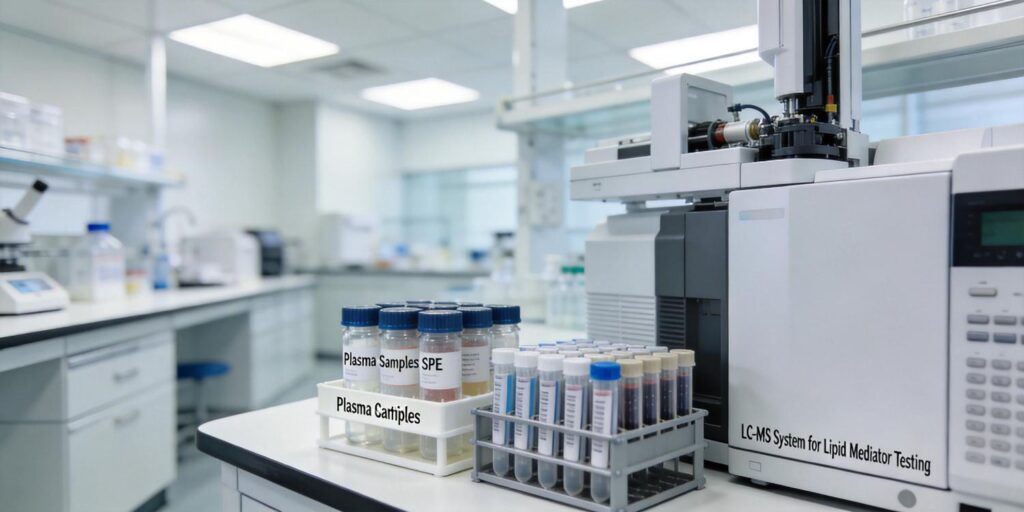
LC-MS/MS Detection Strategies
Modern LC-MS/MS approaches provide the sensitivity and specificity required for lipid mediator analysis:
Chromatographic Separation
Employ reversed-phase chromatography with C18 or C8 columns (2.1 × 100 mm, 1.7-2.7 μm particles) using water-acetonitrile or water-methanol gradients with 0.1% formic acid or ammonium acetate modifiers. Maintain column temperature at 40-50°C for optimal peak shape and resolution of isomeric compounds.
Mass Spectrometric Detection
Utilize electrospray ionization in negative ion mode for most lipid mediators, as they typically contain carboxylic acid groups. Multiple reaction monitoring (MRM) transitions should be optimized for each analyte, with careful selection of precursor and product ions to maximize specificity. As noted in SPE-MS integration literature, “the sensitivity issue is addressed by Bowers et al. (1997)… yielding sensitivities of 50 pg/mL for sample sizes of only 200 μL” (Simpson, 2000).
Internal Standardization
Incorporate stable isotope-labeled internal standards (d4-PGE2, d4-LTB4, etc.) at the earliest possible stage to correct for extraction efficiency, matrix effects, and instrument variability. These standards should be added immediately after sample collection for most accurate quantification.
Method Reproducibility Considerations
Ensuring reproducible results in lipid mediator analysis requires attention to several critical factors:
Standardized Sample Handling
Implement strict protocols for blood collection, processing, and storage. Use consistent anticoagulants (typically EDTA or heparin), process samples within 30 minutes of collection, and store at -80°C with minimal freeze-thaw cycles. Document all handling parameters meticulously.
SPE Method Validation
Validate SPE recovery for each analyte class using spiked plasma samples. Monitor recovery consistency across different lots of SPE cartridges and between operators. Establish acceptance criteria for recovery (typically 70-120%) and precision (<15% RSD).
Quality Control Implementation
Include quality control samples at low, medium, and high concentrations in each analytical batch. Monitor system suitability parameters including retention time stability, peak shape, and signal-to-noise ratios. Implement Westgard rules or similar statistical quality control measures.
Matrix Effect Assessment
Evaluate matrix effects using post-extraction addition experiments and calculate matrix factors. Use appropriate internal standards to compensate for ionization suppression/enhancement. As emphasized in SPE method development, “clean plasma extracts are essential” for achieving required sensitivities in pharmacokinetic studies (Ingwersen, 2000).
Documentation and Traceability
Maintain comprehensive records of all method parameters, including SPE cartridge lots, solvent batches, instrument conditions, and calibration data. Implement electronic laboratory notebooks or LIMS systems to ensure data integrity and traceability.
Successful SPE-based sample preparation for plasma lipid mediator analysis requires careful consideration of each step in the workflow, from sample collection through final LC-MS/MS detection. By selecting appropriate sorbents, optimizing extraction conditions, and implementing rigorous quality control measures, researchers can achieve the sensitivity, specificity, and reproducibility needed for meaningful biological and clinical investigations of these important signaling molecules.