
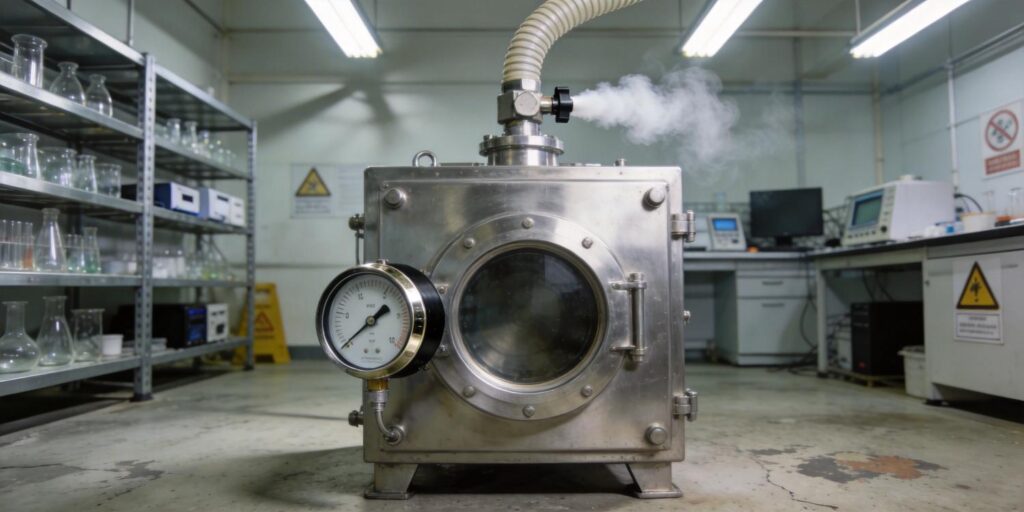
Effect of Sudden Atmospheric Exposure on Cold Cathode Gauges
Cold cathode ionization gauges, such as Poseidon Scientific’s VG-SM225, are designed for reliable operation in the high-vacuum regime from 10⁻³ Torr down to 10⁻⁷ Torr. When a vacuum chamber undergoes rapid venting to atmosphere, however, the gauge experiences an abrupt transition into the low-vacuum region where its operating principle breaks down. Without proper safeguards, this exposure can lead to immediate sensor stress, inaccurate readings, or accelerated wear.
In a typical industrial scenario—such as opening a large coating chamber for substrate loading—the pressure rises from high vacuum to atmospheric levels in seconds. At pressures above 10⁻³ Torr, the Penning discharge that powers the gauge becomes unsustainable. The VG-SM225 incorporates built-in protection to mitigate these effects, automatically disabling high voltage when pressure exceeds the safe threshold. Understanding this behavior helps engineers and system operators maintain gauge longevity and measurement integrity across repeated process cycles.
Discharge Quenching Process
The VG-SM225 operates on the Penning (or magnetron) discharge principle. Electrons emitted by field emission are trapped in crossed electric and magnetic fields, following extended spiral paths that increase the probability of ionizing residual gas molecules. The resulting positive ion current is collected and converted into a pressure reading.
At pressures above approximately 10⁻³ Torr, the mean free path of electrons becomes extremely short. Molecules are so dense that electrons undergo frequent collisions before gaining sufficient energy from the electric field to cause ionization. Instead of a self-sustaining avalanche, the discharge current collapses rapidly—a phenomenon known as quenching. The relationship between ion current and pressure becomes non-monotonic; the signal first peaks and then drops sharply as pressure continues to rise. This quenching is why cold cathode gauges are unsuitable for continuous low-vacuum monitoring and why Poseidon’s design includes automatic high-voltage shutdown above 10⁻³ Torr.
The VG-SM225’s software and hardware interlocks detect this transition instantly, reducing the anode voltage from the normal –2000 V operating level (after an initial –2500 V start-up boost) and preventing damage. A flashing indicator light alerts operators that the high-voltage supply has been disabled, providing clear visual confirmation during venting events.
Risk of Contamination During Rapid Venting
Rapid venting introduces two primary contamination mechanisms. First, the sudden influx of air carries moisture, hydrocarbons, and particulates into the gauge head. Second, during the brief transition through the 10⁻² to 10⁻¹ Torr range—where discharge may still be active before quenching—high ion currents bombard the stainless-steel cathode and anode surfaces. This sputtering can dislodge electrode material and crack residual process gases, depositing carbon or oxide layers.
Over repeated cycles, these deposits increase the work function of the cathode, raising the ignition voltage and extending start-up times. In severe cases, the gauge may fail to ignite altogether or produce readings shifted by an order of magnitude (e.g., displaying 10⁻⁶ Torr when actual pressure is 10⁻⁵ Torr). The VG-SM225’s positive-magnetron structure and removable sensor head minimize these risks compared with non-serviceable designs, but proactive protection remains essential for long-term performance in production environments.
Protection Through Isolation Valves
The most effective defense against sudden atmospheric exposure is physical isolation. Installing a high-conductance isolation valve (KF16 or KF25) between the gauge and the main chamber allows operators to close the valve before venting. This keeps the VG-SM225 under vacuum while the chamber is opened, eliminating any risk of contamination or discharge quenching.
For systems without dedicated isolation valves, Poseidon recommends relying on the gauge’s internal protections while following strict procedural controls. The VG-SM225’s software automatically closes the high-voltage supply at the 10⁻³ Torr threshold, and hardware current limiting prevents over-current damage. These features were developed in direct response to customer feedback from vacuum metallizing and heat-treatment applications where rapid venting is routine. When combined with proper valve placement, they extend sensor life to 3–5 years in clean environments and 1–2 years in moderately contaminated ones.
Recommended Venting Procedures
To ensure safe and repeatable operation, follow these field-proven steps when venting a chamber equipped with the VG-SM225:
- Confirm the system has reached the target base pressure and all process steps are complete.
- Manually or automatically close the isolation valve (if installed) to isolate the gauge head.
- Command the VG-SM225 controller to disable high voltage via the RS232 interface or front-panel button; verify the indicator light flashes.
- Initiate chamber venting using dry nitrogen or clean dry air to minimize moisture ingress.
- Once the chamber reaches atmospheric pressure, perform any required maintenance or loading.
- Before re-pumping, reopen the isolation valve only after the chamber pressure has dropped below 10⁻¹ Torr.
These procedures align with best practices outlined in vacuum technology standards and have been validated across dozens of Poseidon-installed systems. The VG-SM225’s customizable digital protocol allows seamless integration into PLC sequences, automating steps 2 and 3 for error-free operation.
Restart and Ignition Delay After Vent
After venting and re-evacuation, the VG-SM225 must re-establish the Penning discharge. Ignition occurs reliably once chamber pressure falls below 10⁻³ Torr. At moderate vacuum levels (around 10⁻⁴ Torr), start-up typically takes less than 30 seconds. Deeper in the high-vacuum range—10⁻⁶ Torr or below—ignition delay can extend to 5 minutes or more because fewer gas molecules are available to initiate the electron avalanche.
The gauge’s two-stage voltage algorithm (–2500 V boost for 10–20 seconds, then automatic reduction to –2000 V) accelerates this process without risking electrode damage. Operators should allow sufficient pump-down time before relying on the gauge reading and use the built-in status output to confirm stable operation. In large-volume chambers, where pressure equilibration is slower, this delay is rarely the limiting factor in overall cycle time.
Maintenance Inspection Checklist
Regular inspection after venting cycles prevents small issues from becoming costly downtime. Use the following checklist for the VG-SM225:
| Inspection Item | Acceptable Condition | Action if Out of Spec |
|---|---|---|
| Start-up time at 10⁻⁴ Torr | < 60 seconds | Clean electrodes or check high-voltage supply |
| Reading stability vs. reference gauge | Within ±20 % across operating range | Perform full calibration or electrode cleaning |
| Electrode appearance (after disassembly) | Metallic luster, no black carbon or colored oxide | Sand with 500-mesh or 200-mesh paper; wipe with isopropyl alcohol |
| Leak rate at flange seal | < 10⁻¹¹ Pa·m³/s | Replace O-ring or sealing compound |
| Indicator light behavior during high-pressure events | Flashes when HV disabled | Verify software/firmware settings |
The sensor head is fully removable without disturbing the vacuum seal, allowing cleaning in minutes using standard shop tools. Poseidon recommends performing this inspection quarterly or after every 50 venting cycles in high-throughput applications.
Conclusion and Operational Guideline Download
Rapid venting is a routine part of many vacuum processes, but it need not shorten the life of your cold cathode gauge. The VG-SM225’s combination of automatic high-voltage protection, field-serviceable design, and proven Penning geometry delivers the robustness engineers require while keeping ownership costs low. By following the procedures outlined above and performing routine inspections, operators can achieve years of reliable service even in demanding production environments.
For a complete, printable PDF version of these venting and maintenance guidelines—tailored specifically for the VG-SM225—download our free operational handbook from the product support page. It includes wiring diagrams, PLC integration examples, and troubleshooting flowcharts developed from real customer installations.
Explore the full specifications or request application support for your system: VG-SM225 Cold Cathode Vacuum Gauge. Poseidon Scientific’s vacuum engineers are ready to review your chamber layout and venting sequence to ensure maximum gauge uptime and measurement confidence.


