
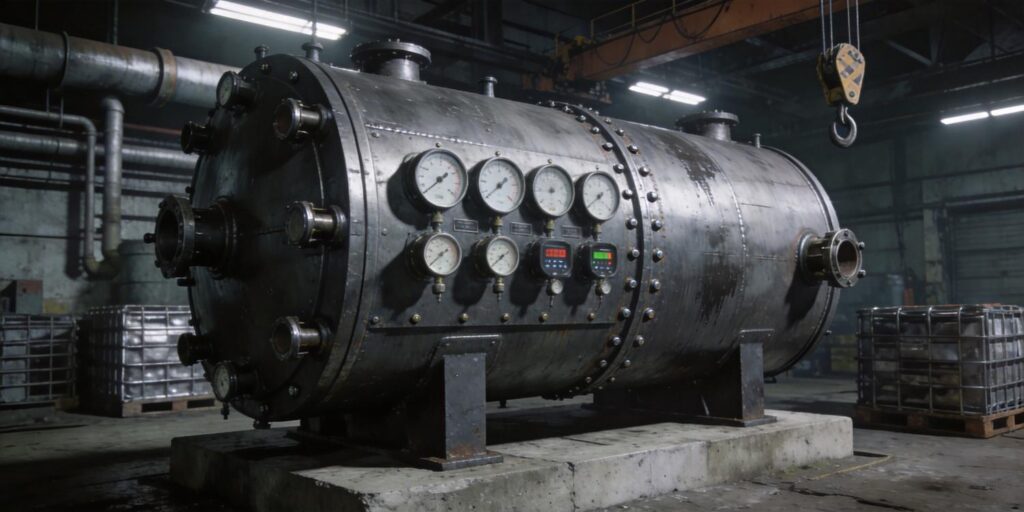
Understanding Chamber Volume Impact on Pump Down Time
In vacuum system design, chamber volume is one of the primary variables that determines how long it takes to reach target pressure. The relationship is governed by the basic pump-down equation τ = V / S, where τ is the system time constant, V is the chamber volume in liters, and S is the effective pumping speed in L/s. For a 1000 L chamber paired with a 500 L/s turbomolecular pump, the time constant is roughly 2 seconds in the molecular-flow regime, but real-world pump-down from atmosphere to 10⁻³ Torr can easily exceed 30–60 minutes once outgassing and conductance limitations are factored in.
Large-volume chambers (>1000 L) therefore experience slower pressure transitions than bench-top instruments. This extended timeline places specific demands on vacuum gauges: they must deliver stable, repeatable readings over minutes to hours without introducing false transients that could trigger unnecessary interlocks or abort cycles. Engineers sizing gauges for these systems must prioritize sensors that maintain accuracy across the full pressure curve while tolerating the thermal and gas-load variations inherent to big chambers.
At Poseidon Scientific, the VG-SP205 Pirani Vacuum Transmitter and VG-SM225 Cold Cathode Vacuum Gauge were engineered with large-chamber applications in mind. Their compact footprints and low-cost architecture allow multiple units to be deployed economically, while built-in temperature compensation and robust signal processing keep readings reliable even as chamber walls and fixturing slowly outgas.
Required Measurement Resolution During Roughing
During the roughing phase—from atmosphere down to approximately 1 Torr—the pressure drop is steepest in small systems but comparatively gradual in large volumes. A 1500 L chamber may require 10–20 minutes simply to cross from 100 Torr to 10 Torr. High resolution in this decade is essential for confirming that roughing pumps are performing as specified and for timing the crossover to high-vacuum pumps.
The VG-SP205 Pirani gauge excels here. Operating on the thermal-conductivity principle with a platinum filament, it provides linear response between 10 Torr and 10⁻² Torr and maintains usable output from atmosphere to 10⁻³ Torr. Its 0–10 V analog signal (effective range 2–8 V) gives procurement teams and system integrators ample resolution for PLC-based control loops. Because the filament is held at constant temperature, power variations directly reflect gas-molecule collision rates, delivering the resolution needed to detect small leaks or pump degradation long before they affect process yield.
In contrast, attempting to use a cold-cathode gauge in the rough-vacuum regime risks sensor damage from excessive ion bombardment. The VG-SP205’s maintenance-free design and 3–5 year typical lifetime in clean environments make it the logical choice for continuous roughing monitoring in large chambers.
Gauge Response Time Considerations
Response time becomes critical when a large chamber undergoes sudden changes—such as valve actuation, gas admission, or the onset of high-vacuum pumping. Thermal Pirani gauges like the VG-SP205 have a filament thermal time constant on the order of milliseconds, allowing them to track rapid pressure excursions during roughing. Cold-cathode gauges rely on Penning discharge initiation, which can take seconds to minutes at the 10⁻³ Torr crossover point if not properly managed.
The VG-SM225 mitigates this with a two-stage voltage algorithm: a brief –2500 V boost to accelerate discharge formation, followed by automatic reduction to –2000 V for stable operation. In large-volume systems, where pressure changes are diffusion-limited rather than instantaneous, this start-up behavior aligns well with actual dynamics. The gauge’s positive-magnetron (“工”字形) structure further ensures consistent electron trajectories regardless of orientation, eliminating the directional sensitivity sometimes seen in older designs.
When specifying gauges, engineers should verify that the combined system response (gauge + control logic) does not lag behind the chamber’s natural pump-down curve. Poseidon’s instruments, with their RJ45 interface and customizable RS232 protocols, integrate directly into modern PLCs, ensuring sub-second data updates where needed.
Signal Stability During Large System Transitions
Large chambers introduce thermal gradients, mechanical vibration, and prolonged outgassing that can challenge gauge stability. Temperature swings of 15–50 °C are common as pumps and chamber walls equilibrate. The VG-SP205 incorporates both hardware and algorithmic compensation to keep its power-to-pressure curve accurate across this range. The VG-SM225 uses similar compensation on its ion-current measurement, plus software interlocks that automatically disable high voltage above 10⁻³ Torr to prevent spurious readings or electrode contamination.
During transitions—such as rough-to-high-vacuum handover—both gauges exhibit minimal hysteresis. The Pirani’s platinum filament resists chemical attack from residual process gases, while the cold cathode’s stainless-steel electrodes and removable sensor head allow quick recovery if minor carbon deposits accumulate. These design choices translate into stable signals that system integrators can trust for interlock decisions in chambers exceeding 1000 L.
Cable Length and Noise Mitigation
In large vacuum systems, gauges are often mounted far from the control cabinet—sometimes 10–30 meters away. Analog 0–10 V signals are susceptible to electromagnetic interference and ground loops over long runs. Poseidon’s instruments address this with two strategies:
- Digital-first architecture: RS232 output with customizable protocols allows noise-immune transmission; a simple twisted-pair cable suffices for runs up to 50 m.
- Analog fallback with shielding: When 0–10 V is required, shielded cable and proper grounding at the controller end keep noise below 10 mV—well within the gauge’s resolution.
Both models use industry-standard RJ45 connectors, eliminating the need for proprietary cables and simplifying field wiring. For chambers with multiple gauges, a single RS485 bus (available via minor board revision) can further reduce cabling complexity while maintaining full diagnostic access.
Case Example for >1000 L Chamber
Consider a 1500 L vacuum heat-treatment furnace used for annealing titanium components. The system employs a 2000 m³/h roots blower for roughing and a 3000 L/s turbomolecular pump for high vacuum. Target base pressure is 5×10⁻⁵ Torr before the heating cycle begins.
Without proper gauging, operators historically observed unexplained pressure “spikes” during crossover that triggered unnecessary aborts. After installing a VG-SP205 on the roughing manifold and a VG-SM225 on the process dome, the system achieved repeatable 45-minute pump-downs to 10⁻⁴ Torr. The Pirani tracked roughing with ±5 % accuracy in the critical 10–0.1 Torr band, while the cold cathode verified the final high-vacuum condition within 30 seconds of turbo activation. Maintenance intervals extended from quarterly to annual, and the customer reported a 15 % reduction in energy consumption by optimizing crossover timing.
This real-world performance mirrors the design goals of Poseidon’s gauges: small size for easy integration, cost control that keeps the gauge budget under 10 % of total system cost, and protocol flexibility that required only five units to implement a custom Modbus register map.
Recommended Pirani and Cold Cathode Pairing
For chambers larger than 1000 L, the optimal solution is a dual-gauge strategy that matches each technology to its ideal pressure regime:
| Gauge Model | Pressure Range | Primary Role in Large Chamber | Key Benefit |
|---|---|---|---|
| VG-SP205 Pirani | Atmosphere to 10⁻³ Torr | Roughing monitoring and crossover trigger | Fast response, maintenance-free, temperature-compensated |
| VG-SM225 Cold Cathode | 10⁻³ to 10⁻⁷ Torr | High-vacuum verification and process interlock | Compact Penning design, field-cleanable sensor, low outgassing |
Both units share identical mechanical interfaces (KF16/KF25 flanges) and electrical connectors, simplifying spare-parts inventory. Their combined cost is typically 40–60 % lower than equivalent imported pairs, while offering equivalent or better long-term stability in industrial environments. Placement guidelines remain simple: mount the Pirani near the roughing port for fastest response and the cold cathode at a representative process location to capture true chamber conditions.
Get Expert Sizing Support for Your Large-Volume System
Sizing vacuum gauges for chambers exceeding 1000 L is not a one-size-fits-all exercise. Pump speed, conductance, gas species, and thermal environment all interact to shape the pressure profile your gauges must track. Poseidon Scientific’s application engineers have supported dozens of large-scale vacuum systems and can provide a free system-sizing review—including pump-down simulations, recommended gauge locations, and integration drawings—within 48 hours.
Whether you are scaling an existing metallizing line, building a new vacuum furnace, or upgrading an R&D coating chamber, the right gauge pair can reduce cycle time, improve repeatability, and lower total cost of ownership. Contact our team today to discuss your chamber volume, target pressures, and control architecture. We’ll recommend the exact VG-SP205 / VG-SM225 configuration that meets your performance and budget goals.
Explore the product pages for detailed specifications and request a quote: VG-SP205 Pirani Vacuum Transmitter and VG-SM225 Cold Cathode Vacuum Gauge. Let Poseidon help you size your vacuum gauges correctly—the first time.


