Environmental Concern of Endocrine Disruptors (BPA, Nonylphenol)
Endocrine-disrupting chemicals (EDCs) represent one of the most pressing environmental challenges of our time. Bisphenol A (BPA) and nonylphenol are two prominent EDCs that have garnered significant regulatory and scientific attention due to their widespread occurrence in aquatic environments and potential health impacts. These compounds mimic or interfere with natural hormones, potentially causing reproductive abnormalities, developmental issues, and increased cancer risks in wildlife and humans.
River systems serve as critical conduits for these contaminants, receiving inputs from industrial discharges, wastewater treatment plants, agricultural runoff, and urban stormwater. The persistence and bioaccumulation potential of EDCs create long-term environmental concerns, necessitating robust monitoring programs to assess exposure levels and ecological risks.
Trace-Level Detection Challenges
The analysis of endocrine disruptors in river water presents formidable analytical challenges due to their typically low concentrations (often in the ng/L to μg/L range) and complex environmental matrices. Several factors complicate trace-level detection:
Matrix Interferences
River water contains dissolved organic matter (DOM), humic substances, suspended particulates, and various inorganic ions that can interfere with analytical measurements. As noted in environmental SPE literature, DOM can bind to hydrophobic pollutants, potentially affecting their extraction efficiency and recovery rates. Research by Nakamura et al. (1996) established that analytes with log Pow values above approximately 4 when using alkyl-bonded silicas, or above 3 when using polystyrene sorbents, may experience reduced recovery in the presence of humic acids.
Low Concentration Requirements
Environmental quality standards for EDCs often require detection limits well below 1 μg/L, necessitating effective preconcentration techniques. Traditional liquid-liquid extraction methods, while effective, involve large volumes of organic solvents and can be labor-intensive. The breakthrough of SPE as an environmental technique emerged from the need to avoid these limitations while maintaining adequate sensitivity.
Sample Volume Considerations
Large sample volumes (typically 0.5-2 L) are required to achieve sufficient analyte mass for reliable detection at trace levels. This necessitates SPE cartridges with adequate capacity to prevent breakthrough while maintaining efficient flow characteristics.
SPE Sorbent Options for Endocrine-Disrupting Chemicals
Selecting the appropriate SPE sorbent is critical for successful enrichment of EDCs from river water. The chemical properties of target compounds dictate sorbent selection:
Hydrophilic-Lipophilic Balance (HLB) Sorbents
HLB sorbents, such as those offered by Poseidon Scientific, provide balanced retention for both polar and non-polar compounds. These polymeric sorbents are particularly effective for EDCs like BPA and nonylphenol, which exhibit moderate hydrophobicity (log Pow ~3-4). The dual retention mechanism (hydrophobic and hydrophilic interactions) ensures reliable recovery across varying pH conditions.
Mixed-Mode Sorbents
For EDCs with ionizable functional groups, mixed-mode sorbents combining reversed-phase and ion-exchange mechanisms offer enhanced selectivity. MCX (mixed-mode cation exchange) and MAX (mixed-mode anion exchange) sorbents can be particularly useful when dealing with complex matrices containing competing compounds.
Traditional Reversed-Phase Sorbents
C18 and C8 bonded silica sorbents remain viable options for hydrophobic EDCs. However, their performance can be affected by sample pH and the presence of DOM. Research indicates that a sorbent mass of 1 g is often sufficient for retaining many environmental contaminants from liter-scale water samples.
Sorbent Capacity Considerations
Environmental applications typically require larger sorbent masses (200 mg to 1 g) to handle the substantial sample volumes needed for trace analysis. As demonstrated in environmental SPE studies, a ratio of 1 g sorbent per liter of water provides adequate capacity for most applications involving trace organic contaminants.
Large-Volume River Water Enrichment Workflow
A systematic approach to SPE enrichment ensures reliable results for EDC analysis in river water:
Sample Preparation
River water samples should be filtered through 0.45 μm glass-fiber filters to remove suspended particulates that could clog SPE cartridges. Acidification to pH ~3 is often recommended for phenolic compounds like BPA to suppress ionization and enhance retention on reversed-phase sorbents.
SPE Cartridge Conditioning
Proper conditioning is essential for optimal performance. A typical protocol includes sequential conditioning with methanol (or acetonitrile) followed by reagent water or acidified water (pH-adjusted to match sample conditions). This ensures the sorbent is activated and wetted for efficient analyte retention.
Sample Loading
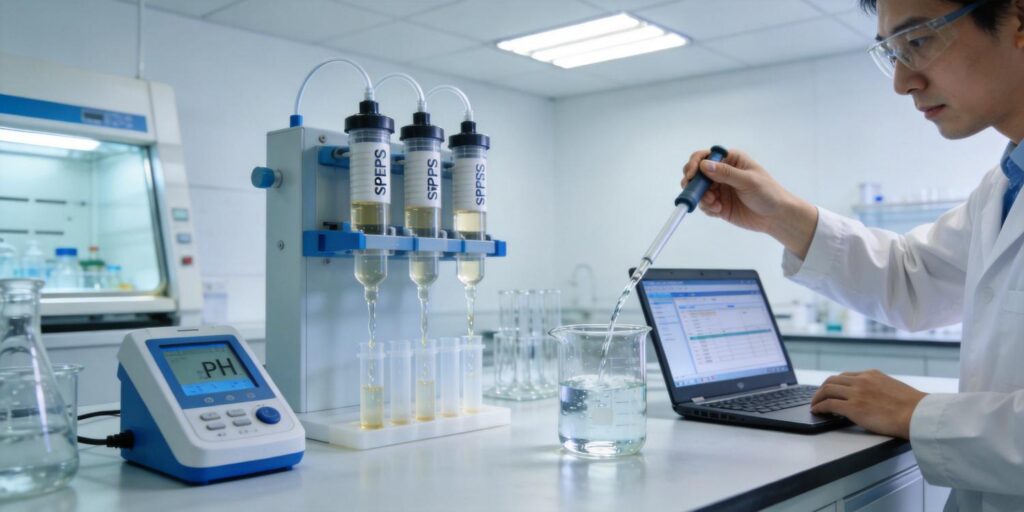
Large-volume samples (0.5-2 L) should be loaded at controlled flow rates (5-10 mL/min) to prevent breakthrough. Vacuum manifolds or positive pressure systems can facilitate consistent flow rates. Monitoring for breakthrough is crucial, especially when dealing with highly variable river water matrices.
Cartridge Washing
A washing step with water or dilute aqueous solutions (5-10% methanol in water) removes weakly retained matrix components while retaining target EDCs. This step is particularly important for river water samples containing high levels of DOM and inorganic salts.
Analyte Elution
EDCs are typically eluted with organic solvents such as methanol, acetonitrile, or ethyl acetate. For phenolic compounds like BPA and nonylphenol, acidified organic solvents (e.g., methanol with 1% formic acid) can improve recovery. Elution volumes generally range from 5-10 mL, which are then concentrated to 0.5-1 mL under gentle nitrogen evaporation.
Quality Control Measures
Procedural blanks, matrix spikes, and surrogate standards should be included in each batch to monitor for contamination and assess method performance. Isotopically labeled internal standards (e.g., 13C-BPA) are particularly valuable for compensating for matrix effects in subsequent LC-MS/MS analysis.
LC-MS/MS Analytical Methods
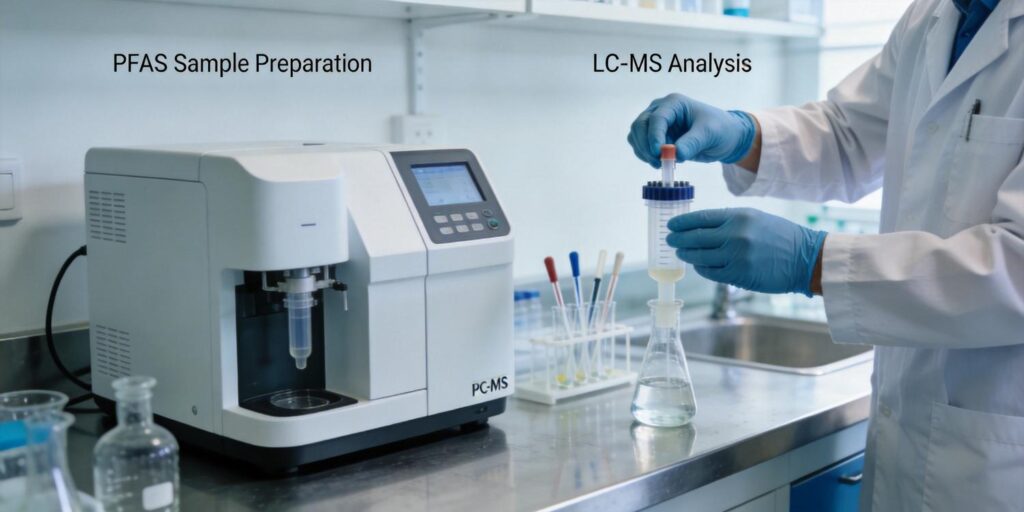
Liquid chromatography coupled with tandem mass spectrometry represents the gold standard for EDC analysis due to its sensitivity, selectivity, and ability to confirm compound identity:
Chromatographic Separation
Reversed-phase columns (C18 or C8) with particle sizes of 1.7-3 μm provide efficient separation of EDCs. Mobile phases typically consist of water and methanol or acetonitrile, often with additives like ammonium acetate or formic acid to enhance ionization. Gradient elution programs effectively separate complex mixtures of EDCs with varying polarities.
Mass Spectrometric Detection
Electrospray ionization (ESI) in negative mode is commonly employed for phenolic EDCs like BPA and nonylphenol. Multiple reaction monitoring (MRM) using two or three transitions per compound provides both sensitive quantification and confirmatory identification. Typical MRM transitions for BPA include m/z 227→212 and 227→133, while nonylphenol transitions might include m/z 219→133 and 219→147.
Method Sensitivity and Validation
Modern LC-MS/MS systems can achieve method detection limits in the low ng/L range for EDCs in water. Method validation should include assessment of linearity (typically 1-500 ng/L), precision (RSD <15%), accuracy (80-120% recovery), and matrix effects. The use of isotope dilution techniques significantly improves data quality by compensating for ionization suppression/enhancement.
Quality Assurance Protocols
Comprehensive quality assurance includes calibration verification, continuing calibration checks, laboratory control samples, and proficiency testing. Documentation of method performance characteristics is essential for regulatory compliance and data defensibility.
Environmental Monitoring Applications
The SPE-LC-MS/MS approach for EDC analysis supports numerous environmental monitoring objectives:
Source Tracking and Pollution Assessment
Monitoring EDC concentrations at various points along river systems helps identify pollution sources and assess the effectiveness of pollution control measures. Spatial and temporal trends provide valuable information for environmental management decisions.
Ecological Risk Assessment
Concentration data combined with toxicity information enables assessment of potential risks to aquatic organisms. This information supports the development of environmental quality standards and protective measures for sensitive ecosystems.
Regulatory Compliance Monitoring
Many jurisdictions have established water quality criteria or guidelines for specific EDCs. The described methodology provides the sensitivity and reliability needed for compliance monitoring under regulations such as the EU Water Framework Directive or US EPA guidelines.
Research Applications
Beyond routine monitoring, this approach supports research on EDC fate and transport, treatment efficiency, and ecological impacts. The ability to measure trace concentrations enables studies on long-term trends and emerging concerns.
Method Adaptability
The SPE enrichment approach can be adapted for other environmental matrices (groundwater, wastewater, sediment pore water) and expanded to include additional EDCs (phthalates, parabens, pharmaceuticals) as monitoring needs evolve. The flexibility of SPE sorbent chemistries allows optimization for specific analyte classes and matrix types.
In conclusion, SPE enrichment coupled with LC-MS/MS analysis provides a robust, sensitive approach for monitoring trace-level endocrine disruptors in river water. By carefully selecting sorbents, optimizing enrichment conditions, and implementing rigorous quality control, environmental laboratories can generate reliable data to support water quality protection and regulatory decision-making. As analytical technologies continue to advance and our understanding of EDC impacts grows, these methods will remain essential tools for environmental scientists and regulators worldwide.