Clinical Importance of Catecholamine Monitoring
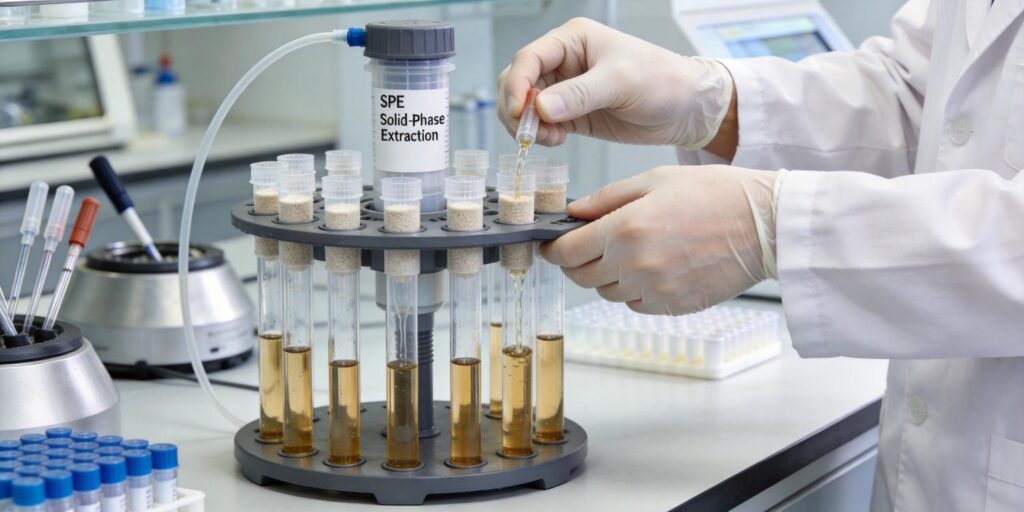
Catecholamines, including dopamine, norepinephrine, and epinephrine, are critical biomarkers for diagnosing and managing neuroendocrine tumors such as pheochromocytoma and neuroblastoma. They also play a key role in assessing autonomic nervous system function and monitoring stress responses. Accurate measurement of these analytes in urine provides a non-invasive window into systemic catecholamine production. However, their low concentration and susceptibility to oxidation demand a robust sample preparation method. Solid-phase extraction (SPE) using mixed-mode cation exchange (MCX) sorbents offers an ideal solution, delivering high recovery and purity for downstream quantification by HPLC or LC-MS.
Urine Sample Preparation and Acidification
Catecholamines are prone to oxidation at neutral or alkaline pH. To stabilize them, urine samples must be collected in acid-washed containers and acidified to pH 2–3 with hydrochloric acid immediately. Typically, 10 mL of a 24-hour urine sample is used, with the addition of an antioxidant like sodium metabisulfite (1 mg/mL) to prevent degradation. After acidification, samples are centrifuged at 3000 rpm for 10 minutes to remove particulates, then the supernatant is diluted with an equal volume of 2% formic acid in water to optimize binding conditions for MCX SPE.
MCX Mixed-Mode Cation Exchange Retention Mechanism
Poseidon Scientific’s MCX SPE cartridges feature a unique mixed-mode sorbent combining strong cation exchange (sulfonic acid groups) with reversed-phase (C18) retention. At low pH (below the pKa of the catecholamine amino groups, typically ~9–10), the basic amine functionalities of catecholamines are protonated, enabling strong electrostatic interaction with the sulfonate groups. Simultaneously, the hydrophobic catechol ring interacts with the C18 chains, providing dual retention. This orthogonal selectivity allows efficient capture of catecholamines while salts and neutral metabolites pass through unretained.
Conditioning and Loading Procedures
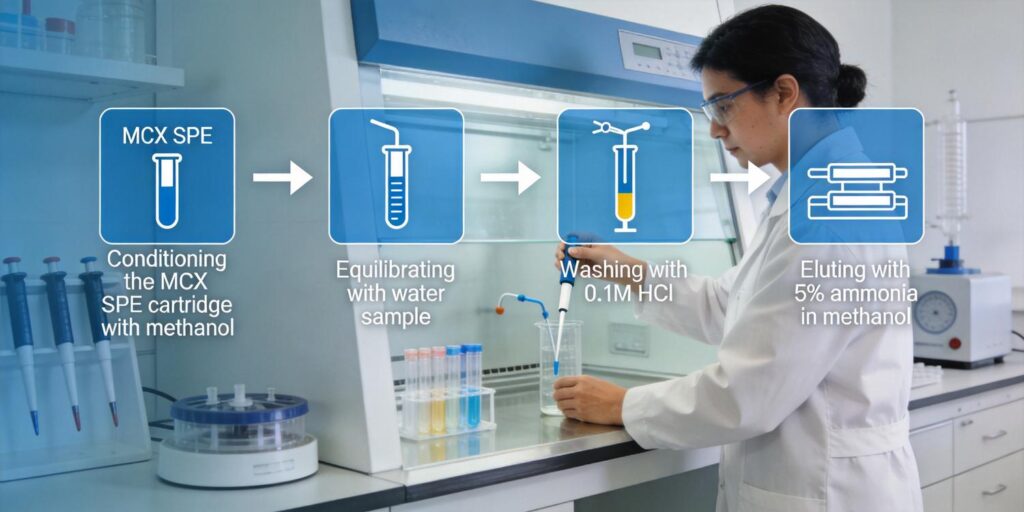
Proper conditioning is essential for reproducible results. The MCX cartridge is first conditioned with 3 mL of methanol to wet the sorbent, followed by 3 mL of 2% formic acid to equilibrate the column at the loading pH. The acidified, diluted urine sample is then loaded at a flow rate of 1–2 mL/min. Under these conditions, catecholamines are quantitatively retained (>95% recovery). Excessive flow rates should be avoided to prevent channeling and breakthrough.
Washing to Remove Salts and Neutral Metabolites
After loading, a two-step wash is performed. First, 3 mL of 2% formic acid removes loosely bound salts and matrix components. Second, 3 mL of 100% methanol eliminates neutral hydrophobic interferences (e.g., steroids, fatty acids) without displacing the ionically bound catecholamines. This rigorous clean-up is critical for reducing ion suppression in LC-MS and improving signal-to-noise ratios in electrochemical detection.
Elution with Ammoniated Methanol
Catecholamines are eluted using 3 mL of methanol containing 5% ammonium hydroxide. The basic eluent deprotonates the amines, neutralizing the positive charge and disrupting the cation exchange interaction. The methanol also desorbs any hydrophobic interactions with the C18 phase. The eluate is collected and evaporated under nitrogen at 40°C, then reconstituted in a suitable mobile phase (e.g., 0.1% formic acid in water) for injection. Recovery rates typically exceed 90% for all three catecholamines.
HPLC or LC-MS Detection
Reversed-phase HPLC with electrochemical detection (ECD) remains the gold standard for clinical catecholamine analysis due to its sensitivity (sub-nanomolar detection limits). A C18 column (e.g., 150×4.6 mm, 3 µm) with a mobile phase of phosphate buffer (pH 3.0) containing 1–5% methanol achieves baseline separation of dopamine, norepinephrine, and epinephrine within 15 minutes. Alternatively, LC-MS/MS with electrospray ionization in positive mode offers superior selectivity, using multiple reaction monitoring (MRM) transitions (e.g., m/z 154→137 for dopamine). The clean MCX extract minimizes matrix effects, ensuring robust quantitation.
Clinical Assay Validation Considerations
Validation of the MCX-SPE method for clinical use must address linearity (typically 10–5000 ng/mL for urine), precision (RSD <15%), and accuracy (recovery within 85–115%). Carryover and matrix effects should be evaluated using pooled urine samples. Stability studies confirm catecholamines are protected from oxidation during the extraction process. For high-throughput labs, the protocol can be adapted to 96-well SPE plates, allowing parallel processing of dozens of samples. Proper validation ensures the method meets CLSI guidelines and is suitable for routine clinical diagnostics.