Introduction: Vacuum Metallizing Process Overview
Vacuum metallizing remains one of the most widely adopted physical vapor deposition techniques for applying thin aluminum films to substrates such as plastic films, paper, and molded parts. The process occurs inside a sealed vacuum chamber where aluminum wire or boats are resistively heated to temperatures exceeding 1,000 °C, causing the metal to evaporate and condense uniformly onto a rotating or moving substrate. This creates a highly reflective, barrier, or decorative coating typically 0.01–0.1 µm thick.
Success depends on precise control of chamber pressure throughout every stage—from initial pump-down to the critical evaporation window. Incorrect pressure can lead to poor film adhesion, oxidation, or surface defects that compromise product performance. Engineers and procurement teams evaluating vacuum gauges for metallizing systems therefore focus on reliability, compactness, and cost-effectiveness while ensuring measurement accuracy across the required vacuum range.
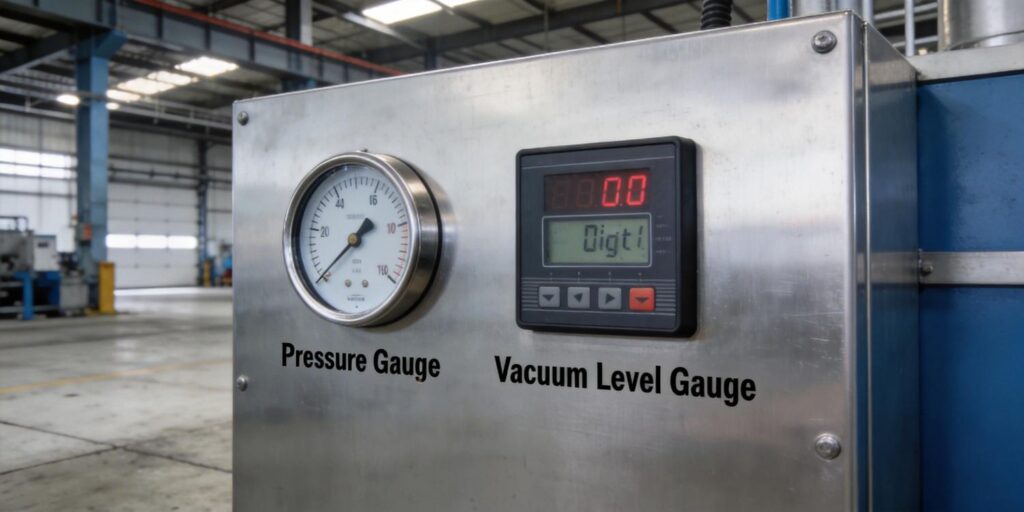
At Poseidon Scientific, our VG-SP205 Pirani Vacuum Transmitter and VG-SM225 Cold Cathode Vacuum Gauge were developed specifically to address these needs. Both instruments offer small footprints, low ownership costs, and customizable digital protocols, making them ideal for integration into modern metallizing equipment.
Required Pressure Stages from Roughing to High Vacuum
Vacuum metallizing systems operate across three distinct pressure regimes, each demanding different gauge technologies:
- Rough vacuum (atmospheric to ~1 Torr / 133 Pa): Mechanical roughing pumps remove the bulk of the chamber atmosphere.
- Medium vacuum (1 Torr to 10⁻³ Torr / 0.133 Pa): Transition zone where outgassing accelerates and diffusion or turbo-molecular pumps engage.
- High vacuum (10⁻³ Torr to 10⁻⁶ Torr or lower): The evaporation stage where aluminum vapor transport occurs with minimal residual gas interference.
Industry standards for aluminum metallizing typically require a base pressure of 10⁻⁴ to 10⁻⁵ Torr before evaporation begins. Higher residual pressures increase the mean free path collision rate, leading to scattering of aluminum atoms and incorporation of oxygen or water vapor into the growing film. Poseidon’s gauge pair covers the entire spectrum: the VG-SP205 handles atmospheric to 10⁻³ Torr, while the VG-SM225 seamlessly takes over from 10⁻³ Torr down to 10⁻⁷ Torr.
Film Adhesion Sensitivity to Pressure Stability
Film adhesion in vacuum metallizing is highly sensitive to pressure stability. At pressures above 10⁻⁴ Torr, residual gases—particularly oxygen and water vapor—react with the freshly deposited aluminum layer, forming aluminum oxide that weakens interfacial bonding. Studies in vacuum science literature confirm that even brief pressure excursions during evaporation can reduce peel strength by 30–50 % and introduce pinholes or haze.
Stable pressure also minimizes substrate outgassing and prevents arcing in the evaporation source. Engineers therefore require gauges with fast response, repeatable readings, and minimal drift. The VG-SP205 employs platinum filament technology and active temperature compensation to maintain accuracy across 15–50 °C, while the VG-SM225 uses a robust Penning discharge design with software-controlled high-voltage protection to avoid false readings or sensor damage.
Pirani Monitoring During Pump Down
During the critical pump-down phase, real-time monitoring ensures the system reaches the crossover pressure efficiently without unnecessary energy consumption or pump wear. The VG-SP205 Pirani Vacuum Transmitter excels here. Operating on the thermal conductivity principle, it measures pressure by maintaining a constant filament temperature and tracking the power required to counteract gas-molecule cooling.
Key advantages for metallizing systems include:
- Wide range from atmosphere to 10⁻³ Torr, with highest linearity between 10 Torr and 10⁻² Torr.
- Platinum filament offering superior chemical stability and resistance to contamination compared with tungsten alternatives.
- Maintenance-free design with 3–5 year typical lifetime in clean environments.
- 0–10 V analog output plus customizable RS232 protocol for direct PLC integration.
By installing the VG-SP205 near the roughing port or chamber wall, operators receive immediate feedback on pump performance and can trigger turbo-molecular pump activation at the optimal point, reducing cycle times and energy costs.
Cold Cathode Verification Before Evaporation
Once the system enters high vacuum, the VG-SM225 Cold Cathode Vacuum Gauge provides the definitive verification that pressure is low enough for high-quality aluminum deposition. Based on the Penning discharge principle, it generates a self-sustaining plasma in crossed electric and magnetic fields; the resulting ion current is directly proportional to gas density.
Engineers appreciate its:
- Measurement range of 10⁻³ Torr to 10⁻⁷ Torr, perfectly aligned with metallizing requirements.
- Positive magnetron (“工”字形) structure that delivers compact size—smaller than most competing units except for specialized inverted-magnetron designs.
- Discharge start-up assistance via temporary –2500 V boost, followed by stable –2000 V operation.
- Easy maintenance: the sensor head is fully removable for sanding with 500-mesh paper to remove carbon deposits or oxide layers, restoring performance without breaking vacuum seals.
The VG-SM225’s red LED indicator and software interlock prevent operation above 10⁻³ Torr, protecting the sensor and ensuring the system only proceeds to evaporation when conditions are verified.
Avoiding Contamination During Aluminum Evaporation
Aluminum evaporation introduces unique contamination risks. Sublimated metal can deposit on gauge surfaces, while residual process gases may form insulating layers. Traditional hot-cathode gauges suffer filament burnout or calibration drift; cold-cathode designs avoid these issues entirely.
The VG-SM225’s stainless-steel electrodes and PEEK insulators resist aluminum adhesion better than many ceramic alternatives. When contamination does occur—indicated by extended start-up times or readings shifted by an order of magnitude—cleaning takes minutes using standard shop tools. The VG-SP205, being completely sealed and filament-based, requires no field maintenance and tolerates the relatively clean environment typical of metallizing chambers.
Both gauges feature low outgassing materials and leak rates below 10⁻¹¹ Pa·m³/s, minimizing their own contribution to chamber background pressure.
Recommended Dual Gauge Wiring Layout
For optimal performance, we recommend a dual-gauge configuration that leverages the strengths of each technology:
| Position | Gauge | Output | Function |
|---|---|---|---|
| Roughing line or chamber sidewall (high-conductance location) | VG-SP205 Pirani | 0–10 V analog + RS232 | Monitor pump-down and crossover pressure |
| Process dome or opposite chamber wall | VG-SM225 Cold Cathode | 0–10 V analog + RS232 | Confirm base pressure before evaporation |
Both instruments use industry-standard RJ45 connectors for power and communication. A simple PLC or industrial PC can read both outputs simultaneously, enabling logic such as “if Pirani < 10⁻² Torr AND Cold Cathode < 5×10⁻⁵ Torr, enable evaporation source.” Custom protocol support (5–10 unit minimum) allows seamless integration with existing SCADA systems without additional hardware.
Power supplies should be isolated; the VG-SM225 requires a stable –2000 V supply with current limiting, while the VG-SP205 operates on standard 24 V DC. Physical separation of the two gauges prevents magnetic-field crosstalk and ensures representative sampling of chamber conditions.
Conclusion and Consultation CTA
Selecting the right vacuum gauges for vacuum metallizing systems directly impacts throughput, film quality, and total cost of ownership. Poseidon Scientific’s VG-SP205 and VG-SM225 combination delivers the pressure coverage, compactness, durability, and integration flexibility that modern metallizing lines demand—at a fraction of the cost of traditional imported solutions.
Whether you are retrofitting an existing chamber or designing a new system, our team of vacuum engineers is ready to review your chamber layout, pump configuration, and control requirements. Contact Poseidon Scientific today for a no-obligation consultation. We can provide application-specific recommendations, custom communication protocols, and even on-site support to ensure your metallizing process achieves consistent, high-adhesion aluminum films with minimal downtime.
Visit our product pages to download datasheets or request a quote: VG-SP205 Pirani Vacuum Transmitter and VG-SM225 Cold Cathode Vacuum Gauge. Let us help you optimize your vacuum metallizing performance—one reliable measurement at a time.