Overview of Nitrosamine Contamination Concerns in Pharmaceuticals
Nitrosamine contamination has emerged as one of the most significant quality control challenges facing the pharmaceutical industry in recent years. These potentially carcinogenic impurities, formed through reactions between secondary or tertiary amines with nitrosating agents, have been detected in various drug products including angiotensin II receptor blockers (ARBs), ranitidine, metformin, and other medications. The discovery of N-nitrosodimethylamine (NDMA) and N-nitrosodiethylamine (NDEA) in pharmaceutical products has triggered global regulatory actions, product recalls, and heightened scrutiny of manufacturing processes.
The concern stems from the fact that nitrosamines are classified as probable human carcinogens by the International Agency for Research on Cancer (IARC). Even trace amounts in the parts-per-billion (ppb) range can pose significant health risks when consumed over extended periods. This has necessitated the development of highly sensitive analytical methods capable of detecting these impurities at levels as low as 0.03 ppm (30 ppb) for many drug substances.
Target Compounds: NDMA, NDEA, and Other Nitrosamines
The primary nitrosamines of concern in pharmaceutical analysis include:
N-Nitrosodimethylamine (NDMA)
Molecular weight: 74.08 g/mol, CAS: 62-75-9. NDMA is the most frequently detected nitrosamine in pharmaceutical products and has been found in valsartan, losartan, and ranitidine products. Its detection requires methods with sensitivity in the low parts-per-billion range due to its potent carcinogenicity.
N-Nitrosodiethylamine (NDEA)
Molecular weight: 102.14 g/mol, CAS: 55-18-5. NDEA has been detected in various sartan medications and requires similar detection sensitivity to NDMA. Its slightly higher molecular weight and different chemical properties necessitate specific analytical considerations.
Other Nitrosamines of Concern
Additional nitrosamines that may be present include N-nitrosomethylphenylamine (NMPA), N-nitrosomethyl-4-aminobutyric acid (NMBA), N-nitrosodiisopropylamine (NDIPA), and N-nitrosodibutylamine (NDBA). Each presents unique analytical challenges due to varying chemical properties and detection requirements.
Sample Extraction from Tablets or APIs
Effective sample preparation is critical for accurate nitrosamine detection. The extraction process must efficiently recover nitrosamines from complex pharmaceutical matrices while minimizing interference from active pharmaceutical ingredients (APIs) and excipients.
Tablet Extraction Procedures
For solid dosage forms, tablets are typically ground to a fine powder using a mortar and pestle or mechanical grinder. A representative sample (usually 0.5-1.0 g) is then weighed and transferred to an appropriate extraction vessel. Common extraction solvents include methanol, acetonitrile, or mixtures with water, depending on the solubility characteristics of both the nitrosamines and the matrix components.
API Extraction Considerations
When analyzing active pharmaceutical ingredients directly, the extraction process must account for the chemical properties of the API. Some APIs may contain functional groups that can interfere with nitrosamine detection or may require specific solvent systems for complete extraction. The extraction conditions (time, temperature, solvent composition) must be optimized for each specific drug substance.
Extraction Efficiency Validation
Extraction efficiency must be validated through spike-and-recovery experiments. Known amounts of nitrosamine standards are added to drug product samples prior to extraction, and the recovery percentages are calculated. Acceptable recovery ranges typically fall between 70-120%, with relative standard deviations (RSDs) below 15%.
SPE Cleanup Strategies for Pharmaceutical Matrices
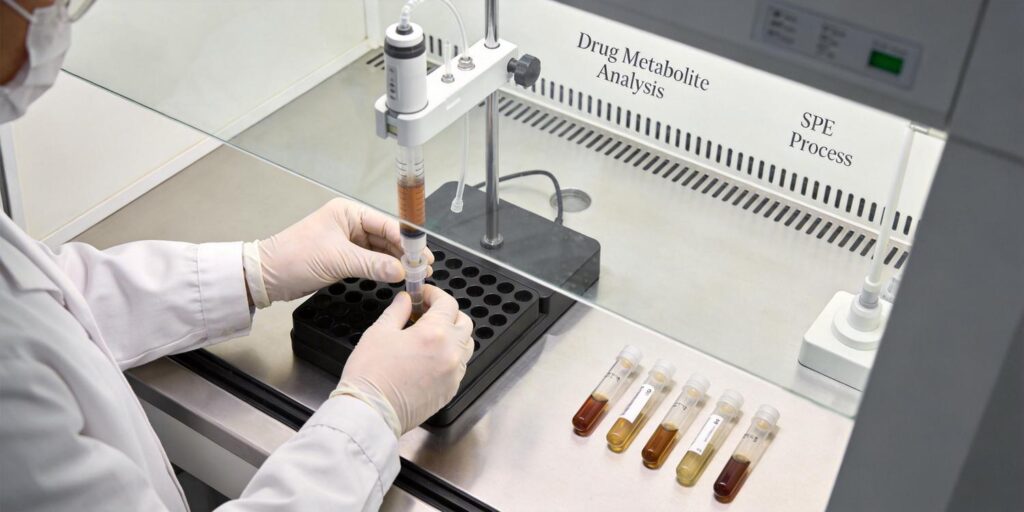
Solid-phase extraction (SPE) plays a crucial role in nitrosamine analysis by removing matrix interferences and concentrating the target analytes. The selection of appropriate SPE sorbents and conditions is essential for achieving the required sensitivity and specificity.
SPE Sorbent Selection
For nitrosamine analysis, several SPE sorbent types have proven effective:
Mixed-Mode SPE Cartridges
Mixed-mode sorbents combining reversed-phase and ion-exchange mechanisms offer excellent cleanup for complex pharmaceutical matrices. These sorbents can retain both hydrophobic nitrosamines and ionic interferences, providing cleaner extracts for analysis.
Reversed-Phase SPE (C18)
Traditional C18 sorbents work well for many nitrosamine applications, particularly when combined with appropriate washing steps to remove polar interferences. The hydrophobic nature of nitrosamines makes them well-suited for reversed-phase retention.
Specialized Nitrosamine SPE Cartridges
Some manufacturers offer SPE cartridges specifically designed for nitrosamine analysis, incorporating optimized sorbent chemistries and bed masses for maximum recovery and cleanup efficiency.
SPE Procedure Optimization
The SPE workflow typically involves four key steps:
- Conditioning: The SPE cartridge is activated with appropriate solvents (typically methanol followed by water or buffer) to prepare the sorbent surface for analyte retention.
- Sample Loading: The extracted sample is applied to the cartridge under controlled flow conditions (usually 1-2 mL/min).
- Washing: Interfering compounds are removed using carefully selected wash solvents. For nitrosamine analysis, this often involves water or low-percentage organic solutions to remove polar impurities while retaining the target analytes.
- Elution: Nitrosamines are recovered using strong organic solvents such as dichloromethane, ethyl acetate, or methanol-based mixtures.
Quality Control in SPE
Proper quality control measures include monitoring recovery rates, assessing matrix effects, and ensuring consistent performance across different lots of SPE cartridges. The use of internal standards (such as deuterated nitrosamines) helps correct for variations in extraction efficiency and matrix effects.
LC-MS Detection Sensitivity Improvements
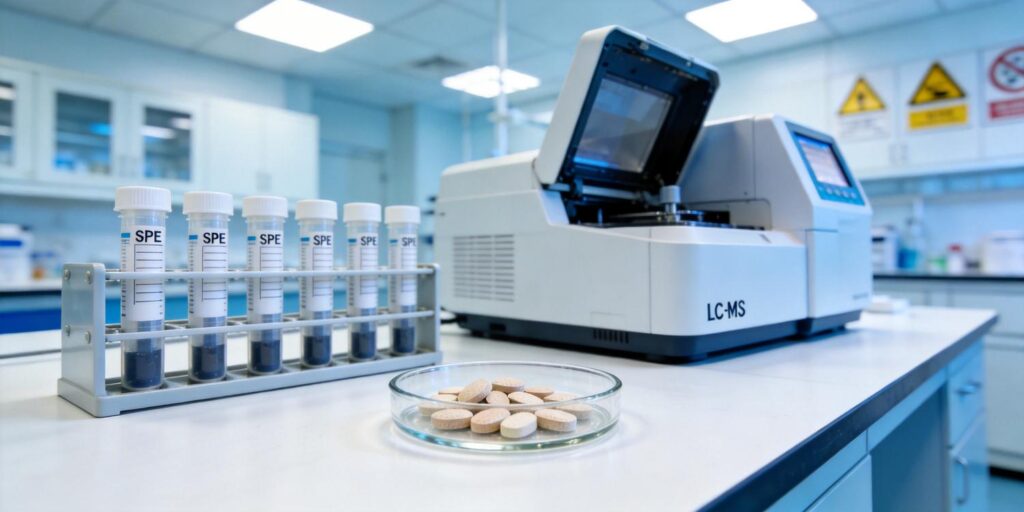
Liquid chromatography-mass spectrometry (LC-MS) has become the gold standard for nitrosamine detection due to its exceptional sensitivity and specificity. Several strategies can enhance detection sensitivity for these challenging analytes.
Chromatographic Optimization
Proper chromatographic separation is essential for minimizing matrix effects and improving detection limits. Key considerations include:
- Column Selection: Reversed-phase columns with C18 or phenyl-hexyl stationary phases often provide optimal separation for nitrosamines.
- Mobile Phase Optimization: The use of ammonium formate or acetate buffers can improve ionization efficiency in mass spectrometry detection.
- Gradient Elution: Carefully optimized gradients can separate nitrosamines from matrix interferences while maintaining adequate peak shapes.
Mass Spectrometry Parameters
Multiple Reaction Monitoring (MRM)
MRM mode provides the highest sensitivity and specificity for nitrosamine detection. Each nitrosamine is monitored using specific precursor-to-product ion transitions, allowing for detection at sub-ppb levels.
Ion Source Optimization
Electrospray ionization (ESI) parameters must be optimized for nitrosamine detection. This includes source temperature, gas flows, and ionization voltages. Atmospheric pressure chemical ionization (APCI) may offer advantages for certain nitrosamine compounds.
Collision Energy Optimization
Optimal collision energies must be determined for each nitrosamine to maximize sensitivity while maintaining specificity. This typically involves infusion experiments with pure standards.
Sensitivity Enhancement Techniques
Several approaches can further improve detection sensitivity:
- Large Volume Injection: Injecting larger sample volumes (up to 100 μL) can increase absolute amounts of analytes reaching the detector.
- Post-Column Infusion: Adding a make-up flow of organic solvent or ionization enhancer post-column can improve ionization efficiency.
- Signal Averaging: Increasing dwell times or using scheduled MRM can improve signal-to-noise ratios for low-abundance analytes.
Regulatory Testing Considerations
Nitrosamine testing must comply with stringent regulatory requirements from agencies including the FDA, EMA, Health Canada, and other global regulatory bodies.
Acceptable Intake Limits
Regulatory agencies have established acceptable intake (AI) limits for various nitrosamines:
- NDMA: 96 ng/day
- NDEA: 26.5 ng/day
- NMBA: 96 ng/day
- NDIPA: 26.5 ng/day
These limits translate to maximum concentration limits in drug products based on maximum daily doses.
Method Validation Requirements
Analytical methods for nitrosamine detection must undergo comprehensive validation including:
Specificity
Methods must demonstrate no interference from matrix components at the retention times of target nitrosamines.
Linearity and Range
Calibration curves must demonstrate linearity over the required concentration range, typically from the limit of quantitation (LOQ) to at least 200% of the specification limit.
Accuracy and Precision
Accuracy (recovery) should be within 70-120% with precision (RSD) below 15% at the LOQ and below 10% at higher concentrations.
Limit of Detection (LOD) and Quantitation (LOQ)
Methods must achieve LODs and LOQs sufficient to detect nitrosamines at or below regulatory limits. For many applications, LOQs of 0.03 ppm (30 ppb) or lower are required.
Quality Control Samples
Each analytical batch should include appropriate quality control samples:
- Method Blanks: To monitor for contamination
- System Suitability Samples: To ensure instrument performance
- Quality Control Samples: At low, medium, and high concentrations to monitor method performance
- Matrix-Matched Standards: To account for matrix effects
Documentation and Reporting
Complete documentation of analytical procedures, validation data, and results is essential for regulatory compliance. This includes detailed records of sample preparation, instrument conditions, calibration data, and quality control results.
Ongoing Monitoring Requirements
Once validated methods are implemented, ongoing monitoring is required to ensure continued method performance. This includes regular system suitability testing, participation in proficiency testing programs, and periodic method re-validation.
The development and implementation of robust SPE workflows for nitrosamine detection represents a critical component of pharmaceutical quality control in the current regulatory landscape. By combining optimized sample preparation with sensitive LC-MS detection, laboratories can meet the challenging requirements for nitrosamine analysis while ensuring patient safety and regulatory compliance.