
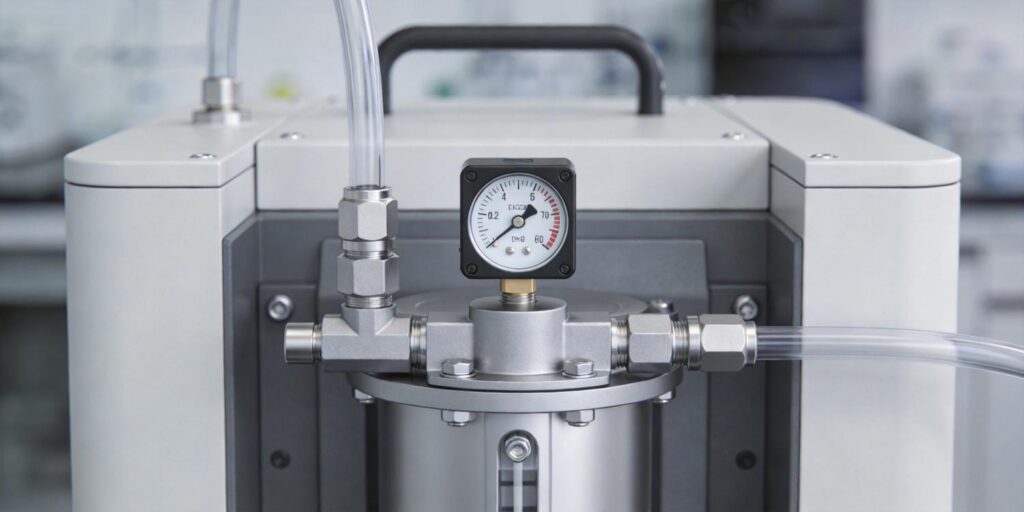
Selecting Vacuum Gauges for Laboratory R&D Equipment
In laboratory research and development environments, vacuum measurement is rarely a one-size-fits-all proposition. Scientists and engineers working with mass spectrometers, scanning electron microscopes, vacuum heat-treatment furnaces, and custom analytical instruments require gauges that deliver reliable performance across fluctuating pressures while fitting tight spatial constraints and integrating seamlessly with modern data systems. Selecting the right vacuum gauge directly impacts experimental repeatability, equipment uptime, and overall project costs. At Poseidon Scientific, we designed the VG-SP205 Pirani Vacuum Transmitter and VG-SM225 Cold Cathode Vacuum Gauge specifically to address these real-world R&D demands—offering a balanced combination of wide-range coverage, compact form factor, and flexible integration at a fraction of the cost of traditional imported solutions.
This guide examines the key selection criteria for R&D applications, drawing on established vacuum science principles and practical field experience. Whether you are equipping a new prototype chamber or upgrading an existing test stand, understanding these factors will help you make informed procurement decisions that align with both technical requirements and budget realities.
R&D Flexibility Requirements
Research laboratories operate under conditions far more variable than production semiconductor fabs or industrial coating lines. Experiments may involve changing gas compositions, rapid pump-down cycles, or frequent system reconfiguration. Vacuum gauges must therefore support easy adaptation without requiring extensive hardware redesigns.
Key flexibility needs include customizable digital communication protocols, modular mounting options, and compatibility with both analog control systems and modern PLC or PC-based data acquisition. Traditional gauges often lock users into fixed RS232 or proprietary interfaces, forcing additional driver development. In contrast, compact transmitters that allow protocol customization at the software layer—even for small orders of five to ten units—dramatically reduce integration time and cost.
Durability also ranks high on the flexibility checklist. R&D systems frequently experience occasional venting to atmosphere or exposure to trace contaminants. Gauges with robust electrode materials (such as stainless steel) and cleanable sensor heads minimize downtime and extend service intervals, allowing researchers to focus on data rather than maintenance.
The Need for Wide Measurement Range
Most laboratory vacuum processes span multiple orders of magnitude. A typical mass spectrometer, for example, may require monitoring from atmosphere during initial pump-down through the high-vacuum regime (10-3 to 10-7 Torr) where ion sources and detectors operate optimally.
The Pirani gauge excels in the rough-to-medium vacuum range (atmosphere to approximately 10-3 Torr), relying on thermal conductivity principles: heat loss from a heated platinum filament increases with rising gas pressure due to more frequent molecular collisions. This makes the VG-SP205 ideal for foreline monitoring and initial evacuation control, where high linearity between 10 Torr and 10-2 Torr ensures precise process feedback.
For high-vacuum measurement (10-3 to 10-7 Torr), the cold cathode gauge leverages Penning discharge physics. Electrons spiral in crossed electric and magnetic fields, ionizing residual gas molecules and producing a measurable ion current directly proportional to pressure. The VG-SM225 employs a conventional magnetron geometry with a ~100 gauss neodymium magnet and -2000 V operating voltage, delivering stable readings without the X-ray limit that constrains hot-cathode designs.
Pairing these two technologies provides continuous coverage from atmosphere to 10-7 Torr—the practical range for nearly all laboratory R&D vacuum systems—without the complexity or expense of a single wide-range gauge.
Compact Transmitter Benefits
Space is at a premium in modern laboratory setups. Miniaturized instruments, portable test chambers, and densely packed multi-chamber systems leave little room for bulky traditional gauge heads. Poseidon’s VG-SP205 and VG-SM225 transmitters feature significantly reduced footprints compared with legacy models, enabling direct chamber mounting or installation via short KF16/KF25 stubs without compromising flow conductance.
Beyond physical size, compact designs reduce magnetic stray fields and electromagnetic interference—critical when operating near sensitive electron optics or magnetic storage devices. The VG-SM225’s positive magnetron structure further minimizes overall volume while maintaining discharge stability down to 10-7 Torr. These attributes translate directly into simpler system architecture, lower material costs, and easier retrofitting of existing equipment.
Easy Calibration Considerations
Laboratory budgets rarely include dedicated vacuum calibration facilities, and downtime for recalibration disrupts research schedules. Both Poseidon transmitters ship fully factory-calibrated against NIST-traceable standards, establishing voltage-to-pressure mappings that remain stable across typical operating temperatures (15 °C to 50 °C).
The VG-SP205 Pirani requires no field calibration; its platinum filament and temperature-compensated circuitry maintain accuracy within the high-precision linear band. The VG-SM225 cold cathode, while subject to minor environmental drift, incorporates software compensation and can be quickly restored to specification through periodic electrode cleaning rather than full recalibration. This approach aligns with the practical reality of R&D environments, where absolute accuracy of ±20–50 % is often sufficient for process monitoring and trend analysis.
Data Logging Integration
Modern R&D demands real-time data logging, automated setpoint control, and integration with LabVIEW, Python scripts, or SCADA systems. Both Poseidon models output a standardized 0–10 V analog signal (effective 2–8 V range) compatible with virtually all PLC and data acquisition hardware. Additionally, the RS232 digital interface supports fully customizable protocols, allowing engineers to request pressure values, status flags, and error codes in formats that match existing software stacks.
RS485 capability is available via minor board revision for multi-drop networks, while the industry-standard RJ45 connector simplifies field wiring. These features eliminate the need for expensive protocol converters and reduce software development overhead—common pain points when integrating legacy gauges.
Budget Considerations
High-performance vacuum measurement should not dominate equipment budgets. Imported cold cathode and Pirani gauges frequently carry list prices of $1,100–$1,400 USD per unit, while domestic alternatives hover around $700–$850. Poseidon’s self-developed designs achieve manufacturing costs of $400–$500 per transmitter through optimized magnetron geometry, platinum filament selection, and streamlined assembly—delivering equivalent performance at 40–60 % lower cost.
When specifying dual-gauge packages (Pirani + cold cathode), the total system cost drops further due to shared power-supply and mounting hardware opportunities. For university labs and startup R&D teams operating on grant funding, these savings can fund additional instrumentation or extend project scope without sacrificing measurement quality.
Recommended Setup Example for Laboratory R&D Equipment
A proven configuration for most laboratory vacuum systems combines the VG-SP205 Pirani for roughing and foreline monitoring with the VG-SM225 Cold Cathode for high-vacuum measurement. Install the Pirani on the roughing line or chamber wall near the turbo or scroll pump inlet; place the cold cathode directly on the process chamber via a short KF flange stub. This arrangement provides:
- Continuous coverage from atmosphere to 10-7 Torr
- Redundant indication during crossover (10-3 Torr region)
- Analog 0–10 V outputs for direct PLC integration
- Custom RS232 protocol support for unified data logging
- Minimal magnetic interference and compact footprint
For a typical 10–50 liter chamber used in mass spectrometry or thin-film deposition studies, this dual-transmitter setup delivers reliable, drift-compensated readings while keeping total gauge cost under $1,000 USD—well below competing single-vendor packages.
Both units feature identical mounting interfaces and wiring conventions, simplifying inventory and training. In clean environments such as analytical instruments, expected lifetimes exceed three to five years; the cold cathode’s easily removable sensor head allows on-site cleaning with 500-mesh abrasive paper when contamination eventually appears.
Why Poseidon Scientific Meets Laboratory Needs
Engineers and procurement specialists consistently cite three decisive advantages when specifying Poseidon vacuum gauges for R&D: proven wide-range performance, genuine miniaturization without performance trade-offs, and the lowest total cost of ownership in the industry. Backed by in-house design, rigorous factory calibration, and responsive technical support, these transmitters have been validated in real mass-spectrometer and electron-microscope installations worldwide.
Whether your project requires a single gauge for a benchtop prototype or dozens for a multi-chamber research platform, Poseidon Scientific delivers the flexibility, reliability, and value that forward-thinking laboratories demand.
Ready to optimize your vacuum measurement setup? Contact our applications engineering team today for a no-obligation quotation tailored to your specific chamber dimensions, pressure range, and data-interface requirements. We also offer rapid prototyping support for custom communication protocols and mounting adapters.
Learn more about the VG-SP205 Pirani Vacuum Transmitter or explore the VG-SM225 Cold Cathode Vacuum Gauge and request your laboratory quotation within one business day.


