Wastewater Epidemiology and Pharmaceutical Metabolites
Wastewater epidemiology has emerged as a powerful tool for monitoring community-level pharmaceutical consumption and environmental contamination. This approach involves analyzing wastewater influent to detect pharmaceutical metabolites, providing real-time data on population health trends and environmental impact. Pharmaceutical metabolites enter wastewater systems through human excretion, with many parent compounds undergoing partial metabolism before excretion. These metabolites often retain biological activity and can persist in aquatic environments, making their detection crucial for comprehensive environmental monitoring.
Solid-phase extraction (SPE) plays a critical role in this analytical framework by enabling the isolation and concentration of these trace-level contaminants from complex wastewater matrices. As noted in SPE literature, “The versatility of solid phase extraction can be best exhibited by its adaptability to isolate a wide variety of different drugs using a general method” (Forensic and Clinical Applications of Solid Phase Extraction). This capability is particularly valuable for wastewater analysis where multiple pharmaceutical classes and their metabolites must be monitored simultaneously.
Target Analytes: Carbamazepine Metabolites and Beyond
Carbamazepine and its metabolites serve as excellent case studies for pharmaceutical monitoring in wastewater. The anticonvulsant drug carbamazepine undergoes extensive metabolism, producing several biologically active metabolites including carbamazepine-10,11-epoxide and trans-10,11-dihydroxy-10,11-dihydrocarbamazepine. These metabolites have been successfully analyzed using automated microanalysis with column liquid chromatography, demonstrating the feasibility of monitoring pharmaceutical transformation products in environmental samples.
Beyond carbamazepine, wastewater monitoring programs typically target multiple pharmaceutical classes including:
- Analgesics and anti-inflammatory drugs
- Antibiotics and antimicrobial agents
- Psychiatric medications and antidepressants
- Beta-blockers and cardiovascular drugs
- Hormones and endocrine disruptors
As documented in SPE applications, mixed-mode cartridges providing both hydrophobic and cation exchange interactions have proven particularly effective for extracting diverse pharmaceutical compounds from complex matrices. This approach allows for “high recoveries of analytes from plasma, urine, whole blood, and tissues” (Solid-Phase Extraction Principles and Applications), with similar principles applying to wastewater analysis.
SPE Enrichment Strategies for ng/L Detection
Detecting pharmaceutical metabolites at ng/L concentrations in wastewater requires sophisticated SPE enrichment strategies. The fundamental challenge involves concentrating trace analytes while minimizing matrix interference from natural organic matter, suspended solids, and other wastewater constituents. Modern SPE approaches for environmental applications emphasize several key principles:
Selective Sorbent Chemistry
Choosing appropriate sorbent chemistry is paramount for successful enrichment. For pharmaceutical metabolites, mixed-mode sorbents combining reversed-phase and ion-exchange mechanisms often provide optimal selectivity. As research indicates, “The strategy of a mixed-mode cartridge providing hydrophobic and cation exchange interactions, combined with a pH-dependent sample application and extraction, can give high recoveries of analytes” (Solid-Phase Extraction Principles and Applications).
pH Optimization
Controlling sample pH during SPE is critical for maximizing recovery of ionizable pharmaceutical metabolites. Most pharmaceutical compounds contain ionizable functional groups with pKa values typically ranging from 2 to 10. By adjusting wastewater samples to appropriate pH conditions before SPE, analysts can ensure optimal retention of target metabolites while minimizing interference from matrix components.
Large-Volume Loading Techniques
For ng/L detection limits, large-volume SPE loading (typically 100-1000 mL) is essential. This requires careful consideration of breakthrough volumes and sorbent capacity. Environmental applications often utilize specialized high-capacity SPE cartridges or disks designed specifically for large-volume water samples. As noted in environmental SPE literature, “Low nanogram per milliliter level determination of twenty N-methylcarbamate pesticides and twelve of their polar metabolites in surface water” has been achieved through optimized SPE protocols (Forensic and Clinical Applications of Solid Phase Extraction).
Large-Volume Extraction Workflow
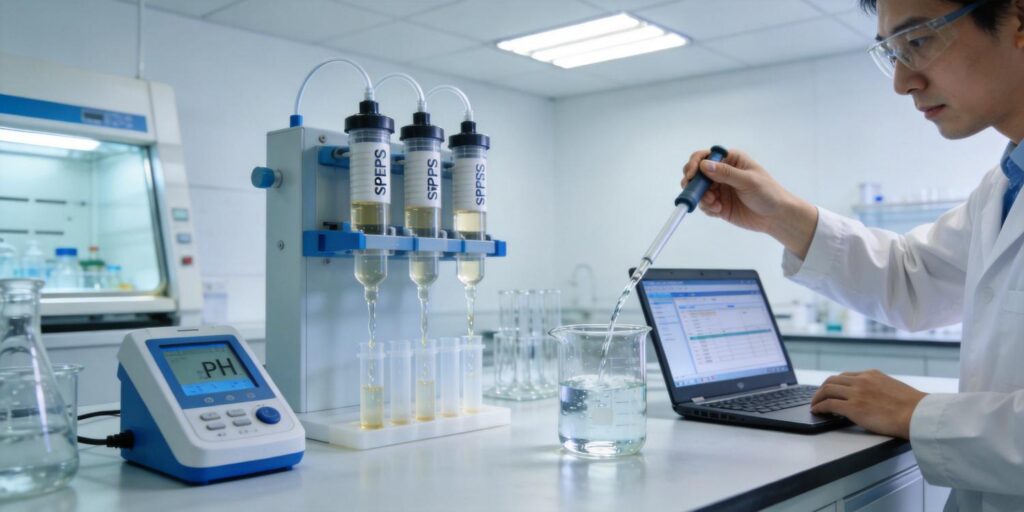
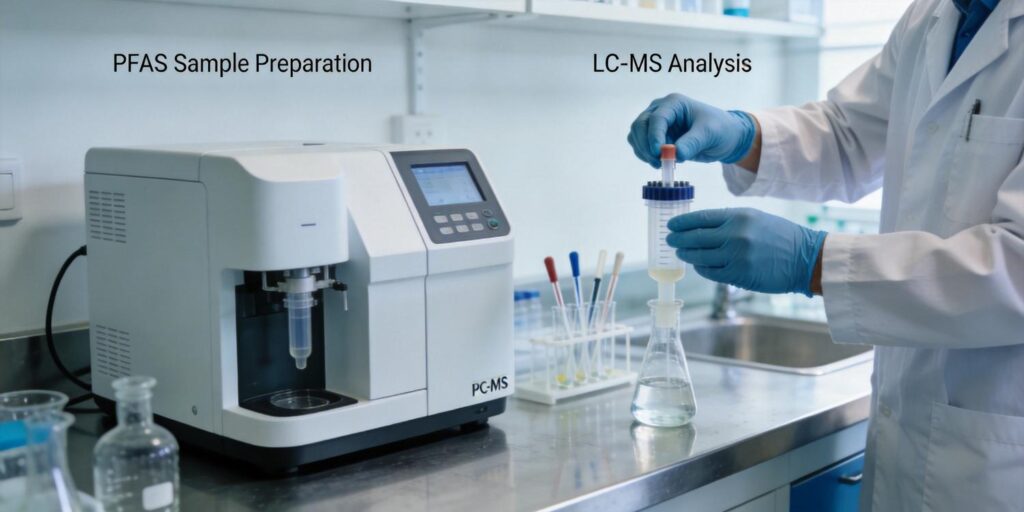
The large-volume SPE workflow for wastewater analysis follows a systematic approach designed to maximize recovery and reproducibility:
Sample Pretreatment
Wastewater samples typically require filtration (0.45 μm or 0.7 μm glass fiber filters) to remove suspended solids that could clog SPE cartridges. pH adjustment follows filtration, with target pH values selected based on the pKa of target metabolites. Some protocols include addition of preservatives or chelating agents to prevent degradation or complexation of target analytes.
SPE Cartridge Conditioning
Proper conditioning is essential for reproducible SPE performance. Standard conditioning protocols involve sequential washing with organic solvent (typically methanol or acetonitrile) followed by water or buffer at the same pH as the sample. This process activates the sorbent surface and ensures consistent retention characteristics.
Sample Loading and Washing
Large-volume loading requires controlled flow rates (typically 5-10 mL/min) to prevent breakthrough. Automated SPE systems or vacuum manifolds facilitate consistent loading conditions. Following sample loading, washing steps remove weakly retained matrix components while retaining target metabolites. Wash solvents are carefully selected to maximize matrix removal without eluting target compounds.
Elution and Concentration
Target metabolites are eluted using minimal volumes of appropriate organic solvents (often methanol or acetonitrile, sometimes with acid or base modifiers). Eluates are typically concentrated to 100-500 μL using gentle evaporation (nitrogen stream or centrifugal evaporation) to achieve the necessary concentration factors for ng/L detection.
LC-MS/MS Detection of Metabolites
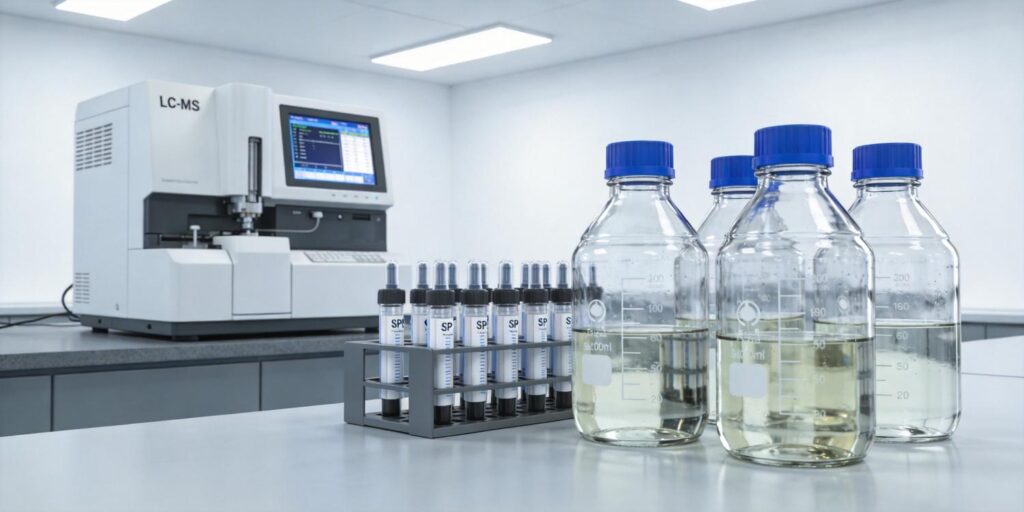
Liquid chromatography-tandem mass spectrometry (LC-MS/MS) represents the gold standard for detecting pharmaceutical metabolites in enriched wastewater extracts. The combination of SPE enrichment with LC-MS/MS provides the sensitivity, selectivity, and confirmatory power required for trace-level analysis.
Chromatographic Separation
Modern LC systems with sub-2μm particle columns provide excellent separation of pharmaceutical metabolites from matrix interferences. Gradient elution with water and organic modifiers (typically methanol or acetonitrile) containing volatile buffers (ammonium formate or acetate) optimizes separation while maintaining MS compatibility.
Mass Spectrometric Detection
Triple quadrupole MS/MS systems operating in multiple reaction monitoring (MRM) mode offer the sensitivity and specificity needed for metabolite detection. Each target metabolite is monitored using two or more characteristic precursor-product ion transitions, providing both quantitative data and confirmatory identification. As demonstrated in pharmaceutical analysis, “Automated SPE and tandem MS without HPLC columns, for quantifying drugs at the picogram level” has been achieved (Solid-Phase Extraction Principles and Applications), highlighting the power of integrated SPE-MS approaches.
Method Validation
Comprehensive method validation includes assessment of linearity, accuracy, precision, recovery, matrix effects, and limits of detection/quantification. Isotope-labeled internal standards (when available) compensate for matrix effects and recovery variations, ensuring accurate quantification even in complex wastewater matrices.
Data Interpretation for Environmental Monitoring
The final stage of wastewater pharmaceutical monitoring involves interpreting analytical data to extract meaningful environmental and public health information. Several key considerations guide this interpretation:
Back-Calculation to Population Consumption
Pharmaceutical metabolite concentrations in wastewater can be back-calculated to estimate population-level drug consumption using established pharmacokinetic data and wastewater flow rates. This approach, known as wastewater-based epidemiology, provides near real-time information on community pharmaceutical use patterns.
Environmental Risk Assessment
Detected concentrations are compared to predicted no-effect concentrations (PNECs) or other environmental quality standards to assess potential ecological risks. Pharmaceutical metabolites often exhibit different toxicity profiles than parent compounds, necessitating metabolite-specific risk assessment.
Temporal and Spatial Trends Analysis
Long-term monitoring data reveal temporal trends in pharmaceutical contamination, potentially correlating with prescribing patterns, seasonal variations, or public health interventions. Spatial comparisons between different wastewater treatment plants provide insights into regional variations in pharmaceutical use and environmental management.
Method Performance Evaluation
Ongoing quality control includes monitoring SPE recovery rates, matrix effects, and method detection limits. Participation in proficiency testing programs and inter-laboratory comparisons ensures data comparability and method robustness. As SPE technology continues to evolve, “attempts to speed up and/or miniaturize the extraction process have recently led to the introduction of SPE discs or micro-columns” (Solid-Phase Extraction Principles and Applications), offering potential improvements for future wastewater monitoring applications.
The integration of SPE sample preparation with advanced analytical detection represents a powerful approach for monitoring pharmaceutical metabolites in wastewater. This methodology not only supports environmental protection efforts but also provides valuable public health surveillance data, demonstrating the growing importance of analytical chemistry in addressing complex environmental challenges.