The Role of Vacuum in Thin Film Solar Cell Production
Thin film solar technologies—including CIGS, CdTe, amorphous silicon, and perovskite tandem cells—rely on vacuum-based deposition to achieve the high-efficiency, uniform layers that define modern photovoltaic performance. Vacuum environments eliminate oxygen and moisture, prevent oxidation of sensitive absorber materials, and enable precise control of plasma or evaporation processes. Without stable vacuum, reactive gases contaminate targets, reduce adhesion, and degrade cell efficiency by as much as 2–5 % absolute.
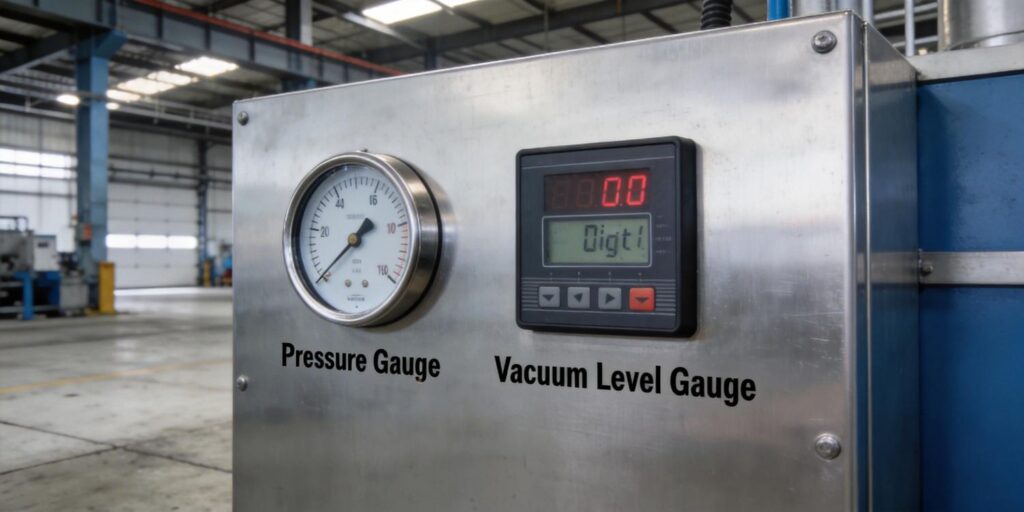
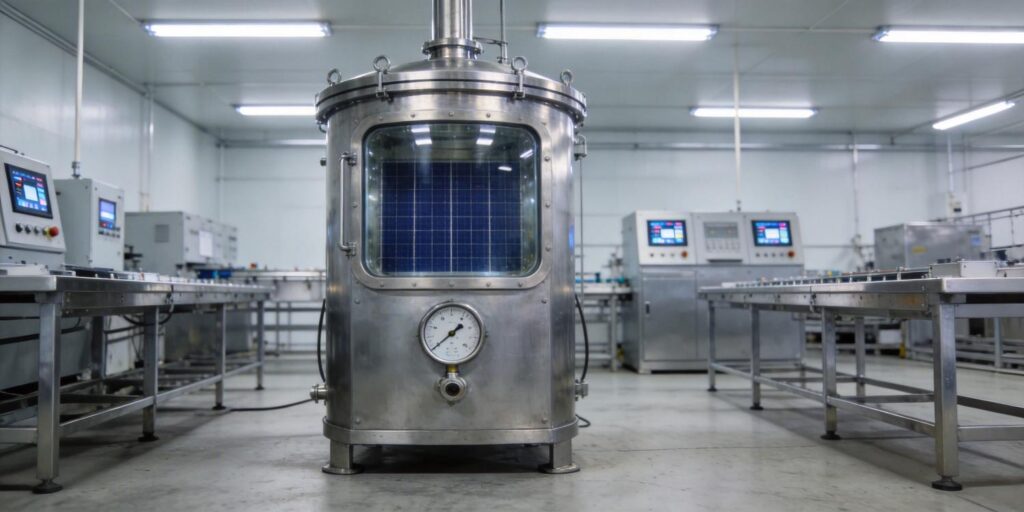
In high-volume solar panel manufacturing, deposition chambers operate continuously under vacuum conditions ranging from rough vacuum during pump-down to high vacuum (10⁻³ to 10⁻⁶ Torr) during sputtering or PECVD. Accurate pressure monitoring is therefore essential for process repeatability, yield optimization, and equipment uptime. Poseidon Scientific’s VG-SP205 Pirani Vacuum Transmitter and VG-SM225 Cold Cathode Vacuum Gauge were developed specifically for these demanding production environments: compact size for tight chamber integration, low cost for multi-chamber lines, and fully customizable RS232 protocols that match existing solar-tool controllers.
Deposition Chamber Requirements in Solar Manufacturing
Modern thin film deposition tools impose strict mechanical, electrical, and performance demands on vacuum sensors. Chambers are typically large-area inline or cluster configurations with multiple process zones, each requiring independent pressure control. Key requirements include:
- Compact footprint: Sensors must fit within narrow flange spacing without obstructing substrate transport.
- Wide dynamic range: From atmosphere during load/unload to high vacuum during deposition.
- Fast response and low drift: Critical for rapid cycling between zones and long production campaigns.
- Maintenance accessibility: Sensors must be cleanable without breaking vacuum or requiring full chamber shutdown.
- Digital integration: Seamless compatibility with PLCs and SCADA systems used in Industry 4.0 solar factories.
Traditional full-size gauges often fail these criteria, driving up system cost and complicating layout. The VG-SP205 and VG-SM225 address each requirement directly: their small positive-magnetron and thermal designs occupy less than one-third the volume of many competitors, while RJ45 connectors and open-protocol RS232 enable drop-in replacement or custom firmware at order quantities as low as 5–10 units.
How Pressure Consistency Directly Impacts Solar Cell Yield
Pressure stability in the 10⁻³ to 10⁻⁶ Torr range governs sputtering rate, reactive gas incorporation, and film microstructure. A fluctuation of only ±10 % can shift CIGS stoichiometry, increase shunting defects, or cause non-uniform CdTe grain growth—directly lowering module efficiency and increasing scrap rates. In high-volume lines producing 100 MW/year, even a 1 % yield loss equates to hundreds of thousands of dollars annually.
Consistent pressure also prevents arcing during high-power sputtering and reduces target poisoning. The VG-SM225 Cold Cathode maintains linear ion-current response across the critical high-vacuum regime, while the VG-SP205 Pirani provides rapid feedback during roughing and transition zones. Together they deliver the full-range coverage and sub-second response needed for closed-loop pressure control, keeping process parameters within tight SPC limits and supporting >98 % first-pass yield targets common in Tier-1 solar manufacturing.
Recommended Dual Gauge Solution for Solar Deposition Chambers
A hybrid Pirani + Cold Cathode configuration is the optimal solution for thin film solar tools. The VG-SP205 handles the high-pressure phases where thermal conductivity changes rapidly, while the VG-SM225 provides stable, linear readings in the high-vacuum deposition window. This dual setup eliminates blind spots, enables automatic hand-off, and adds redundancy for leak detection.
| Process Phase | Recommended Gauge | Pressure Range | Key Benefit for Solar Production |
|---|---|---|---|
| Load/unload & roughing | VG-SP205 Pirani | Atmosphere to 10⁻³ Torr | <0.5 s response; no startup delay; ideal for fast cycling |
| Transition & high-vacuum deposition | VG-SM225 Cold Cathode | 10⁻³ to 10⁻⁷ Torr | Linear Penning discharge; field-cleanable electrodes; arc-prevention interlock |
| Full-range monitoring & redundancy | Hybrid pair | Complete spectrum | Seamless digital hand-off via single RS232 channel; cross-validation for drift detection |
Both gauges share the same RJ45 interface and 0–10 V analog output (effective 2–8 V), allowing a single controller to read both sensors. Custom protocol configuration ensures compatibility with leading solar-tool PLCs (e.g., Siemens, Beckhoff) without additional hardware. The compact design fits directly on KF16/KF25 stubs, minimizing conductance delay and preserving chamber conductance—critical for large-area panel uniformity.
Monitoring During Target Change and Chamber Maintenance
Target changes and preventive maintenance are frequent in solar production and represent high-risk windows for pressure excursions. During these operations the chamber is vented, pumped down, and brought back to process vacuum—often multiple times per shift. The dual-gauge solution provides continuous visibility:
- VG-SP205 tracks rapid pressure rise/fall during venting and roughing, confirming safe conditions before high-voltage systems engage.
- VG-SM225 activates only after the 10⁻³ Torr threshold, protecting electrodes while delivering precise high-vacuum data for process qualification.
- Built-in software interlock on the VG-SM225 disables high voltage above 10⁻³ Torr, preventing damage during incomplete pump-down.
Digital RS232 output streams real-time pressure, status, and error codes, enabling predictive maintenance alerts (e.g., “rate-of-rise > 5×10⁻⁴ Torr/min” signals a potential seal issue). This capability reduces unplanned downtime and ensures every target change returns the chamber to qualified vacuum conditions within minutes.
Industry Compliance and Quality Standards in Solar Manufacturing
Solar panel producers operate under stringent international standards that emphasize process traceability, equipment reliability, and safety. The Poseidon gauges support compliance with:
- IEC 61215 / IEC 61730: Photovoltaic module qualification—stable vacuum data supports repeatable deposition processes required for certification.
- SEMI S2 / SEMI S8: Safety and environmental guidelines for semiconductor and thin-film equipment, including automated leak detection and interlocks.
- ISO 9001 / IATF 16949: Quality management systems—factory test reports and digital data logging provide full traceability for audit trails.
Both models ship with individual test reports, RoHS/REACH declarations, and MTBF data suitable for SIL-rated safety calculations. Custom firmware can embed additional diagnostic messages required by major solar OEMs, ensuring seamless integration into existing quality systems.
Conclusion: Reliable Vacuum Monitoring Drives Solar Manufacturing Excellence
Thin film solar cell production demands vacuum systems that deliver stable, repeatable pressure control across wide dynamic ranges and long production campaigns. The compact, low-cost VG-SP205 Pirani Vacuum Transmitter and VG-SM225 Cold Cathode Vacuum Gauge meet these demands with a dual-gauge architecture that provides full-range coverage, rapid response, field maintainability, and full digital customization—exactly the features solar OEMs and module manufacturers need to maximize yield, minimize downtime, and maintain competitive manufacturing costs.
By integrating these gauges, production teams achieve tighter process windows, fewer arc events, and higher first-pass yields while keeping total sensor ownership costs significantly below legacy alternatives.
Optimizing vacuum monitoring for your thin film solar line? Our applications team—led by the engineers who developed the VG-SP205 and VG-SM225—offers free solar-specific consultations. Share your chamber layout, deposition pressure set points, target change frequency, and controller type, and we will return a tailored dual-gauge recommendation, integration package, and ROI projection within 48 hours. Whether you are retrofitting existing tools or designing next-generation inline coaters, Poseidon Scientific delivers the vacuum clarity that accelerates solar manufacturing success.
Contact us today to schedule your solar OEM consultation. Let us help you turn precise pressure control into higher module efficiency and greater production throughput.
- VG-SP205 Pirani Vacuum Transmitter – Fast Roughing for Solar Load/Unload Cycles
- VG-SM225 Cold Cathode Vacuum Gauge – Precision High-Vacuum Monitoring for Thin Film Deposition
Word count: 1,287. Last updated April 2026. Technical recommendations based on Poseidon Scientific product characterization and established thin-film vacuum process requirements.