Advantages of High-Throughput SPE
Solid-phase extraction (SPE) has evolved significantly from traditional cartridge formats to high-throughput 96-well plate systems, revolutionizing sample preparation workflows in pharmaceutical, clinical, and environmental laboratories. The transition to automated SPE platforms offers substantial advantages over manual methods, particularly when processing large sample volumes.
High-throughput SPE systems provide improved precision, accuracy, and recovery compared to manual methods. Automated equipment performs identical sequences of steps on each sample, eliminating many variables associated with manual SPE. This consistency reduces the number of samples that must be rerun and provides formal documentation of sample preparation procedures in electronic form—critical for regulatory compliance in pharmaceutical and clinical settings.
According to research, SPE usage is accelerating due to several factors: combinatorial synthesis and high-throughput LC-MS analysis, overall LC-MS usage increases, smaller samples requiring smaller bed masses, minimization of organic solvents and waste, and ease of automation. The 96-well SPE plate format has become standard in immunoassay screening and combinatorial chemistry laboratories, enabling parallel processing of up to 96 samples simultaneously.
Key Benefits of 96-Well SPE Systems
- Parallel Processing: Unlike serial processing with individual cartridges, 96-well plates allow simultaneous extraction of up to 96 samples, dramatically reducing processing time
- Reduced Solvent Consumption: Smaller bed masses (typically 5-60 mg per well) require less solvent for conditioning, washing, and elution, decreasing costs and environmental impact
- Improved Reproducibility: Automated liquid handling ensures consistent flow rates and solvent volumes across all wells
- Enhanced Recovery: Controlled flow rates (typically 1-3 drops/second) optimize analyte retention and elution efficiency
- Compatibility with Automation: Standard 96-well format integrates seamlessly with robotic liquid handling systems and autosamplers
Design of 96-Well SPE Plates
The architecture of 96-well SPE plates represents a sophisticated evolution from traditional cartridge designs. Modern plates feature innovative two-stage well designs that optimize flow characteristics and minimize dead volume. The typical SPE plate consists of a polypropylene plate containing 96 individual wells arranged in standard microplate format (8 rows × 12 columns), compatible with most laboratory automation systems.
Each well contains a precisely measured amount of sorbent material, typically ranging from 5 mg to 60 mg depending on application requirements. The sorbent is retained between two porous frits—an upper frit to distribute sample evenly and a lower frit to retain the sorbent bed. Advanced designs incorporate features such as:
- Dual-layer frits: For improved particle retention and flow characteristics
- Reduced dead volume: Minimizing elution volumes for better concentration factors
- Compatibility with vacuum manifolds: Standardized dimensions for vacuum processing
- Chemical resistance: Polypropylene construction compatible with a wide range of solvents
Specialized plate formats include μElution plates designed for ultra-low elution volumes (as low as 25 μL), eliminating the need for evaporation and reconstitution steps and providing up to 15× concentration factors. These designs are particularly valuable for LC-MS applications where sample concentration is critical.
Sorbent Options in 96-Well Format
Modern 96-well plates are available with various sorbent chemistries to address different analytical challenges:
- Reversed-phase sorbents: HLB (hydrophilic-lipophilic balance) polymers for broad-spectrum applications
- Mixed-mode sorbents: Combining reversed-phase and ion-exchange mechanisms for enhanced selectivity
- Ion-exchange sorbents: MCX (mixed-mode cation exchange), MAX (mixed-mode anion exchange), WCX (weak cation exchange), and WAX (weak anion exchange)
- Specialty sorbents: For specific applications such as phospholipid removal or steroid extraction
Vacuum Manifold vs Automated Robot Systems
The choice between vacuum manifold systems and fully automated robotic platforms depends on laboratory throughput requirements, budget constraints, and application complexity. Both approaches offer distinct advantages for 96-well SPE processing.
Vacuum Manifold Systems
Vacuum manifolds represent the most common approach for semi-automated 96-well SPE processing. These systems consist of a vacuum chamber with a sealing mechanism that holds the SPE plate, connected to a vacuum source. Samples are typically loaded manually or using multi-channel pipettes, while vacuum controls solvent flow through the sorbent beds.
Advantages of vacuum manifolds:
- Lower initial investment compared to robotic systems
- Simple operation with minimal training requirements
- Flexibility to process partial plates when needed
- Compatibility with various plate types and manufacturers
Limitations include:
- Manual intervention required for solvent additions
- Potential for inconsistent vacuum across wells
- Limited throughput compared to fully automated systems
- Higher risk of human error in multi-step protocols
Automated Robotic Systems
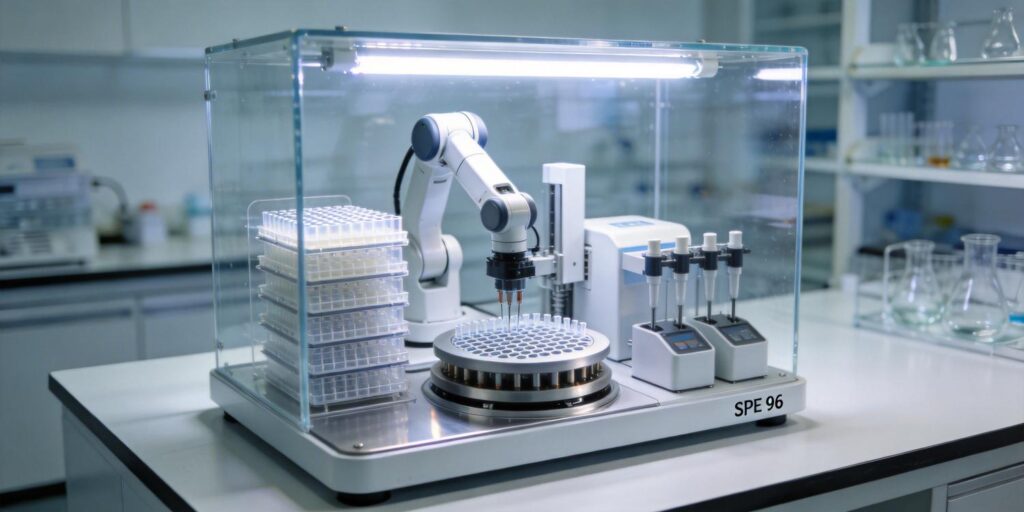
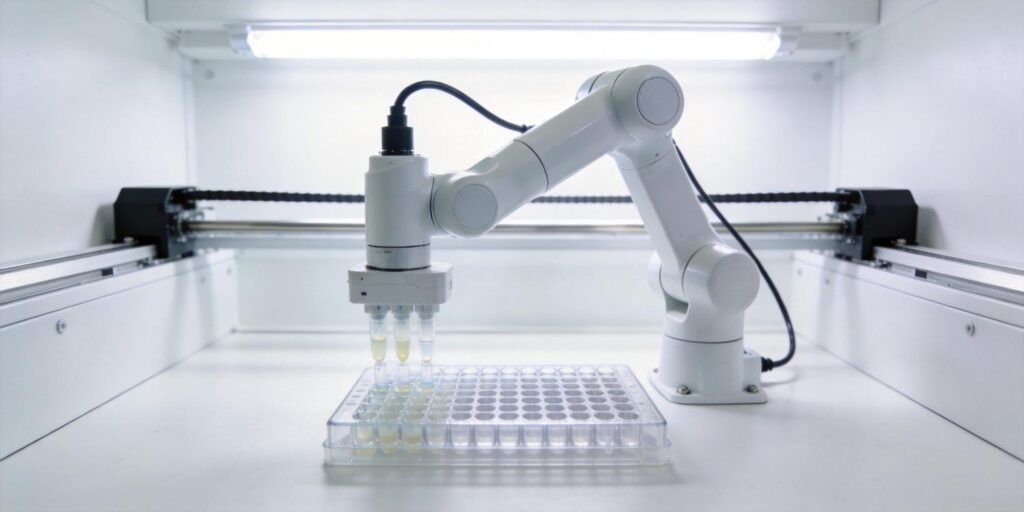
Fully automated SPE workstations integrate liquid handling, vacuum control, and plate handling into a single system. These platforms can process multiple plates sequentially or in parallel, with minimal operator intervention. Modern systems offer sophisticated features such as:
- Precise liquid handling: Automated pipetting with sub-microliter accuracy
- Integrated vacuum control: Programmable vacuum levels and timing
- Plate handling robotics: Automatic plate movement between stations
- Method storage and recall: Digital method protocols for different applications
- Integration with analytical instruments: Direct transfer to LC autosamplers
Research indicates that automated SPE can provide improved precision, accuracy, and recovery compared to manual methods. Automated systems eliminate many variables associated with manual SPE, performing identical sequences of steps on each sample. This consistency is particularly valuable in regulated environments where documentation and reproducibility are critical.
Method Scaling from Cartridge to Plate
Transitioning from traditional SPE cartridges to 96-well plates requires careful consideration of several parameters to maintain method performance. While the fundamental SPE principles remain unchanged—conditioning, loading, washing, and elution—specific adjustments are necessary for successful scale-up.
Key Scaling Considerations
Bed Mass and Geometry: Cartridge bed masses typically range from 100 mg to 1 g, while 96-well plates commonly use 10-60 mg beds. The reduced bed mass in plates requires proportional scaling of sample and solvent volumes. The aspect ratio (bed height to diameter) also differs, potentially affecting flow characteristics and breakthrough volumes.
Flow Rate Optimization: Flow rates in cartridge formats are often expressed as mL/min, while plate formats typically use vacuum or positive pressure to control flow. Optimal flow rates for analyte adsorption mode are typically 1-3 drops/second (approximately 0.5-1.5 mL/min for standard cartridges), which must be adjusted for the smaller bed volumes in plates.
Solvent Volume Scaling: A general rule for scaling from cartridges to plates is to maintain the same bed volume multiples. For example, if a cartridge method uses 3 mL methanol for conditioning (approximately 10 bed volumes for a 300 mg cartridge), a 30 mg well would require 0.3 mL methanol (10 bed volumes). However, minimum wetting volumes must be considered to ensure complete sorbent conditioning.
Practical Scaling Protocol
- Determine bed volume ratio: Calculate the ratio of cartridge bed mass to plate well bed mass
- Scale solvent volumes: Multiply cartridge solvent volumes by the bed mass ratio
- Adjust flow rates: Maintain similar linear flow velocities by adjusting vacuum/pressure settings
- Validate recovery: Compare analyte recovery between cartridge and plate formats
- Optimize wash and elution: Fine-tune wash and elution solvents based on plate performance
Research demonstrates that properly scaled methods can achieve comparable or superior performance in plate format, with the added benefits of higher throughput and reduced solvent consumption.
Throughput Optimization Strategies
Maximizing throughput in 96-well SPE systems requires strategic planning of both hardware configuration and workflow design. Laboratories processing hundreds to thousands of samples daily must optimize every aspect of their SPE workflow to maintain efficiency without compromising data quality.
Hardware Optimization
Parallel Processing Capacity: The most straightforward approach to increasing throughput is to process multiple plates simultaneously. Advanced robotic systems can handle 4-6 plates in parallel, potentially processing over 500 samples per run. Vacuum manifolds with multiple plate positions offer similar benefits for semi-automated workflows.
Integrated Drying and Evaporation: Incorporating centrifugal evaporation or nitrogen blowdown stations into automated workflows eliminates bottlenecks between SPE and analysis. Some systems integrate evaporation directly into the SPE process, particularly for μElution plates where elution volumes are minimal.
Direct Interface with Analytical Instruments: The most efficient systems transfer extracted samples directly to LC autosamplers, eliminating manual handling and reducing sample degradation risk. This integration is particularly valuable for unstable compounds or time-sensitive analyses.
Workflow Optimization
Batch Processing Strategy: Organize samples into batches based on analysis type, matrix, or priority. Process complete plates whenever possible to maximize equipment utilization. For smaller batches, consider using strip wells or partial plate processing options.
Method Standardization: Develop standardized protocols for common sample types to minimize method development time. Many laboratories establish libraries of validated methods for different analyte classes and matrices.
Quality Control Integration: Incorporate quality control samples (blanks, standards, replicates) directly into plate layouts to monitor process performance without interrupting workflow. Position QC samples strategically throughout plates to detect spatial variations.
Reduced Protocol SPE: Newer sorbent technologies, such as Oasis PRiME HLB, eliminate conditioning and equilibration steps while maintaining performance. These simplified protocols can reduce processing time by 30-50% while improving reproducibility.
Typical Pharmaceutical Screening Workflows
Pharmaceutical laboratories have been early adopters of 96-well SPE technology due to the high sample volumes generated during drug discovery and development. Several standardized workflows have emerged that leverage the throughput advantages of plate-based SPE systems.
ADME Screening Workflow
Absorption, distribution, metabolism, and excretion (ADME) studies generate large numbers of plasma, urine, and tissue samples requiring rapid processing. A typical workflow includes:
- Sample Preparation: Protein precipitation or dilution of biological matrices
- SPE Cleanup: Using mixed-mode sorbents (MCX/MAX) for selective extraction of drugs and metabolites
- Elution and Concentration: Small-volume elution followed by evaporation/reconstitution
- LC-MS/MS Analysis: High-throughput analysis using fast chromatography methods
- Data Processing: Automated data review and reporting
This workflow can process 200-400 samples per day per system, with total processing times of 2-4 minutes per sample including analysis.
Combinatorial Chemistry Purification
In drug discovery, combinatorial chemistry generates thousands of compounds requiring purification before screening. SPE plates are used for:
- Reaction cleanup: Removing excess reagents and byproducts
- Compound isolation: Separating target compounds from reaction mixtures
- Solvent exchange: Converting compounds to screening-compatible solvents
- Concentration normalization: Adjusting compound concentrations for screening
Specialized 96-well plates with larger bed masses (up to 100 mg) are used for these applications, processing entire compound libraries in parallel.
Bioanalytical Method Support
During clinical trials, bioanalytical laboratories process thousands of samples for pharmacokinetic studies. Automated 96-well SPE systems support:
- High-throughput quantitation: Rapid processing of clinical trial samples
- Metabolite profiling: Selective extraction of parent drugs and metabolites
- Matrix effect reduction: Clean extracts for sensitive LC-MS/MS analysis
- Regulatory compliance: Automated documentation and audit trails
Modern systems can process full validation batches (including standards, QCs, and unknowns) in a single run, improving efficiency and data quality.
Future Trends in Automated SPE
The evolution of 96-well SPE technology continues with several emerging trends:
- Integration with other sample preparation techniques: Combining SPE with protein precipitation, filtration, or derivatization in single workflows
- Miniaturization: 384-well formats for ultra-high-throughput applications
- On-line SPE-LC-MS systems: Direct coupling for automated analysis without manual intervention
- Artificial intelligence optimization: Machine learning algorithms for method development and troubleshooting
- Sustainable chemistry: Reduced solvent consumption and waste generation
As pharmaceutical research continues to demand higher throughput and better data quality, automated 96-well SPE systems will remain essential tools for efficient sample preparation. The combination of advanced sorbent chemistries, sophisticated automation, and integrated workflows provides laboratories with powerful solutions for meeting today’s analytical challenges while preparing for tomorrow’s demands.
For laboratories considering implementation of automated SPE systems, careful evaluation of current and future needs is essential. Factors to consider include sample volumes, matrix complexity, required throughput, available budget, and regulatory requirements. Many vendors offer evaluation programs or pilot studies to help laboratories assess system performance with their specific applications before making significant investments.