The Critical Role of SPE in LC-MS/MS Bioanalysis
In the demanding world of bioanalysis, where pharmaceutical development, clinical research, and forensic toxicology rely on precise measurements of drugs and metabolites in biological matrices, sample preparation stands as the critical foundation for success. Liquid chromatography-tandem mass spectrometry (LC-MS/MS) has revolutionized quantitative bioanalysis with its exceptional sensitivity and specificity, but this powerful technology is only as reliable as the samples it analyzes. Solid-phase extraction (SPE) has emerged as the gold standard for preparing clean, reproducible samples for LC-MS/MS analysis, addressing the unique challenges posed by complex biological matrices.
1. The Non-Negotiable Need for Clean Samples in LC-MS/MS
The fundamental objective of any LC-MS/MS bioanalytical method is to provide accurate, precise, and reproducible quantification of target analytes at trace levels. Clean samples are not merely desirable—they are essential for achieving this goal. As noted in the literature, successful sample preparation must deliver the analyte of interest in solution, free from interfering matrix elements, and at an appropriate concentration for detection or measurement.
LC-MS/MS instruments, particularly those using electrospray ionization (ESI), are remarkably sensitive to matrix effects. The mass spectrometer’s ability to discriminate between species in a sample and detect only a select group has fundamentally changed sample preparation requirements. While early LC-MS/MS users hoped to eliminate sample preparation entirely, they quickly discovered that components of biological samples—particularly proteins and other macromolecules—could deposit in the transfer capillary or interface, causing rapid signal decline and spectral quality deterioration.
This realization led to the widespread adoption of SPE as an essential step in bioanalytical workflows. The 96-well plate format SPE devices have been particularly transformative, enabling high-throughput sample preparation that keeps pace with the rapid analysis times of modern LC-MS/MS systems.
2. Matrix Effects and Ion Suppression: The Silent Assassins of Quantitative Accuracy
Matrix effects represent one of the most significant challenges in LC-MS/MS bioanalysis. These phenomena occur when co-eluting compounds from the sample matrix interfere with the ionization process of the target analytes in the mass spectrometer source. Ion suppression, where matrix components reduce analyte ionization efficiency, can lead to false negatives, reduced sensitivity, and poor quantitative accuracy.
As research indicates, atmospheric pressure ionization-MS analysis suffers from suppression of ionization by co-extracted endogenous interferences from biofluids. To avoid false negatives, selective SPE extraction applications are required. Phospholipids, in particular, have been identified as major contributors to matrix effects, causing ion suppression, shortening column lifetime, increasing MS maintenance costs, and elevating LC-MS quantitative variability.
SPE addresses these challenges through selective retention of target analytes while allowing interfering matrix components to pass through or be removed during wash steps. The sensitivity to quenching of the ion source or other disruption of the MS fragmentation/ionization process means that eliminating proteins during the SPE stage is crucial, often accomplished through the use of appropriate buffers such as ammonium acetate.
3. Strategic Selection of Cartridge Chemistry: HLB vs. MCX and Beyond
The choice of SPE sorbent chemistry represents a critical decision point in method development. Different chemistries offer distinct advantages for specific analyte classes and matrix types:
Hydrophilic-Lipophilic Balance (HLB) Cartridges
HLB sorbents, based on a patented copolymer of divinylbenzene and N-vinylpyrrolidone, offer balanced retention of both hydrophilic and lipophilic compounds. Their water-wettable nature eliminates the need for conditioning and equilibration steps required with traditional silica-based sorbents. HLB cartridges are particularly valuable for their:
- High capacity for polar compounds
- Compatibility with pH 0-14 solvents
- Ability to handle acid, base, and neutral compounds
- Removal of 95% of common matrix interferences including salts, proteins, and phospholipids
Mixed-Mode Cation Exchange (MCX) Cartridges
MCX sorbents combine reversed-phase and strong cation exchange mechanisms, making them ideal for basic compounds with pKa ≥ 4.5. These cartridges offer orthogonal selectivity that can dramatically reduce matrix effects. Key advantages include:
- Targeted purification of basic compounds
- Removal of up to 99% of phospholipids
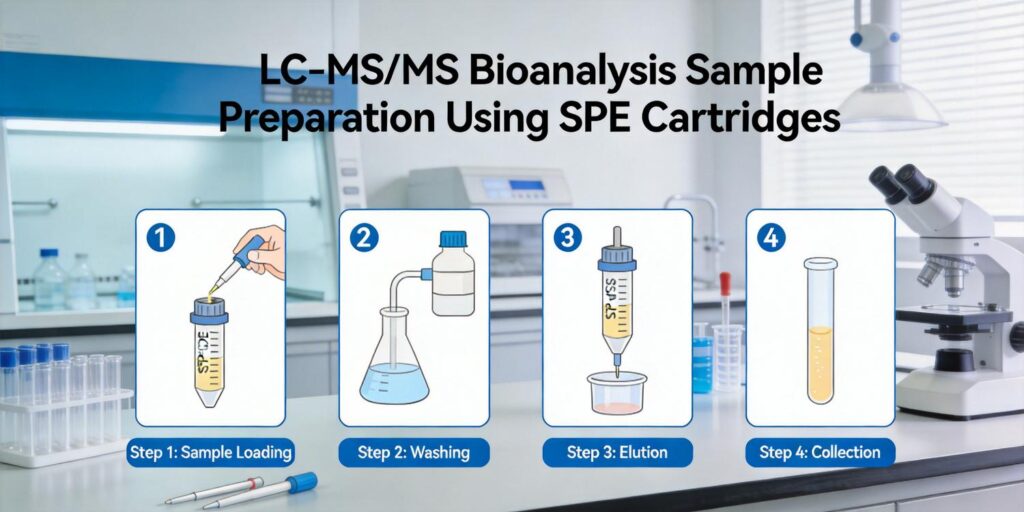
- Simplified 3-step or 4-step protocols requiring minimal method development
- Enhanced specificity for ionizable compounds
Other Specialized Chemistries
Beyond HLB and MCX, bioanalytical scientists can select from:
- MAX (Mixed-Mode Anion Exchange): For acidic compounds with pKa 2-8
- WCX (Weak Cation Exchange): For strong basic compounds with pKa > 10
- WAX (Weak Anion Exchange): For strong acidic compounds with pKa < 1
The Oasis 2 x 4 method development strategy exemplifies efficient SPE selection, using just two extraction protocols and four sorbents to analyze all compound types.
4. Sample Pretreatment Options: Setting the Stage for Successful SPE
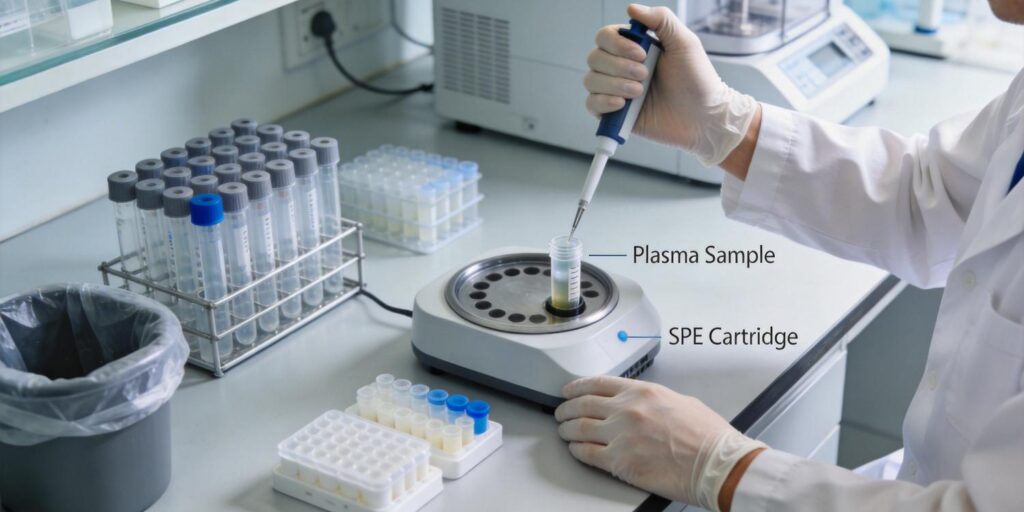
Effective SPE begins with proper sample pretreatment. Biological matrices like plasma, serum, urine, and tissue homogenates require specific pretreatment strategies:
Protein Precipitation
While simple protein precipitation with acetonitrile or other solvents can reduce matrix effects, it often proves insufficient for LC-MS/MS applications. As noted in the literature, early LC-MS/MS users discovered that protein precipitation alone frequently led to signal decline and spectral quality deterioration due to unobserved co-analytes depositing in the instrument interface.
However, protein precipitation followed by SPE represents a powerful combination. The 96-well plate format SPE devices have been adapted to remove precipitated proteins from biosamples that don’t require full SPE cleanup, offering a streamlined approach for certain applications.
Dilution and pH Adjustment
Proper dilution with appropriate buffers serves multiple purposes:
- Reduces viscosity for consistent flow through SPE cartridges
- Adjusts pH to optimize analyte retention based on ionization state
- Minimizes non-specific binding to container surfaces
- For MCX applications, samples are typically diluted 1:1 with water containing 4% H3PO4 to acidify and protonate basic compounds
Enzymatic Digestion
For tissue samples or matrices containing conjugated metabolites, enzymatic digestion with β-glucuronidase or sulfatase may be necessary to release target analytes before SPE.
5. Wash Steps: The Art of Removing Endogenous Compounds
Wash steps represent the critical phase where endogenous interferences are removed while target analytes remain retained on the sorbent. The strategic design of wash solvents determines the final extract cleanliness:
Aqueous Washes
Water or dilute aqueous buffers (typically 5-10% organic solvent) effectively remove:
- Salts and inorganic ions
- Highly polar endogenous compounds
- Residual proteins and peptides
- Excess buffer components
Washing the cartridge with pure water eliminates excess ions that can improve system performance by reducing source contamination.
Organic Washes
Carefully selected organic solvents or solvent mixtures remove:
- Lipids and phospholipids
- Non-polar endogenous compounds
- Moderately retained matrix components
For mixed-mode cartridges, specific wash protocols are essential. MCX cartridges typically use 100% methanol followed by aqueous solutions containing 2% formic acid or similar acids to remove neutral and acidic interferences while retaining basic analytes through cation exchange interactions.
Selective Wash Strategies
Advanced wash strategies include:
- pH-adjusted washes: Using buffers at specific pH values to selectively elute interferences while retaining analytes
- Solvent strength gradients: Gradually increasing organic content to remove increasingly non-polar interferences
- Dual wash protocols: Combining aqueous and organic washes for comprehensive cleanup
6. Elution Solvent Compatibility: Maximizing Recovery and MS Compatibility
The final elution step must balance several competing requirements: complete analyte recovery, minimal co-elution of interferences, and compatibility with subsequent LC-MS/MS analysis.
Solvent Selection Criteria
Ideal elution solvents should:
- Provide strong elution strength for the target analytes
- Minimize elution of retained interferences
- Be compatible with LC-MS/MS mobile phases
- Evaporate efficiently if concentration is required
- Maintain analyte stability
Common Elution Solvents
For HLB cartridges: Methanol, acetonitrile, or mixtures (e.g., 90:10 acetonitrile:methanol) provide effective elution for most compounds. The use of pure organic solvents without modifiers or buffer ions is desirable, as it was for off-line LC-MS sample preparation.
For MCX cartridges: Basic conditions are required to neutralize the cation exchange sites. Typical elution employs 5% ammonium hydroxide in methanol, which effectively elutes basic compounds while leaving acidic and neutral interferences retained.
For MAX cartridges: Acidic conditions (e.g., 2% formic acid in methanol) elute acidic compounds while basic and neutral interferences remain retained.
Evaporation and Reconstitution
Following elution, solvent evaporation and reconstitution in mobile phase-compatible solvents may be necessary to:
- Concentrate analytes to improve detection limits
- Exchange solvents for better chromatographic performance
- Reduce matrix effects by decreasing organic content
μElution plates represent an innovative solution, allowing elution in volumes as low as 25 μL without evaporation and reconstitution, significantly streamlining workflows.
MS Compatibility Considerations
Elution solvents must be compatible with MS detection:
- Low volatility solvents can cause source contamination
- High organic content may cause precipitation when mixed with aqueous mobile phases
- Additives like formic acid or ammonium hydroxide should be at concentrations compatible with MS detection
- Salts and non-volatile buffers should be minimized or eliminated
Conclusion: SPE as the Cornerstone of Reliable LC-MS/MS Bioanalysis
SPE sample preparation has evolved from a simple cleanup technique to a sophisticated, strategic component of modern LC-MS/MS bioanalysis. By understanding the principles of matrix effects, strategically selecting cartridge chemistry, optimizing pretreatment and wash steps, and ensuring elution solvent compatibility, scientists can develop robust methods that deliver the sensitivity, specificity, and reproducibility required for critical applications in pharmaceutical development, clinical research, and forensic analysis.
The continued innovation in SPE technologies—from advanced sorbent chemistries to high-throughput formats—ensures that sample preparation will remain a vital partner to LC-MS/MS instrumentation, enabling scientists to extract meaningful data from increasingly complex biological matrices with confidence and precision.
For laboratories seeking to optimize their bioanalytical workflows, investing time in SPE method development represents one of the highest-return activities, directly impacting data quality, instrument performance, and ultimately, the reliability of scientific conclusions drawn from LC-MS/MS analyses.