Vacuum Gauge Selection for Vacuum Heat Treatment Processes
Vacuum heat treatment—encompassing annealing, tempering, brazing, and sintering—relies on precise pressure control to eliminate oxidation, decarburization, and hydrogen embrittlement while achieving uniform metallurgical properties. Incorrect vacuum levels during critical stages can ruin entire batches, leading to costly rework or scrap. The VG-SP205 Pirani Vacuum Transmitter and VG-SM225 Cold Cathode Vacuum Gauge from Poseidon Scientific form a compact, cost-effective monitoring solution specifically validated for vacuum tempering and annealing furnaces. Covering atmosphere to 10−7 Torr with seamless crossover at 10−3 Torr, these gauges deliver the reliability engineers need at 30–50 % lower total ownership cost than imported equivalents, plus full RS232 protocol customization for direct furnace PLC integration.
Both instruments operate within a 15–50 °C envelope, making proper thermal isolation essential in high-temperature furnaces (often exceeding 1000 °C). Their small footprint, user-serviceable design, and analog/digital outputs simplify retrofits into existing furnace control systems while supporting predictive maintenance through real-time data.
1. Heat Treatment Vacuum Stages
A typical vacuum heat-treatment cycle consists of three distinct pressure regimes:
- Roughing stage: Pump-down from atmosphere to ~10−2 Torr using mechanical pumps. This removes bulk air and moisture.
- High-vacuum transition: Further evacuation to the target base pressure (usually 10−3 to 10−5 Torr) before ramping temperature. Residual gases must be low enough to prevent surface reactions during heating.
- Hold and cooling stage: Maintain base pressure throughout the thermal cycle and controlled cool-down, often with backfill of inert gas (argon or nitrogen) at controlled pressure.
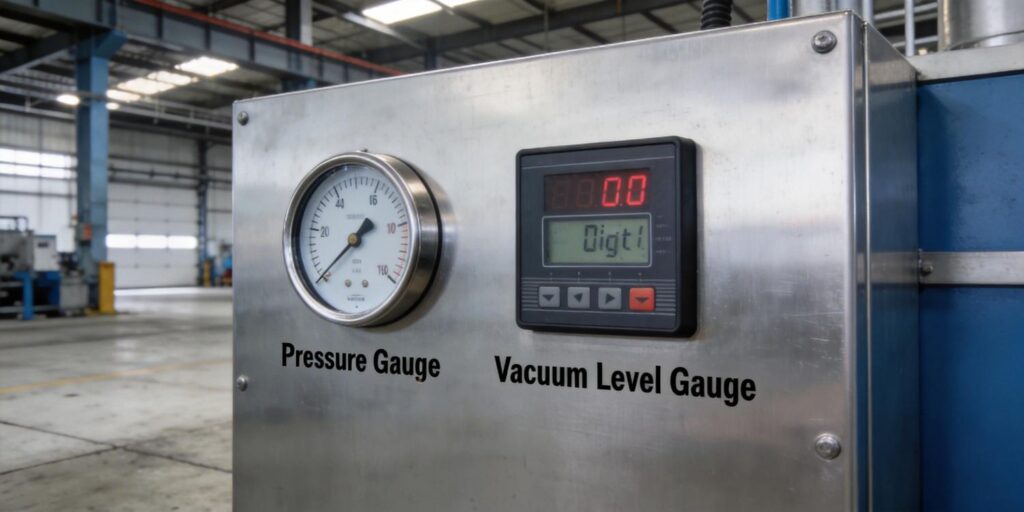
The VG-SP205 Pirani excels in the roughing stage, delivering fast, maintenance-free thermal-conductivity readings from atmosphere down to 10−3 Torr. Once crossover occurs, the VG-SM225 Cold Cathode takes over with linear Penning-discharge response through the high-vacuum regime. This staged approach—enabled by the gauges’ shared 0–10 V analog output and customizable RS232 protocol—ensures continuous monitoring without data gaps, a common pain point with single wide-range gauges that lose accuracy at either extreme.
2. Required Pressure Before Heating Cycle
Heating must not begin until the chamber reaches a pressure low enough to suppress oxidation and ensure clean metallurgical results. Industry standards for most steels and alloys call for:
- 10−3 Torr minimum for basic annealing
- 10−4 to 10−5 Torr for high-precision tempering or brazing
- Below 10−5 Torr for specialty alloys or vacuum sintering
At these levels, mean free path exceeds chamber dimensions, minimizing gas–metal interactions. The VG-SM225 provides repeatable, linear ion-current output exactly in this window, with software interlock capability that can prevent the furnace from ramping until the VG-SP205 confirms safe crossover and the cold cathode stabilizes. Engineers report that this interlock logic—implemented via the gauges’ RS232 status codes—eliminates premature heating incidents that previously caused surface scaling or decarburization in 5–10 % of batches.
Because both gauges are factory-calibrated against certified references and maintain stability within ±50 % at range extremes (far tighter in the linear bands), operators achieve consistent batch-to-batch results without frequent recalibration.
3. High Temperature Isolation Design
Neither the VG-SP205 nor VG-SM225 is rated for direct exposure to furnace temperatures above 50 °C. Their platinum filament (Pirani) and stainless-steel electrodes/PEEK insulators (cold cathode) would suffer rapid degradation or calibration drift if mounted inside the hot zone. Poseidon’s design philosophy therefore emphasizes thermal isolation:
- Stainless-steel construction and vacuum-grade O-rings maintain <10−11 Pa·m³/s leak rate even when the gauge body sits in cooler regions.
- Low thermal-mass sensor heads minimize heat soak from the chamber wall.
- Built-in temperature-compensation circuitry (both gauges) corrects for ambient fluctuations up to 50 °C.
These features allow reliable long-term operation in heat-treatment plants where furnace skin temperatures can exceed 200 °C near ports. In contrast, many legacy gauges require expensive water-cooled jackets or active thermal barriers; Poseidon units need only proper positioning and, where necessary, a short KF extension tube.
4. Gauge Positioning Outside Hot Zone
Correct placement is the simplest and most effective isolation method. Recommended configurations include:
- Direct chamber port mounting on a cooled manifold or furnace wall section kept below 50 °C.
- KF16/KF25 extension tube (100–300 mm length) routed to an external, ambient-temperature location. Gas conductance remains high enough that the gauge accurately reflects true chamber pressure.
- Multiple monitoring points: one near the workload (via tube) and one at the pump foreline for complete system health.
The gauges’ compact size—significantly smaller than most INFICON or MKS equivalents—fits easily into tight furnace layouts without obstructing load doors or heating elements. Installation is direction-independent, simplifying retrofits. In validated annealing and tempering furnaces, this positioning strategy keeps gauge body temperature within 15–50 °C even when the workload reaches 1200 °C, ensuring years of drift-free performance.
5. Integration with Furnace Control
Modern heat-treatment furnaces use PLC or SCADA systems for automated cycles. The Poseidon pair integrates natively:
- Analog 0–10 V output (effective 2–8 V range) feeds directly into PLC analog inputs for simple pressure interlocks.
- Customizable RS232 protocol (available at 5–10 unit volumes) streams vacuum value, status codes, error flags, and software version—enabling precise “vacuum OK” logic before heating ramps begin.
- RJ45 interface supports Ethernet gateways for Modbus TCP or OPC UA mapping to MES systems.
A typical control sequence reads: “If VG-SP205 <10−3 Torr and VG-SM225 stable for 60 s, enable heating ramp.” The cold cathode’s automatic high-voltage disable above 10−3 Torr provides hardware-level safety redundancy. Engineers value the free protocol customization that eliminates custom driver development—unlike rigid imported gauges—accelerating commissioning by weeks.
6. Reliability Considerations
In vacuum heat treatment, minor metal vapors or residual oils can accumulate over time. The VG-SP205 Pirani is inherently maintenance-free with a 3–5 year lifespan in clean service. The VG-SM225 Cold Cathode, while more sensitive to deposits, features a fully disassemblable sensor head that restores performance in 15 minutes:
- Sand electrodes and discharge plate with 200–500 mesh paper until metallic luster returns.
- No impact on factory calibration.
In heat-treatment environments, electrode cleaning is typically needed every 1–2 years—far less frequent than competitor units requiring full sensor replacement. Software interlocks and startup diagnostics (red indicator for delayed ignition) enable predictive maintenance before readings drift. Combined with the gauges’ low-cost design (self-developed at 3000–3500 RMB manufacturing target) and INFICON PTR225N-compatible footprint, total ownership cost remains the lowest in class while delivering the uptime furnaces demand.
Direction-independent mounting and robust stainless-steel construction further enhance reliability across repeated thermal cycles and occasional venting.
Conclusion: Optimized Vacuum Monitoring for Heat Treatment Success
Selecting the right vacuum gauges for heat-treatment processes means matching staged pressure requirements, ensuring thermal isolation, and enabling seamless control integration—all while controlling long-term costs. The Poseidon Scientific VG-SP205 Pirani and VG-SM225 Cold Cathode combination meets these criteria precisely: full atmosphere-to-10−7 Torr coverage, validated performance in annealing and tempering furnaces, compact size for easy positioning outside the hot zone, and customizable digital output for modern PLC systems. Engineers gain batch-to-batch consistency; procurement teams gain immediate TCO reduction and faster ROI.
Ready to upgrade your furnace vacuum monitoring? Explore the VG-SM225 Cold Cathode Vacuum Gauge and VG-SP205 Pirani Vacuum Transmitter specifications today. Request a sample pair for your heat-treatment rig, a custom RS232 interlock script tailored to your PLC, or a complete system diagram showing optimal gauge positioning and thermal isolation. Our application engineers will deliver a turnkey configuration—often within 48 hours—designed to eliminate oxidation risks and maximize furnace uptime. Contact Poseidon Scientific now and secure consistent, cost-effective vacuum control for every heat-treatment cycle.