What Causes Channeling in SPE Cartridges
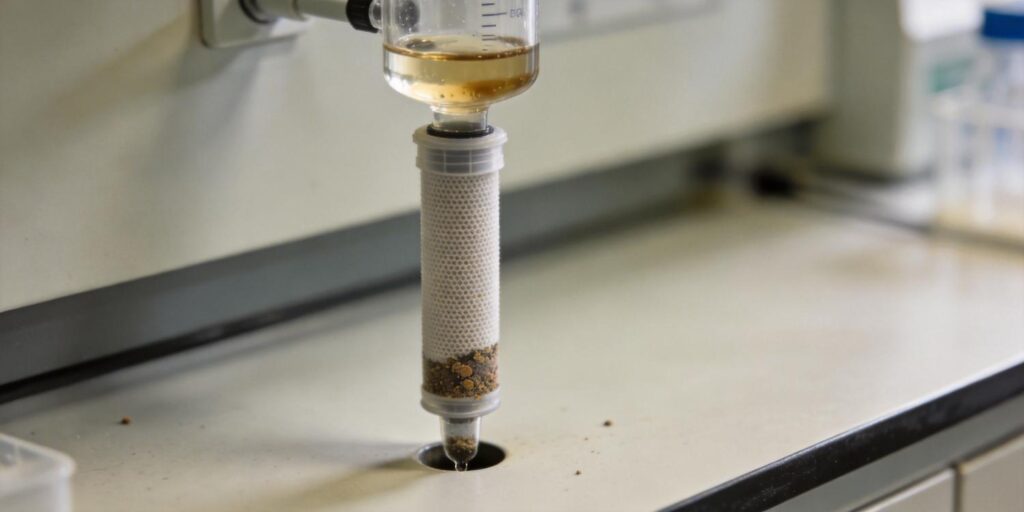
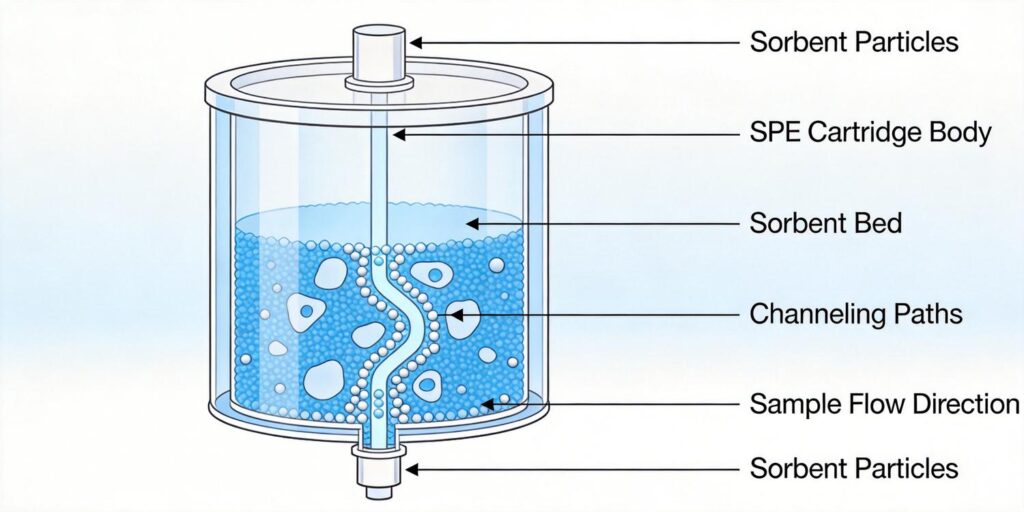
Channeling in solid phase extraction (SPE) cartridges represents one of the most significant flow problems that can compromise extraction efficiency and analyte recovery. According to established literature, channeling occurs when liquids take the path of least resistance through the sorbent bed, creating tunnels or channels that bypass the majority of the stationary phase.
The fundamental cause of channeling is excessive flow rates during critical SPE steps, particularly conditioning. When too much vacuum or pressure is applied to SPE columns, the liquid flow preferentially creates pathways through the sorbent bed rather than distributing evenly across the entire stationary phase surface. This phenomenon is exacerbated when sorbent beds are allowed to dry excessively between steps, creating cracks and fissures that become permanent flow channels.
From a physical perspective, channeling significantly reduces the available surface area for sample contact, effectively decreasing sorbent capacity. As noted in forensic applications literature, “Channeling is detrimental to efficient extraction and recovery because it reduces the available surface area for sample contact. In essence, sorbent capacity is significantly reduced, because only a portion of the sorbent is successfully solvated.” This reduction in effective capacity can lead to breakthrough of target analytes and compromised method performance.
Improper Packing Issues Contributing to Channeling
Manufacturing and Assembly Factors
SPE cartridge manufacturing processes can significantly influence susceptibility to channeling. Three primary manufacturing factors contribute to this problem:
- Particle Size Distribution: Sorbent batches with wide particle size distributions containing excessive “fines” (particles significantly smaller than average) create irregular packing density. These fines can migrate during flow, creating voids and channels within the bed structure.
- Frit Quality and Placement: Polyethylene frits with unevenly cut edges or inappropriate pore diameters can cause liquids to channel down the sides of the column rather than through the sorbent bed. Glass-weave frits, while more hydrophilic and less resistant to aqueous phases, represent an alternative but come with higher cost considerations.
- Packing Consistency: Columns packed too tightly create restrictive flows that encourage channeling, while insufficient packing allows for bed movement and channel formation. Automated packing processes generally provide more uniform results than hand-packing methods, though operator variation remains a concern in specialty phases.
Sorbent Bed Compression and Quality
High-quality cartridges with sorbents of narrow particle size ranges and proper compression demonstrate significantly less susceptibility to channeling. As documented in veterinary drug testing applications, “Sorbent bed compression by the plunger in high-quality cartridges with sorbents of narrow particle size ranges results in less channeling of the fluids through the sorbent bed and therefore more reliable stationary phase-mobile phase interactions.”
The evolution of disk-type columns represents a direct response to channeling problems. These devices feature reduced bed depths and rigid supports that prevent channeling even at higher flow rates, making them ideal for processing large sample volumes where traditional packed beds might fail.
Flow Rate Considerations for Preventing Channeling
Optimal Flow Rate Ranges
Flow rate regulation represents the most critical operational factor in preventing channeling. Research indicates that flow rates between 0.5 and 3.0 mL/min generally allow sufficient solvent-sorbent contact for proper solvation without causing channeling. These rates provide adequate contact time for effective mass transfer while maintaining reasonable processing times.
It’s important to recognize that different SPE mechanisms exhibit varying sensitivity to flow rates. Ion-exchange extractions are typically more sensitive to flow rate variations than polar or non-polar extractions. The load and elute steps generally demonstrate the highest sensitivity to flow rate optimization.
Pressure vs. Flow Rate Control
The distinction between pressure-controlled and flow rate-controlled systems significantly impacts channeling prevention:
- Vacuum/Pressure Systems: Traditional vacuum manifolds maintain constant pressure while allowing flow rates to vary based on sample viscosity and sorbent characteristics. This approach can inadvertently create conditions conducive to channeling if not carefully monitored.
- Positive Displacement Systems: Automated SPE workstations using syringe pumps or piston mechanisms provide more precise flow control by explicitly setting flow rates rather than pressures. These systems maintain consistent flow regardless of sample characteristics, significantly reducing channeling risk.
As noted in SPE methodology literature, “An automated SPE workstation that uses a pump or syringe to provide positive pressure displacement of a liquid volume through the SPE cartridge bed will provide the most stable flow.” This stability directly translates to reduced channeling and improved reproducibility.
Step-Specific Flow Rate Optimization
Different SPE steps require different flow rate considerations:
- Conditioning: Requires moderate flow rates (0.5-2 mL/min) to ensure complete sorbent solvation without creating channels
- Sample Loading: Typically benefits from slower flows (1-3 drops/second) to maximize analyte retention and recovery
- Washing: Can tolerate slightly higher flows while maintaining selectivity
- Elution: Often requires precise, controlled flows to ensure complete analyte recovery in minimal solvent volumes
Prevention Strategies for Channeling in SPE Applications
Operational Best Practices
Implementing proper operational techniques represents the first line of defense against channeling:
- Proper Conditioning Protocol: Always condition sorbents immediately before sample application. If excessive time passes between conditioning steps, restart the conditioning process to ensure proper solvation.
- Moderate Flow Control: Maintain flow rates within the recommended 0.5-3.0 mL/min range during all critical steps. Avoid the temptation to accelerate processing with excessive vacuum or pressure.
- Continuous Liquid Presence: Keep solvent continually on the sorbent bed during conditioning and sample application steps. Allowing beds to dry between steps significantly increases channeling risk.
- Matrix Preparation: For viscous samples or those containing particulates, implement appropriate pretreatment including dilution, filtration, centrifugation, or protein precipitation to improve flow characteristics.
Equipment and Format Selection
Choosing appropriate SPE formats and equipment can prevent channeling at the system design level:
- Disk Format Selection: Consider disk-type columns for applications involving large sample volumes, high particulate content, or requirements for higher flow rates. As documented, “Disk-type columns have evolved in part to overcome channeling problems. Because of reduced bed depths and rigid supports, channeling does not occur even at higher flow rates.”
- Positive Pressure Systems: Implement automated systems with positive displacement mechanisms for critical applications requiring high reproducibility. These systems provide superior flow control compared to traditional vacuum manifolds.
- Cartridge Geometry: Select appropriate cartridge diameters and bed depths for specific sample volumes. Tapered or wide-mouth designs allow processing of larger volumes while maintaining optimal flow characteristics.
Quality Assurance and Method Validation
Implement systematic quality measures to detect and prevent channeling issues:
- Supplier Qualification: Source SPE cartridges from manufacturers with documented quality control processes for particle size distribution, frit quality, and packing consistency.
- Method Validation: Include flow rate optimization and channeling assessment in method development and validation protocols. Test recovery across expected flow rate ranges to establish operational parameters.
- Regular Performance Monitoring: Implement system suitability testing that includes evaluation of flow characteristics and recovery consistency as indicators of potential channeling issues.
- Alternative Format Evaluation: For methods experiencing persistent channeling problems, evaluate alternative formats such as 96-well plates or disk cartridges that may offer improved flow characteristics.
Recovery Optimization Through Flow Management
Research demonstrates clear relationships between flow control and extraction performance. In comprehensive SPE procedures, lowering elution flow rates from 1.5 mL/min to 0.33 mL/min increased extraction yields from approximately 80% to 95%. This improvement highlights the critical importance of precise flow control in maximizing recovery while preventing channeling.
For laboratories using vacuum manifolds, implementing flow restrictors or graduated vacuum control can help maintain optimal flow rates. Monitoring actual flow rates rather than relying solely on vacuum settings provides more reliable channeling prevention.
When Channeling Occurs: Remediation Strategies
Despite best efforts, channeling may still occur. When identified, consider these remediation approaches:
- Immediate Restart: If channeling is detected during conditioning or early in sample processing, discard the affected cartridge and begin with fresh media.
- Method Adjustment: For persistent channeling issues, consider adjusting sample preparation methods to reduce viscosity or particulate content.
- Format Change: Transition to disk formats or alternative cartridge geometries if traditional packed beds consistently exhibit channeling problems.
- Equipment Upgrade: Evaluate upgrading to positive pressure systems if vacuum-based approaches consistently produce channeling issues.
By understanding the causes of channeling and implementing comprehensive prevention strategies, laboratories can significantly improve SPE method reliability, recovery, and reproducibility. Proper attention to flow rate control, equipment selection, and operational techniques ensures optimal performance across diverse SPE applications.
For more information about high-quality SPE products designed to minimize channeling issues, explore our comprehensive range of HLB SPE cartridges, MAX SPE cartridges, MCX SPE cartridges, WAX SPE cartridges, WCX SPE cartridges, and 96-well SPE plates.