Breakthrough Due to Low Sorbent Capacity
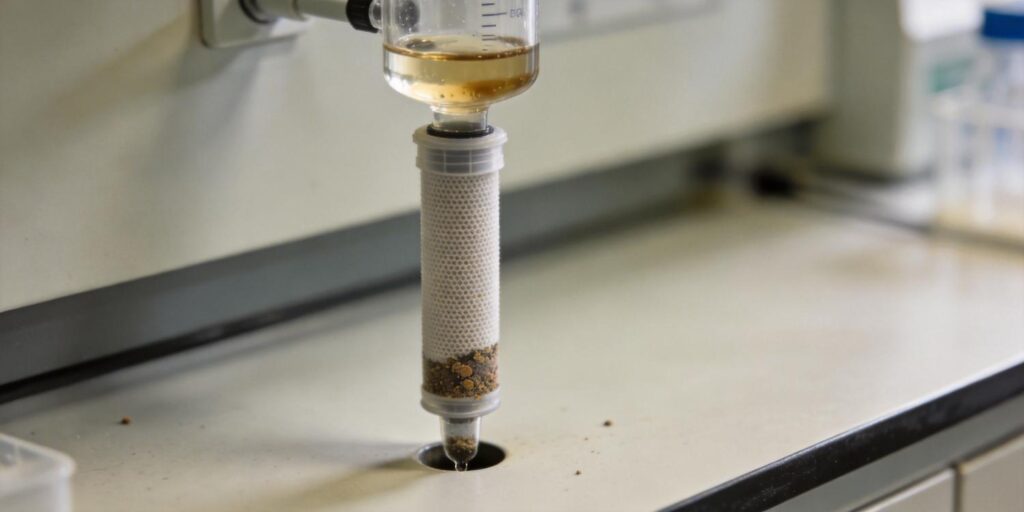
Breakthrough is the ineffective retention of target analytes on the solid phase sorbent, resulting in low analyte recovery. This occurs when the analyte passes through the column unretained during loading or wash phases. The most common cause of breakthrough during sample application is flow rates that exceed the sorbent affinity for binding of target compounds, resulting from inadequate mass transfer of the analyte to sorbent binding sites.
Key Factors Contributing to Breakthrough:
- Improper conditioning: Insufficient solvation can occur if too little solvent is applied, or if the solvent is swept too quickly through the sorbent bed
- Improper loading solvent: Issues with ionic strength or organic strength
- Excessive flow rates: Insufficient diffusion and mass transfer (residence time)
- Volume overload: Weakly retained analytes migrate with the matrix
- Mass overload: Capacity is insufficient (analyte or matrix)
- Incorrect sorbent selection: Choosing a phase that doesn’t retain your compound effectively
The capacity of an SPE column packing is directly impacted by organic loading and other factors. Higher carbon loading generally increases capacity, but other considerations come into play. The sample matrix can compete with the analyte, particularly in biological samples where acidic, neutral, and basic compounds all abound.
Solutions to Capacity Problems:
- Increase bed size: Increase total capacity to overcome competitive interactions
- Change sorbent nature: Switch from monomeric C18 to higher loaded polymeric phases
- Change mechanism: Consider ion exchange or normal phase approaches
- Use coupled columns: Filter out unwanted material with sequential extraction phases
Incorrect pH Causing Weak Retention
Proper pH conditions are crucial for optimal binding in SPE. Column pH conditions are usually driven by the desired ionization state of target analytes. Un-ionized compounds favor retention in reversed phase systems, while ionized compounds are better retained in ion-exchange systems.
pH Optimization Guidelines:
- In most cases, the pH of the sample and that of the sorbent should be equivalent for optimal binding
- For reversed phase extractions, maintain pH at least 2 units away from the analyte’s pKa to ensure the compound remains un-ionized
- For ion-exchange extractions, maintain pH at least 2 units in the appropriate direction to ensure proper ionization
- Use buffers with appropriate capacity to resist pH changes during extraction
Research shows that very hydrophilic analytes can be difficult to retain on reversed-phase silica sorbents. In such cases, the use of an ion pairing agent in the dilution buffer can substantially increase recovery over the pH interval studied. For example, addition of 10 mM tetrabutyl ammonium hydroxide to buffers used for diluting samples significantly improved recovery of hydrophilic analytes.
Inadequate Cartridge Conditioning
Conditioning serves several critical functions in SPE. Solid phase columns are shipped dry for stability and packaging reasons, requiring proper wetting to activate sorbent functional groups.
Conditioning Functions:
- Solvation: Expands functional binding sites away from the solid surface, exposing them to diffusive flow
- Chemical preparation: Creates optimal pH and ionic strength environment for binding
- Impurity removal: Removes dust, fines, and residual polymer impurities from the sorbent
Proper Conditioning Protocol:
- Use methanol or another polar organic solvent that is miscible with aqueous matrices
- Apply 1.5 mL of methanol or acetonitrile per 100 mg of sorbent at low vacuum (~3 in. Hg)
- Follow with deionized or distilled water to remove excess solvent (1 mL H₂O per 100 mg sorbent)
- For ion-exchange columns, apply 1 mL of buffer after flushing to ensure optimal sorbent pH
- Maintain flow rates between 0.5 and 3.0 mL/min to prevent channeling
Insufficient conditioning can lead to channeling, where liquids take the path of least resistance through the sorbent bed. This reduces available surface area for sample contact and significantly decreases sorbent capacity. If channels form due to high flows or excessive drying, reconditioning will not correct the problem.
Strong Wash Solvent Causing Analyte Loss
The wash step aims to remove as many interferences as possible while retaining the analyte(s). However, using wash solvents that are too strong can cause premature elution and loss of target compounds.
Wash Optimization Strategies:
- Identify optimal wash strength: Determine the strongest wash solvent that will not elute your analyte
- Consider pH effects: Wash pH may greatly affect cleanup and/or recovery
- Use sequential washing: Start with weaker solvents and progress to stronger ones if needed
- Dry columns properly: Ensure columns are dry when changing between aqueous solutions and organic solvents
Safe Wash Volumes (Guidelines):
| Sorbent Mass (mg) | Safe Wash Volume (mL) | Typical Assay Wash Volume (mL) |
|---|---|---|
| 100 | 2.5 | 1.5 |
| 200 | 5.0 | 3.0 |
| 500 | 7.5 | 4.5 |
| 1000 | 25.0 | 15.0 |
For hydrophobic and polar analytes, search for a solvent mixture that will wash the most interferences from the sorbent without loss of analyte. For ionically bound analytes, use washes of high organic strength to remove interferences retained by hydrophobic interactions.
Incorrect Elution Solvent
Elution requires completely yet selectively releasing all isolates in minimal volume. The elution solvent strength should be the weakest solvent that completely disrupts all binding mechanisms of the analyte as needed (hydrophobic, polar, and/or ion exchange).
Elution Optimization Factors:
- Solvent strength: Use minimal elution volume for greater selectivity and less solvent to concentrate
- Flow rates: Slower is better for elution; gravity flow is desirable if possible
- pH considerations: For ion-exchange, ensure pH is at least 2 units above analyte pKa
- Solubility: Ensure analyte solubility in elution solvent
Safe Elution Volumes (Guidelines):
| Sorbent Mass (mg) | Safe Elution Volume (mL) | Typical Assay Elution Volume (mL) |
|---|---|---|
| 100 | 0.5 | 0.75 |
| 200 | 1.0 | 1.5 |
| 500 | 2.5 | 4.0 |
| 1000 | 5.0 | 8.0 |
Common Elution Problems:
- Improper pH for ion-exchange: Most common difficulty with ion-exchange procedures
- Insufficient solvent strength: Fails to disrupt all binding mechanisms
- Poor solubility: Analyte doesn’t dissolve adequately in elution solvent
- Excessive volume: Reduces concentration factor and increases evaporation time
For cation exchange extractions of basic drugs, elution solvents often utilize ammonium hydroxide to reverse the ionic state of the drugs. It’s critical that the pH of the elution solvent be at least 2 units above the analyte pKa to fully protonate the compound. Ammonium hydroxide quickly becomes weak as pH decreases when exposed to air, so prepare elution solvent shortly before use.
Systematic Troubleshooting Approach
When facing low recovery problems, take a systematic “Where did it go?” approach. There are limited possibilities:
- Analyte was unretained at sample application and lost with the matrix (breakthrough)
- Analyte was unretained during wash steps and lost with washes (breakthrough)
- Analyte was retained in the elution step and remains bound to the sorbent
Mass Balance Analysis:
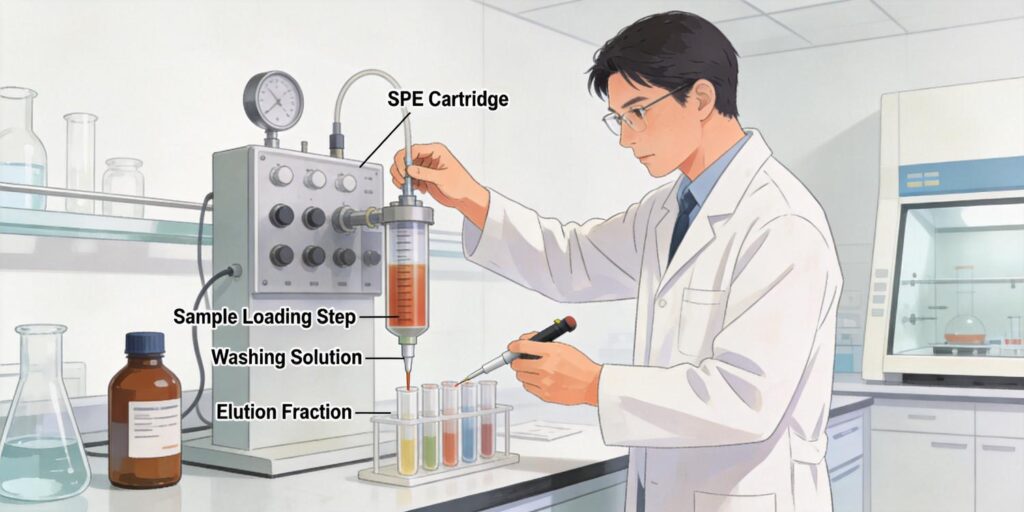
Perform a mass balance by individually collecting and analyzing every liquid fraction to exit the column. This quantitative accounting for all of a known concentration of analyte applied to the SPE column helps determine where breakthrough is occurring. Analyze each mobile phase that has passed through the column to detect whether breakthrough is occurring and, if so, where.
Method Validation Considerations:
- Validate sorbent performance with different cartridges and lots
- Test preconditioning variables (strong solvent, weak solvent)
- Optimize loading solvent (% organic, pH, ionic strength, volume)
- Validate wash solvent parameters
- Test eluent volume and composition
- Optimize flow rates for loading, wash, and elution
- Check analyte stability in loading solvent and eluent
Remember that SPE today has become a real science. If you’re not getting 90% absolute recovery of your analyte, your method is not optimized. However, evaluate method performance based on the optimal recovery needed to sustain required signal-to-noise ratio, not on absolute percent recovery alone. Sometimes acceptable limits of detection are achieved at lower recoveries with cleaner extracts.
For more information on our SPE products including HLB, MAX, MCX, WAX, and WCX cartridges, visit our product pages. Our 96-well SPE plates offer high-throughput solutions for laboratories requiring automated processing.