Understanding Ion Suppression in LC-MS Analysis
Ion suppression remains one of the most challenging issues in liquid chromatography-mass spectrometry (LC-MS) analysis, particularly when dealing with complex biological and environmental matrices. This phenomenon occurs when co-eluting matrix components interfere with the ionization process of target analytes, leading to reduced sensitivity, inaccurate quantification, and potential false negatives. As Dr. Xu, product manager at Poseidon Scientific, I’ve witnessed firsthand how proper solid-phase extraction (SPE) cleanup can dramatically mitigate these effects and improve analytical reliability.
1. Sources of Ion Suppression
Ion suppression primarily originates from the competition between analytes and matrix components during the ionization process in atmospheric pressure ionization sources. According to research, atmospheric pressure ionization-MS analysts face suppression of ionization by co-extracted endogenous interferences from biofluids. The mass spectrometer’s sensitivity to quenching of the ion source or disruption of the MS fragmentation/ionization process means that eliminating proteins during the SPE stage is crucial.
Common sources include:
- Proteins and peptides that deposit in the transfer capillary/interface
- Lipids and phospholipids that affect droplet formation
- Salts and buffers that alter ionization efficiency
- Endogenous compounds with similar chemical properties to analytes
- Sample preparation reagents and solvents
As noted in SPE literature, “the ability of the sorbent bed to filter out proteins before they elute into the MS also increases as the particle size decreases,” highlighting the importance of proper SPE design in preventing these issues.
2. Matrix Components Responsible for Ion Suppression
Different matrix types introduce specific challenges. Biological samples are notoriously dirty, and injecting them with minimum cleanup onto very sensitive and expensive instruments makes very little sense. SPE has been shown to significantly increase column life while reducing downtime on equipment like LCMS for source cleaning.
Key matrix components include:
Biological Matrices
Plasma and serum contain proteins that can foul interfaces between the sample introduction port and the mass spectrometer. Electrospray, thermospray, or particle beam instruments are all susceptible to overloading or clogging of the outlet of the MS chamber. The popular 96-well plate format SPE devices have been adapted to remove precipitated proteins from biosamples that do not require full-scale SPE clean-up.
Environmental Samples
Dissolved organic matter (DOM), humic substances, and surfactants can significantly impact ionization. Nakamura et al. (1996) studied the influences of humic acid and surfactants on SPE behavior, establishing that DOC may hamper quantitation by co-extracting with analytes and enhancing the “matrix effect” that results in spuriously high signals.
Food and Agricultural Samples
Lipids, carbohydrates, and plant pigments can interfere with ionization. The Luke procedure for pesticide analysis demonstrates how SPE steps contribute clean-up of matrix components while analytes pass through unretained.
3. SPE Wash Step Optimization
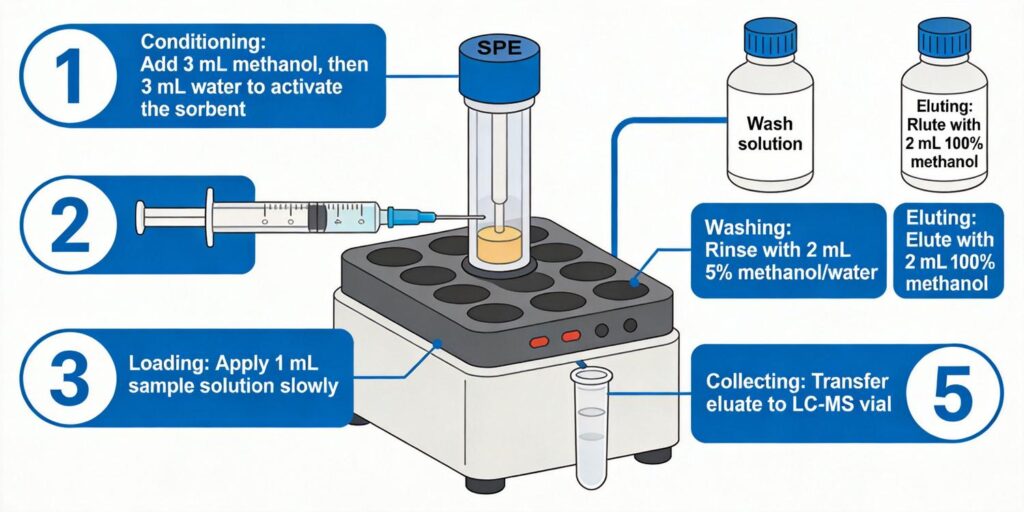
Proper wash step optimization is critical for removing matrix components while retaining target analytes. The fundamental steps for SPE adsorption mode include preconditioning, loading, washing, and elution. The wash step uses solvents that won’t elute the analyte but will remove weakly retained matrix compounds.
Key considerations for wash optimization:
Solvent Selection
Wash solvents should be carefully chosen based on analyte properties and matrix composition. For reversed-phase SPE, aqueous washes with 5-20% organic solvent are common. Ion exchange SPE may require specific buffer conditions to remove interfering ions while maintaining analyte retention.
pH Control
pH plays a crucial role in both analyte retention and matrix removal. For ionizable compounds, adjusting pH to ensure analytes remain charged (for ion exchange) or neutral (for reversed-phase) during washing is essential. Research shows that “matrix components can have a dramatic influence on sorbent-analyte and analyte-sample interactions.”
Volume and Flow Rate
Optimal wash volumes balance thorough matrix removal with minimal analyte loss. Flow rates should be controlled to ensure adequate contact time between wash solvent and sorbent. As noted in troubleshooting guides, “flow parameters can directly affect method performance, and appropriate attention to flow is essential.”
Multiple Wash Steps
Sequential washes with solvents of increasing strength or different selectivity can improve matrix removal. For example, a water wash followed by a water-methanol mixture can remove different classes of interferences.
4. Sorbent Choice for Matrix Removal
Selecting the appropriate SPE sorbent is fundamental to effective matrix removal and ion suppression prevention. The choice depends on analyte properties, matrix composition, and the specific interferences present.
Reversed-Phase Sorbents (C18, C8, HLB)
For non-polar to moderately polar analytes, reversed-phase sorbents like our HLB SPE cartridges provide excellent retention of hydrophobic compounds while allowing polar matrix components to wash through. HLB (hydrophilic-lipophilic balanced) sorbents are particularly effective for a wide range of compounds and can handle 100% aqueous samples without drying out.
Mixed-Mode Sorbents (MCX, MAX, WAX, WCX)
For ionizable compounds, mixed-mode sorbents combine reversed-phase and ion-exchange mechanisms. Our MCX (mixed-mode cation exchange) and MAX (mixed-mode anion exchange) cartridges provide selective retention based on both hydrophobicity and charge. Similarly, WAX (weak anion exchange) and WCX (weak cation exchange) sorbents offer pH-dependent selectivity for challenging separations.
Specialty Sorbents for Specific Matrices
For specific applications, specialized sorbents may be necessary:
- Polymer-based sorbents for humic acid removal
- Carbon-based sorbents for pigment removal
- Diol or silica-based sorbents for phospholipid removal
As research indicates, “the bonded phase will also affect the results and a range of available SPE phases should be examined for each application.”
5. Evaluating Matrix Effects Experimentally
Systematic evaluation of matrix effects is essential for method validation and optimization. Several approaches can be employed:
Post-Extraction Spiking
Compare analyte response in neat solvent versus matrix extract to quantify ion suppression/enhancement. This approach helps identify whether matrix effects originate from the ionization process or from extraction efficiency issues.
Standard Addition Method
Spike samples with known concentrations of analyte and internal standards to assess recovery and matrix effects simultaneously. This method accounts for both extraction efficiency and ionization effects.
Post-Column Infusion
Continuously infuse analyte solution post-column while injecting blank matrix extracts to visualize suppression regions in the chromatogram. This technique identifies specific retention times where matrix effects occur.
Internal Standard Monitoring
Use stable isotope-labeled internal standards or structural analogs to monitor and correct for matrix effects. These compounds experience similar ionization suppression as target analytes but can be distinguished mass spectrometrically.
Method Validation Parameters
Assess accuracy, precision, and recovery at multiple concentration levels in different matrix lots to ensure method robustness. As emphasized in quality guidelines, “SPE recoveries should exceed 90% absolute recovery. If you don’t get that kind of recovery you are not adjusting other parameters correctly.”
Practical Considerations for High-Throughput Applications
For laboratories requiring high throughput, our 96-well SPE plates offer significant advantages. The 96-well format has been widely adopted in high-throughput screening devices, allowing parallel processing of multiple samples with minimal manual intervention. As instruments developed to improve sample throughput, users and manufacturers standardized on this format where collection tubes or wells in an 8 × 12 array are compactly held in a single, small footprint plate.
Key benefits include:
- Reduced solvent consumption and waste generation
- Improved reproducibility through automated processing
- Higher throughput with parallel extraction capabilities
- Compatibility with liquid handling robotics
- Smaller sample volumes required
Conclusion
Preventing ion suppression in LC-MS analysis requires a comprehensive approach combining proper SPE cleanup with careful method development. By understanding the sources of ion suppression, identifying problematic matrix components, optimizing wash steps, selecting appropriate sorbents, and systematically evaluating matrix effects, analysts can achieve reliable, sensitive, and accurate results.
At Poseidon Scientific, we’ve designed our SPE products to address these challenges directly. Whether you’re working with biological fluids, environmental samples, or complex formulations, our range of SPE cartridges and plates provides the selectivity and clean-up needed to minimize matrix effects and maximize analytical performance. Remember that successful SPE method development always begins with characterizing both the analyte and the sample matrix, as these factors ultimately determine the optimal cleanup strategy for your specific application.