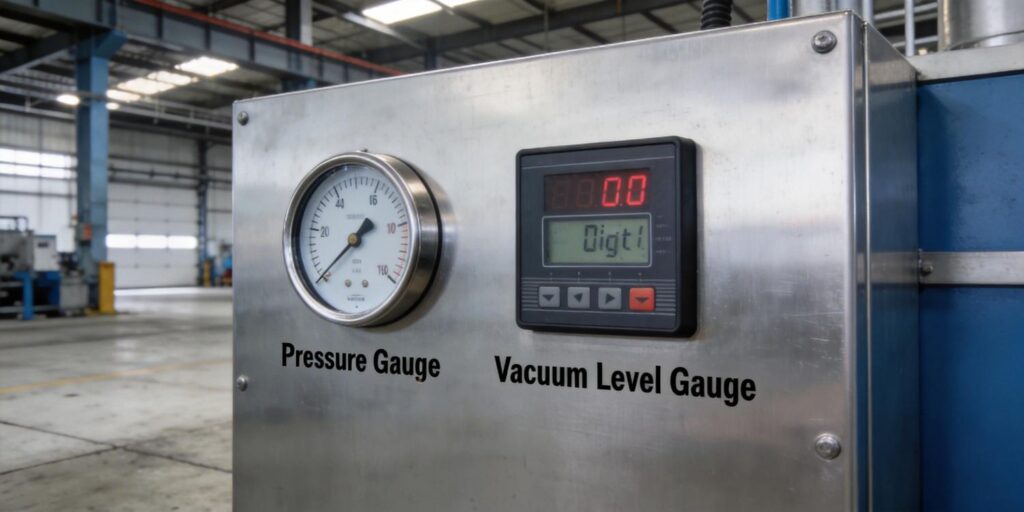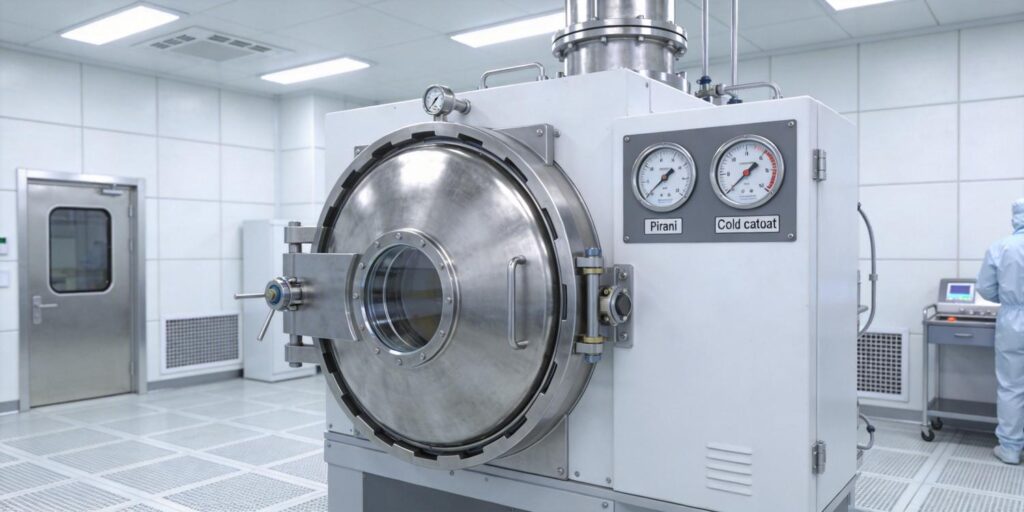
In high-throughput production environments such as semiconductor wafer processing, physical vapor deposition (PVD), and plasma etching, load-lock chambers serve as the critical interface between atmosphere and the main process chamber. By isolating the process volume from frequent venting cycles, load-locks minimize contamination, reduce pump-down times, and protect sensitive process conditions. Selecting the right vacuum gauge for a load-lock is essential to ensure safe, reliable wafer transfer while maintaining throughput and yield. At Poseidon Scientific, we designed the VG-SP205 Pirani Vacuum Transmitter for the rough-vacuum demands of load-lock operations and the VG-SM225 Cold Cathode Vacuum Gauge for any deeper vacuum requirements during transfer or leak checking. Both instruments offer compact size, fast response, and robust construction to withstand the aggressive cycling typical in production lines.
This guide outlines the key considerations for choosing vacuum gauges in load-lock applications. Engineers and procurement specialists will find practical insights to balance performance, durability, and integration while optimizing total cost of ownership.
Role of Load-Lock in Production Lines
Load-locks act as airlocks in vacuum production systems. A wafer or substrate enters the load-lock at atmospheric pressure, the outer door seals, the chamber is pumped down to match the process-chamber pressure (typically 10⁻² to 10⁻⁵ Torr), and then the inner door opens for transfer. After transfer, the inner door closes, the load-lock vents to atmosphere, and the cycle repeats. This isolation prevents atmospheric gases—especially water vapor and oxygen—from flooding the process chamber, which could cause oxidation, particle generation, or baseline pressure spikes that degrade film quality and uniformity.
In modern cluster tools, multiple load-locks service a central transfer chamber, enabling continuous operation. Accurate pressure monitoring in the load-lock ensures that transfer occurs only when pressures are sufficiently equalized (typically within 10–20 % of the process-chamber set point), preventing turbulence or backstreaming that could contaminate wafers. The VG-SP205 Pirani provides the rapid, reliable rough-vacuum feedback needed for these cycles, while the VG-SM225 Cold Cathode offers optional high-vacuum precision for advanced processes requiring deeper load-lock evacuation.
Typical Pressure Cycling Frequency
Production rates dictate load-lock cycling. In high-volume semiconductor fabs, a single load-lock may cycle 20–50 times per hour, equating to 500–1200 cycles per day or over 200,000 cycles annually. Each cycle involves rapid venting from rough vacuum to atmosphere (seconds to minutes) and pump-down from atmosphere to target pressure (typically 30–180 seconds, depending on pump speed and chamber volume).
This aggressive duty cycle stresses gauge components. Thermal shock from sudden pressure changes, residual moisture during venting, and occasional particulate ingress demand sensors with proven durability. Poseidon’s VG-SP205 Pirani uses a platinum filament selected for its chemical stability and resistance to oxidation, while the VG-SM225 Cold Cathode features stainless-steel electrodes and a removable sensor design that tolerates repeated venting without performance degradation. Both gauges are rated for 15–50 °C operation and incorporate vacuum seals achieving 10⁻¹¹ Pa·m³/s leak rates, ensuring long-term reliability in high-cycle environments.
Rough Vacuum Monitoring Needs
Load-lock pressure monitoring focuses primarily on the rough-vacuum regime (atmosphere to ≈10⁻²–10⁻³ Torr). Key requirements include:
- Fast response during pump-down to minimize cycle time.
- Accurate detection of crossover pressure for inner-door opening.
- Robustness against atmospheric venting and residual gases.
The VG-SP205 Pirani excels here with its thermal-conductivity principle, delivering linear output in the 10–10⁻² Torr range where most load-lock decisions occur. Its 90 % response time is ≈300 ms, and temperature-compensated electronics maintain stability across typical fab temperatures. The 0–10 V analog output (effective 2–8 V) connects directly to PLCs for set-point control, while RS232 digital output enables logging and status monitoring. For load-locks that occasionally require deeper evacuation (e.g., for leak testing or pre-conditioning), the VG-SM225 provides complementary high-vacuum capability without compromising rough-vacuum performance.
Transition to Process Chamber
The critical moment in load-lock operation is the pressure equalization and transfer to the process chamber. Inner-door interlocks typically require the load-lock pressure to be within a narrow band of the process-chamber pressure (often 10⁻²–10⁻⁴ Torr) to avoid gas bursts or flow-induced defects. A single rough-vacuum gauge can suffice for most applications, but dual monitoring—roughing line with Pirani and load-lock chamber with cold cathode—offers redundancy and finer control in high-precision processes.
The VG-SP205’s monotonic curve ensures reliable crossover detection, while the VG-SM225’s linear ion-current output below 10⁻³ Torr provides the resolution needed to confirm equalization without overshoot. Both gauges support customizable RS232 protocols (at 5–10 unit minimums), allowing seamless integration with tool controllers for automated door sequencing and safety interlocks.
Sensor Durability Under Rapid Venting
Rapid venting subjects gauges to thermal and mechanical stress. Sudden exposure to atmosphere introduces moisture condensation, air turbulence, and potential particulate ingress. Hot-cathode gauges risk filament shock and oxidation; cold-cathode gauges can accumulate surface films if venting occurs during discharge.
Poseidon’s designs address these challenges directly. The VG-SP205 Pirani features a platinum filament with high chemical stability and no requirement for continuous operation during venting. The VG-SM225 Cold Cathode incorporates automatic high-voltage shutoff above 10⁻³ Torr, preventing discharge during roughing or venting. Its removable electrode assembly allows quick cleaning of any deposits without chamber break. Field data from high-cycle production tools show these gauges maintaining <1 % drift after 100,000+ cycles when properly positioned and protected by basic baffles or isolation valves.
Output Integration with Interlock Systems
Load-lock safety interlocks rely on pressure signals to prevent premature door opening or transfer. PLCs typically use analog 0–10 V thresholds or digital flags (e.g., “pressure ready”) to control pneumatic valves and robot sequences. Both Poseidon gauges provide clean, low-latency outputs: the VG-SP205 and VG-SM225 deliver 0–10 V analog signals with <10 ms hardware latency, ideal for real-time interlock logic.
Digital RS232 adds value with status codes (e.g., filament health, discharge stable) and error flags, enabling predictive alerts. For 4–20 mA loops, an external converter module adapts the analog output. The industry-standard RJ45 connector and optional DB9/DB15 adapters simplify wiring to existing tool controllers. Custom protocols ensure compatibility with legacy systems, reducing integration time and cost.
Maintenance Interval Planning
High-cycle load-locks demand minimal downtime for gauge maintenance. The VG-SP205 Pirani is virtually maintenance-free, with a 3–5 year lifespan in typical production environments. Quarterly atmospheric zero-checks suffice; filament burnout is rare and signaled by output failure.
The VG-SM225 Cold Cathode requires periodic electrode inspection in contaminated or high-cycle setups. Contamination indicators include extended startup or offset readings; cleaning involves removing the sensor, sanding electrodes with 500-mesh paper, and reinstalling—typically <15 minutes. In clean load-lock service, intervals exceed 12–18 months; in higher-particulate environments, annual checks are recommended. Both gauges ship factory-calibrated against traceable standards, eliminating frequent recalibration needs.
Plan maintenance during scheduled tool PMs: trend output drift via RS232 data logging and set preventive alerts at 0.5 % deviation thresholds. This approach keeps unplanned downtime near zero while preserving measurement integrity.
Recommended Gauge Configuration
For standard load-lock applications, a single VG-SP205 Pirani Vacuum Transmitter mounted on the load-lock chamber or foreline provides optimal rough-vacuum monitoring. Its fast response, durability under venting, and straightforward integration deliver the best balance of performance and cost. For processes requiring deeper load-lock evacuation or redundant high-vacuum verification, add a VG-SM225 Cold Cathode Vacuum Gauge. This dual configuration—Pirani for primary roughing and cold cathode for transition/final check—ensures comprehensive coverage without complexity.
Key advantages of Poseidon’s solution include:
- 40–60 % lower acquisition cost than imported equivalents.
- Compact size for easy retrofits in crowded cluster tools.
- Customizable RS232 protocols for seamless tool integration.
- Field-serviceable design that extends life in high-cycle service.
Procurement teams benefit from minimum-order customization, while engineers gain confidence from transparent specifications and proven field reliability. Detailed user manuals and support are available for both models.
Explore the recommended instruments:
- VG-SP205 Pirani Vacuum Transmitter – ideal for load-lock rough-vacuum monitoring
- VG-SM225 Cold Cathode Vacuum Gauge – for deeper vacuum or redundant high-vacuum checks
Selecting the right vacuum gauge for load-lock chambers is about matching sensor capabilities to cycle demands, durability requirements, and integration needs. The VG-SP205 and VG-SM225 deliver the reliability, speed, and affordability that production lines require to maximize uptime, throughput, and process consistency.