
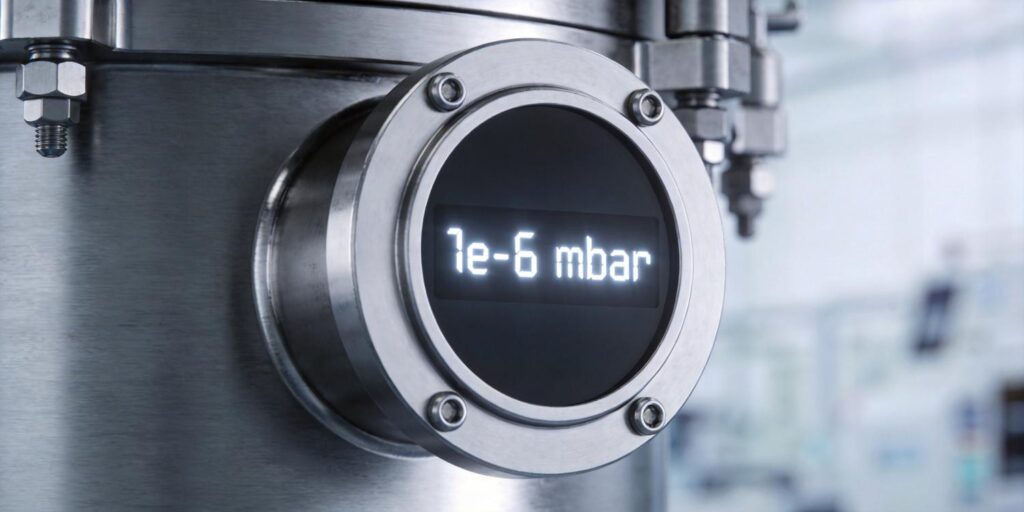
In high-vacuum environments typical of thin-film deposition, surface-science experiments, and analytical instruments, cold-cathode gauges provide robust, filament-free measurement where hot-cathode designs encounter fundamental limits. Poseidon Scientific’s VG-SM225 Cold Cathode Vacuum Gauge is optimized for the 10⁻³ to 10⁻⁷ Torr range (approximately 1.33 × 10⁻³ to 1.33 × 10⁻⁷ mbar), delivering stable 0–10 V analog output and customizable RS232 digital protocol. Paired with the VG-SP205 Pirani Vacuum Transmitter for rough-vacuum monitoring, these instruments enable seamless, low-maintenance control across the full vacuum spectrum demanded by research and production laboratories.
This article examines the physical and engineering constraints that define the lower measurement limits of cold-cathode gauges. By understanding ionization physics, magnetic-field effects, noise floors, and practical calibration realities, engineers and procurement specialists can specify gauges that reliably support process stability and data integrity at the high-vacuum edge.
Definition of High Vacuum Range and Typical mbar Thresholds
High vacuum is conventionally defined as the pressure regime in which the mean free path of gas molecules exceeds the characteristic dimension of the chamber or component. In practical terms this spans roughly 10⁻³ mbar (≈7.5 × 10⁻⁴ Torr) to 10⁻⁷ mbar (≈7.5 × 10⁻⁸ Torr). Below 10⁻³ mbar, gas flow transitions from viscous to molecular, collisions with chamber walls dominate over molecule–molecule interactions, and thermal conductivity drops sharply—rendering Pirani-type gauges ineffective.
The VG-SM225 is rated precisely for this window, with linear ion-current response from 10⁻³ Torr down to 10⁻⁷ Torr. At the upper boundary (≈1.33 × 10⁻³ mbar), protection circuitry automatically disables high voltage to avoid excessive current and electrode sputtering. At the lower boundary, discharge maintenance becomes the limiting factor rather than any hard physical cutoff. These thresholds align with industry standards documented in vacuum metrology references and allow direct compatibility with turbo-pumped analytical systems and coating tools operating in the 10⁻⁴–10⁻⁶ mbar process zone.
Ionization Efficiency at Low Pressure
Ionization efficiency in cold-cathode gauges follows the Penning-discharge principle: electrons emitted by field emission or cosmic-ray events are trapped in crossed electric and magnetic fields, following extended cycloidal or helical trajectories. At high vacuum, molecular density is extremely low (≈3.5 × 10¹⁶ molecules m⁻³ at 10⁻⁷ mbar), so the probability of an electron colliding with a neutral molecule and producing an ion pair drops dramatically.
To compensate, the gauge geometry must maximize electron path length before loss to the anode. Poseidon’s positive-magnetron (“Traditional Penning”) design—featuring a central “工”-shaped cathode surrounded by a cylindrical anode and ≈100 gauss neodymium-boron magnet—confines electrons in tight circular orbits around the cathode column. This geometry yields an effective path length increase of several orders of magnitude compared with unmagnetized systems, sustaining the avalanche necessary for measurable ion current even at 10⁻⁷ mbar. Literature on magnetron gauges confirms that ionization probability scales with the product of magnetic field strength and electron residence time, explaining why cold-cathode instruments outperform hot-cathode types in the molecular-flow regime.
Lower Detection Limits and Signal Stability
The practical lower detection limit of the VG-SM225 is 10⁻⁷ Torr (≈1.33 × 10⁻⁷ mbar), determined by the minimum sustainable discharge current rather than background noise. Below this threshold the ion current falls below the reliable resolution of the internal electrometer (≈10⁻¹² A), and discharge stability degrades. In the linear operating region the ion current remains directly proportional to pressure; deviations appear only near the startup boundary or after prolonged contamination.
Signal stability is enhanced by temperature-compensated electronics and the absence of hot-filament drift. Long-term tests in clean high-vacuum environments show output drift <1 % per 1000 hours. The gauge’s 16-bit internal processing and 0–10 V analog scaling (effective 2–8 V) deliver 0.01 % resolution across the high-vacuum band—more than adequate for most coating uniformity and analytical repeatability requirements. When discharge startup is delayed at ultra-low pressures, the onboard LED and digital status flag alert the controller, preventing erroneous PID action until stable operation is confirmed.
X-ray Limit Considerations
Hot-cathode ionization gauges suffer a fundamental X-ray limit: soft X-rays generated by electron bombardment of the anode liberate photoelectrons at the ion collector, producing a pressure-independent background current that masks true ion current below ≈5 × 10⁻¹⁰ Torr. Cold-cathode gauges eliminate this entirely—no thermionic cathode means no energetic electron bombardment of a grid, and therefore no measurable X-ray photocurrent.
This advantage allows cold-cathode instruments to operate reliably into the 10⁻⁷ mbar range and, with optimized geometries such as inverted-magnetron variants, even lower. The VG-SM225’s positive-magnetron structure trades a slightly narrower range for smaller volume and faster response, yet still avoids the X-ray floor that constrains Bayard-Alpert and similar hot-cathode designs. Comparative studies consistently rank cold-cathode gauges as the preferred choice for high-vacuum applications where X-ray-induced errors would otherwise dominate.
Magnetic Field Influence on Electron Path
The magnetic field is the key enabler of low-pressure operation. At ≈100 gauss, electrons emitted near the cathode are forced into cycloidal orbits with radii on the order of millimeters, greatly increasing collision probability before they reach the anode. Too weak a field (200 gauss) can cause excessive ion bombardment and premature electrode wear.
Poseidon’s neodymium-boron permanent magnet provides a stable, temperature-insensitive field that requires no external power. This design choice keeps the gauge compact (smaller than most commercial cold-cathode units except specialized micro-magnetron variants) while delivering consistent electron trapping across the 15–50 °C operating range. Field orientation in the positive-magnetron geometry also minimizes sensitivity to external stray fields common in electron-microscopy or sputtering chambers. Engineers should note that any significant change in magnet strength—whether from demagnetization or physical damage—directly shifts the current-versus-pressure curve, underscoring the value of periodic visual inspection during maintenance.
Noise Floor and Resolution Discussion
Electronic noise in cold-cathode gauges arises primarily from plasma fluctuations, cable leakage, and electrometer input current. The VG-SM225’s separate feedthrough design for high-voltage anode and ion-current cathode, combined with internal shielding, keeps spurious currents below 10⁻¹³ A—well below the signal level at 10⁻⁷ mbar. The 0–10 V analog output exhibits <10 mV peak-to-peak noise after factory filtering, corresponding to pressure uncertainty of <0.5 % of reading in the mid-range.
Resolution is further improved by logarithmic current-to-voltage conversion inside the transmitter, yielding effective 16-bit performance across decades. For digital users, RS232 output provides pressure values with four significant digits plus status flags, enabling software averaging or Kalman filtering to push effective resolution below 1 × 10⁻⁸ mbar equivalent. In contrast to hot-cathode gauges, where filament emission noise can dominate, the cold-cathode noise floor remains nearly constant with pressure, simplifying control-loop design and data interpretation.
Calibration Methods in High Vacuum
Field calibration of cold-cathode gauges is challenging because the current-versus-pressure relationship depends on electrode surface condition, magnetic-field uniformity, and residual gas composition. Poseidon performs factory calibration against NIST-traceable spinning-rotor or capacitance manometers in dedicated vacuum chambers, establishing the unique voltage-to-pressure map for each unit. The resulting curve is stored internally and reproduced in both analog and digital outputs.
In the laboratory, periodic verification is best accomplished by cross-referencing against a certified reference gauge (e.g., extractor or spinning-rotor) at two or three known pressures within the linear region. Because the VG-SM225 exhibits minimal hysteresis and no X-ray background, single-point checks at 10⁻⁵ mbar often suffice for drift monitoring. Electrode cleaning (detailed in the user manual) restores the original curve without requiring full recalibration. For research applications demanding highest accuracy, custom gas-correction factors can be implemented via the RS232 protocol at order quantities of 5–10 units.
Application Examples in Coating and Research
In PVD and PECVD coating systems the VG-SM225 monitors process-chamber pressure during reactive sputtering or ALD cycles. Its rapid response (<100 ms once discharge is established) and low contamination sensitivity allow closed-loop throttle-valve control that maintains ±2 % pressure stability—directly improving film uniformity and adhesion. The removable sensor design supports quick electrode cleaning between runs involving fluorine or oxygen plasmas, eliminating the downtime associated with filament replacement in hot-cathode alternatives.
Research laboratories benefit similarly. In scanning electron microscopes and mass spectrometers the gauge provides continuous column or analyzer-chamber feedback without introducing outgassing or magnetic interference that could distort electron beams. University core facilities routinely deploy the compact VG-SM225 on multi-user vacuum test stands, where its RJ45 interface and customizable digital protocol integrate directly with LabVIEW or PLC-based data-acquisition systems. Long-term stability in these clean environments routinely exceeds 3–5 years between cleanings, making the instrument ideal for grant-funded or shared-resource installations.
Both Poseidon gauges complement each other in hybrid setups: the VG-SP205 Pirani handles roughing and foreline monitoring while the VG-SM225 takes over at the 10⁻³ Torr crossover, ensuring uninterrupted pressure coverage from atmosphere to high vacuum.
Understanding the physical limits of high-vacuum measurement empowers engineers to select cold-cathode technology with confidence. The VG-SM225 Cold Cathode Vacuum Gauge embodies these principles—compact positive-magnetron geometry, X-ray-free operation, field-serviceable electrodes, and low-noise electronics—delivering reliable performance exactly where it is needed most.
For detailed specifications, installation guidance, and protocol customization options, visit the product pages:
Whether optimizing a production coating line or equipping a research vacuum station, accurate high-vacuum measurement begins with a gauge whose limits are well understood and deliberately engineered to match the application.


