
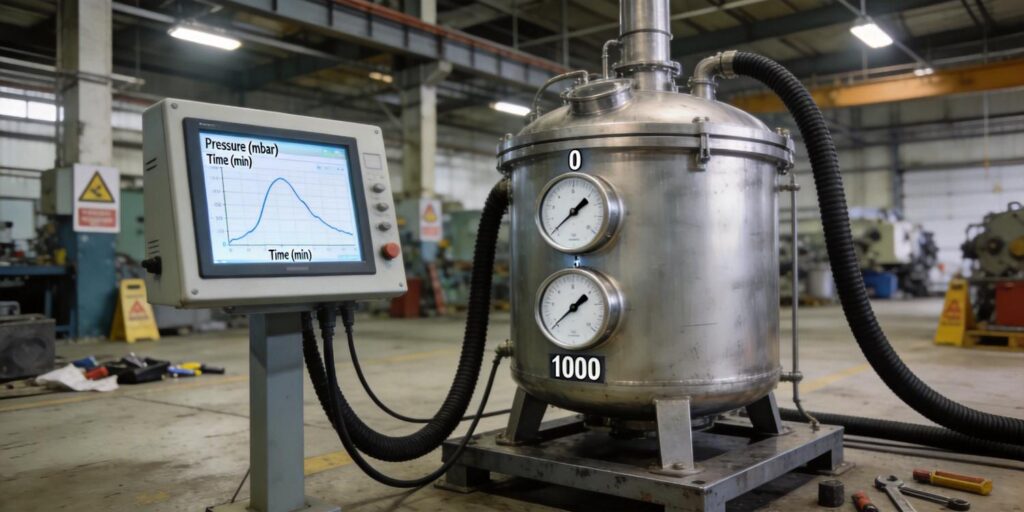
In vacuum systems for thin-film deposition, analytical instrumentation, and industrial heat treatment, pump-down time is a critical performance metric. Every extra minute of evacuation increases energy consumption, reduces throughput, and raises operating costs. Accurate, real-time pressure feedback from properly selected vacuum gauges enables engineers to identify bottlenecks, optimize valve sequences, and achieve smooth regime transitions—often cutting total pump-down time by 20–40 % without hardware upgrades. Poseidon Scientific’s VG-SP205 Pirani Vacuum Transmitter and VG-SM225 Cold Cathode Vacuum Gauge were developed specifically for this purpose: fast-response analog 0–10 V output, customizable RS232 digital protocol, and field-serviceable design that together deliver the reliable data modern control systems demand.
This article explains how precise pressure measurement accelerates pump-down across all phases. Drawing from vacuum metrology fundamentals and practical production data, we provide actionable strategies for process engineers and procurement teams seeking measurable gains in cycle time and system efficiency.
Pump-down Phases Recap
A typical vacuum-system pump-down consists of three overlapping phases:
- Roughing phase (atmosphere to ≈10⁻²–10⁻³ Torr / 1–0.1 Pa): Mechanical or dry roughing pumps remove the bulk gas load. Flow is viscous; pressure drops rapidly.
- Transition phase (10⁻²–10⁻⁴ Torr): Gas flow shifts toward molecular regime. Backing pumps or turbo/cryo pumps engage; conductance and outgassing become dominant.
- High-vacuum phase (10⁻⁴–10⁻⁷ Torr): Molecular flow dominates. Final base pressure is limited by surface outgassing, leaks, and pump speed.
Without accurate feedback, operators often rely on conservative fixed timers—leading to unnecessary hold times or premature transitions that stall progress. Real-time pressure data from the VG-SP205 (Pirani) in the roughing and transition phases and the VG-SM225 (cold cathode) in the high-vacuum phase lets control logic make data-driven decisions, eliminating guesswork.
Identifying Bottlenecks via Pressure Slope
The instantaneous slope of the pressure-versus-time curve (dP/dt) reveals system health more clearly than absolute pressure alone. A healthy roughing phase shows a steep negative slope that flattens predictably as pressure falls. Deviations signal problems:
- Flattening too early → virtual leak, outgassing, or conductance restriction.
- Sudden plateau in the 10⁻³ Torr region → foreline restriction or roughing-pump overload.
- Slow decay below 10⁻⁴ Torr → high-vacuum pump not yet at full speed or residual water vapor.
Both Poseidon gauges output a clean 0–10 V signal (effective 2–8 V range) that feeds directly into PLC or SCADA trend displays. The VG-SP205’s thermal-conductivity response updates within 300 ms in the linear region, while the VG-SM225’s ion-current signal stabilizes in –0.5 decade/min at 10⁻³ Torr triggers a “check conductance” alert), turning the gauge into a diagnostic tool rather than a simple indicator.
Conductance Limitations
Even the fastest pumps cannot overcome poor conductance. Tubing diameter, length, and valve orifice size create pressure drops that delay gauge readings relative to actual chamber pressure. In molecular flow, conductance C scales with the fourth power of tube diameter—doubling diameter can increase speed by 16×.
Place gauges at representative chamber locations (not directly at pump inlets) to capture true process pressure. The compact size of the VG-SP205 and VG-SM225 (smaller than most market equivalents) allows installation on short KF16/KF25 stubs without adding significant dead volume. Their direction-independent mounting further simplifies layout. By monitoring both foreline (Pirani) and chamber (cold cathode) pressures simultaneously, control software can calculate real-time conductance and automatically adjust pump speed or valve position to compensate for restrictions.
Valve Timing Optimization
Manual or timer-based valve sequencing wastes time. With accurate pressure feedback, pneumatic valves can be actuated at precise pressure thresholds rather than fixed delays. Typical optimizations include:
- Close roughing valve and open high-vacuum valve exactly when chamber pressure reaches the crossover point (typically 10⁻²–10⁻³ Torr).
- Delay turbo-pump spin-up until foreline pressure is below 10⁻¹ Torr to protect bearings and reduce power draw.
- Modulate throttle valves proportionally once the cold cathode confirms stable high vacuum.
The VG-SP205’s RS232 digital output (customizable at 5–10 unit minimum orders) provides pressure, status, and error flags directly to the PLC. The VG-SM225 adds a discharge-stable flag that prevents premature high-vacuum valve opening. These signals eliminate the 10–30 s safety margins common in older systems, shaving valuable seconds off every cycle.
Rough-to-High Vacuum Transition Control
The transition at ≈10⁻³ Torr is the most common source of extended pump-down. If the high-vacuum pump engages too early, it operates inefficiently against high gas load; too late, and valuable time is lost. Dual-gauge systems solve this elegantly: the VG-SP205 monitors the roughing phase and signals the PLC at the exact crossover pressure. The VG-SM225 then takes over, confirming discharge establishment before full high-vacuum pumping begins.
Software can implement a smooth hand-off: ramp down roughing-pump speed while ramping up high-vacuum pump speed, guided by continuous pressure slope. Poseidon’s gauges support this with overlapping ranges and monotonic output curves, ensuring no dead band or hysteresis that could confuse the controller.
Role of Pirani During Initial Stage
During the roughing phase the VG-SP205 Pirani Vacuum Transmitter is unmatched. Its platinum filament and thermal-conductivity principle deliver fast, stable readings from atmosphere down to 10⁻³ Torr, with highest linearity in the 10–10⁻² Torr region where most time is spent. Temperature-compensated electronics keep drift <0.5 % across 15–50 °C, and the virtually maintenance-free design (3–5 year life in clean service) eliminates downtime concerns.
Engineers use the Pirani’s rapid response to implement aggressive roughing-pump speed profiles and leak-check routines—detecting a 0.1 Torr/min leak within seconds rather than minutes. Its 0–10 V analog output connects directly to any PLC analog input, while digital RS232 enables integration into recipe-driven automation.
Cold Cathode During Final Stage
Once pressure drops below 10⁻³ Torr, the VG-SM225 Cold Cathode Vacuum Gauge assumes control. Its Penning-discharge ion-current output remains linear and stable down to 10⁻⁷ Torr, with <50 ms response once the discharge is active. The positive-magnetron geometry and removable electrode design ensure quick startup (≈5 min at 10⁻⁶ Torr) and easy field cleaning—critical when reactive gases leave deposits.
During the final high-vacuum phase the cold cathode provides the resolution needed to fine-tune throttle valves and confirm base-pressure targets. Its low-noise electronics and built-in protection circuitry (automatic high-voltage shutoff above 10⁻³ Torr) protect both the gauge and the pump system, preventing damage during unexpected pressure spikes.
Practical Optimization Workflow
Follow this eight-step workflow to systematically reduce pump-down time:
- Baseline measurement: Install VG-SP205 on foreline and VG-SM225 on chamber. Log full pump-down curve for 5–10 cycles.
- Calculate slopes: Identify phases and quantify dP/dt at key points (10 Torr, 10⁻² Torr, 10⁻⁴ Torr).
- Map conductance: Measure pressure differential between gauge and pump inlet; resize tubing if drop exceeds 20 %.
- Program threshold logic: Set valve-actuation setpoints using gauge analog or digital outputs.
- Implement transition automation: Link Pirani crossover signal to cold-cathode activation and pump-speed ramp.
- Validate with trend data: Compare new versus baseline curves; target 20 % reduction in total time.
- Schedule maintenance: Quarterly zero-check for Pirani; annual electrode inspection/cleaning for cold cathode (500-mesh sanding, <15 min).
- Monitor long-term: Use RS232 telemetry to trend startup time and output offset; adjust parameters proactively.
Facilities that complete this workflow routinely achieve 25–35 % faster pump-down while improving process repeatability. Poseidon’s low acquisition cost (40–60 % below imported equivalents) and 5–10 unit protocol customization make the upgrade economically attractive even for single-system retrofits.
Accurate pressure feedback transforms pump-down from a passive waiting period into an actively optimized process. By pairing the VG-SP205 Pirani Vacuum Transmitter for the initial roughing stage with the VG-SM225 Cold Cathode Vacuum Gauge for the final high-vacuum stage, engineers gain the data resolution, response speed, and serviceability required for modern vacuum systems.
Explore the instruments engineered to accelerate your cycles:
- VG-SP205 Pirani Vacuum Transmitter – fast, maintenance-free rough-vacuum feedback
- VG-SM225 Cold Cathode Vacuum Gauge – precise, field-cleanable high-vacuum control
Whether retrofitting an existing tool or designing a new vacuum station, the right gauge pair and control logic deliver shorter pump-down times, lower energy costs, and higher overall equipment effectiveness—turning measurement precision into tangible production gains.


