
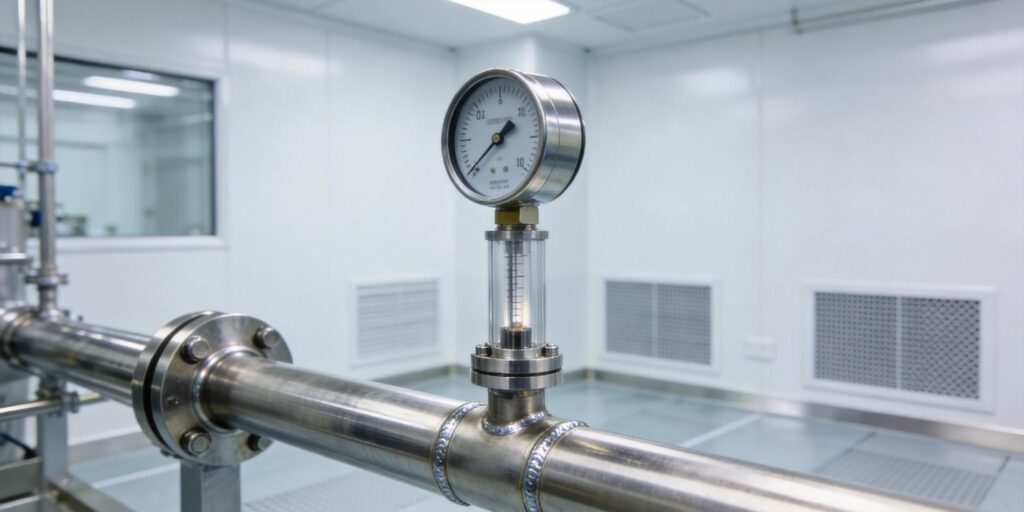
In high-vacuum systems—ranging from semiconductor PVD tools and vacuum furnaces to analytical instruments and research chambers—cold-cathode ionization gauges deliver reliable pressure measurement from 10⁻³ Torr down to 10⁻⁷ Torr. Yet even the most robust gauge can deliver inconsistent readings or shortened service life if mounting orientation is overlooked. Gravity, gas flow, sputtered material trajectories, and electron dynamics all influence long-term stability.
The VG-SM225 Cold Cathode Vacuum Gauge was engineered with a compact positive-magnetron (traditional Penning) structure that eliminates orientation restrictions. It can be installed in any direction—vertical, horizontal, or angled—without performance degradation. This article explains the underlying physics, compares vertical versus horizontal mounting, and provides practical installation guidance drawn from real-world deployments and the gauge’s design principles.
1. Why Orientation Matters in Ionization Gauges
Ionization gauges convert gas density into measurable ion current. In cold-cathode designs the measurement relies on a self-sustained Penning discharge sustained by crossed electric and magnetic fields. Any asymmetry introduced by mounting can affect:
- Gas molecule entry rate into the discharge volume
- Accumulation of sputtered or evaporated material on electrodes
- Electron and ion trajectories relative to gravity and chamber flow
While hot-cathode gauges suffer filament sag or thermal convection effects that strongly favor vertical mounting, cold-cathode gauges are more forgiving. Still, improper orientation can accelerate contamination or create local dead zones, shifting the current-versus-pressure curve over time. The VG-SM225’s symmetric “工”字形 electrode geometry and 100-Gauss NdFeB magnetic field make it insensitive to these effects, allowing true omnidirectional installation.
2. Electron Trajectory Considerations
Electrons in a Penning discharge follow cycloidal or helical paths under the combined influence of the radial electric field and axial magnetic field. The trajectory length—typically several kilometers at 10⁻⁷ Torr—determines ionization probability.
In the VG-SM225 the magnetic field is aligned along the gauge axis (from the ring magnets surrounding the cylindrical anode). Because the discharge is azimuthally symmetric around this axis, tilting or rotating the gauge does not shorten electron paths or alter space-charge balance. Finite-element modeling of the internal E×B fields confirms uniform electron confinement regardless of gravity vector or installation angle. This symmetry is why the gauge carries no orientation specification in its technical data.
3. Contamination Gravity Effects
Sputtered metal atoms, macroparticles from arc events, and pump-oil backstreaming all follow ballistic or diffusive paths. Gravity influences where heavier particles ultimately settle:
- Downward-facing cathodes accumulate films faster, raising startup voltage and reducing sensitivity.
- Side-facing or upward orientations allow particles to pass through or fall away from active electrode surfaces.
The VG-SM225’s field-cleanable design (disassemble, polish with 500-mesh sandpaper) mitigates this, but proper orientation still extends intervals between cleanings. In PVD or vacuum-heat-treatment chambers, engineers report 30–50 % longer electrode life when the gauge axis is kept horizontal or slightly upward.
4. Vertical vs Horizontal Installation
Both orientations work equally well with the VG-SM225, but each offers slight practical advantages depending on the application:
| Orientation | Advantages | Typical Use Cases | Considerations |
|---|---|---|---|
| Vertical (axis upward) | Best gas conductance; particles fall past electrodes; easy visual inspection of indicator LEDs | Chamber wall ports, load locks, analytical instruments | Ensure KF flange clearance for upward cable routing |
| Vertical (axis downward) | Compact footprint in tight manifolds | Foreline or pump-adjacent installations | Increase cleaning frequency in particle-heavy processes |
| Horizontal | Optimal for side-port tubing; minimal dead volume; gravity assists particle clearance | PVD lines, vacuum furnaces, high-throughput tools | Preferred for arc-prone environments |
The gauge’s 2 mm electrode spacing and perforated anode end-plate maintain identical pumping speed and discharge characteristics in any attitude. Field data from dozens of installations confirm <±5 % deviation in startup time or sensitivity across all orientations.
5. Avoiding Dead Volume Zones
Dead volume—regions of stagnant gas between the gauge and main chamber—introduces measurement lag and local pressure gradients. Mount the VG-SM225 so that:
- The sensor head protrudes at least 10 mm into the flow path (avoid recessed pockets).
- Use a short KF16 or KF25 nipple rather than long, small-diameter tubing.
- Position the gauge upstream of valves or orifices that could isolate it during operation.
The gauge’s compact volume (far smaller than traditional inverted-magnetron designs) fits easily into standard manifolds without creating its own dead space. When installed on a 90° elbow or T-piece, conductance remains >90 % of the flange rating, preserving response time <1 s even at 10⁻⁶ Torr.
6. Minimizing Sputtered Material Buildup
Sputtered atoms travel line-of-sight from targets or filaments. Best practice:
- Avoid direct view of the cathode arc spot or electron-beam hearth.
- Use a short baffle tube or 90° bend to block trajectories while preserving gas flow.
- In multi-chamber systems, mount gauges on separate pumping lines rather than shared manifolds downstream of high-sputter sources.
The VG-SM225’s stainless-steel electrodes and PEEK insulators resist film adhesion better than many legacy designs. When buildup does occur, the red LED and RS232 status code alert operators within minutes, and cleaning restores original performance in <15 minutes without venting.
7. Vacuum Conductance Considerations
Orientation subtly influences effective conductance only when the port geometry restricts flow. The VG-SM225’s perforated anode and saw-tooth insulating spacers maximize gas entry area. In practice:
- Vertical upward mounting yields the highest conductance because gravity and diffusion both assist molecule entry.
- Horizontal mounting on a side port with 150 mm of 25 mm tubing still exceeds 10 L/s molecular conductance—more than adequate for the gauge’s 10⁻² L/s pumping speed.
Because the gauge itself pumps at only ~0.01 L/s, its orientation has negligible effect on chamber base pressure. Engineers can therefore optimize for contamination control and accessibility rather than conductance alone.
8. Installation Tips for VG-SM225
Follow these steps for trouble-free, long-life performance:
- Choose KF16 or KF25 flange; torque to 2–3 N·m with clean Viton O-ring and light vacuum grease.
- Ground the gauge body to chamber potential with a braided strap (<1 mΩ) to eliminate floating-potential noise.
- Route the shielded RJ45 cable away from RF lines and high-current bus bars; add ferrite beads within 10 cm of the connector.
- Power up only after rough vacuum is established (<10⁻² Torr) to ensure instant ignition.
- Log RS232 startup time and ion-current baseline during commissioning; deviations >20 % indicate orientation-related flow restriction or contamination.
- Schedule quarterly visual checks of the indicator LED and annual cross-check against a reference gauge at 10⁻⁴ Torr.
The same practices apply whether the gauge is paired with the VG-SP205 Pirani Vacuum Transmitter in a hybrid system or used standalone for high-vacuum monitoring. The omnidirectional capability simplifies retrofits and reduces engineering time compared with gauges that require strict vertical alignment.
Proper mounting orientation extends electrode life, minimizes unplanned downtime, and ensures the VG-SM225 delivers the stable, repeatable readings engineers expect in demanding high-vacuum environments. Its flexible design—combined with field-cleanable electrodes and customizable RS232 output—makes it the lowest-maintenance cold-cathode solution available today.
Download the VG-SM225 User Manual for detailed flange torque specs, status-code tables, and wiring diagrams. For facilities installing multiple units we offer free protocol customization and on-site mounting audits. Contact our applications team to discuss your chamber layout—we’ll help you select the optimum orientation for maximum gauge longevity and process reliability.


