1. Overview of Endocrine Disrupting Compounds in Water
Endocrine disrupting compounds (EDCs) represent a significant environmental concern due to their ability to interfere with hormonal systems at trace concentrations. These compounds include diverse chemical classes such as bisphenols (notably bisphenol A), natural and synthetic hormones (estrogens, androgens), pharmaceuticals, pesticides, and industrial chemicals. According to research, these substances can enter water systems through various pathways including industrial discharge, agricultural runoff, and wastewater treatment plant effluents.
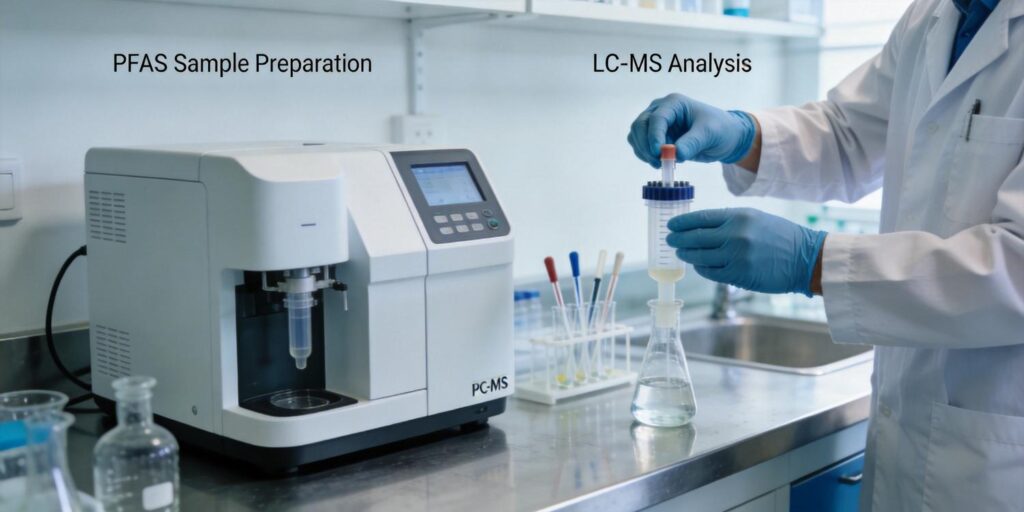
The analytical challenge with EDCs lies in their typically low concentrations (parts-per-trillion to parts-per-billion levels) in environmental waters, requiring sophisticated sample preparation and detection methods. As noted in environmental monitoring literature, SPE combined with LC-MS/MS has become the gold standard for EDC analysis due to its ability to concentrate analytes while removing matrix interferences.
2. Collection and Preservation of Environmental Water Samples
Proper sample collection and preservation are critical first steps in EDC analysis. Environmental water samples should be collected in pre-cleaned glass containers to minimize contamination from plasticizers. For surface water sampling, grab samples or composite samples may be collected depending on the monitoring objectives.
Immediate preservation is essential to prevent degradation of target analytes. Samples should be acidified to pH 2-3 using hydrochloric or sulfuric acid to stabilize acidic compounds and prevent microbial degradation. For comprehensive EDC analysis, samples should be stored at 4°C and processed within 24-48 hours, though some protocols recommend immediate extraction or freezing at -20°C for longer storage.
3. Pre-filtration to Remove Suspended Particles
Environmental water samples often contain suspended particles that can clog SPE cartridges and interfere with analysis. Pre-filtration through glass fiber filters (0.7 μm followed by 0.45 μm) effectively removes particulate matter while minimizing analyte loss. Research by Durand and Barcelo (1993) demonstrated the importance of step-wise filtration for seawater analysis of pesticides.
For particularly challenging matrices like wastewater or sediment extracts, additional filtration aids such as diatomaceous earth (Hydromatrix) or centrifugation may be employed. It’s crucial to consider that some EDCs may be bound to particulate matter, so the filtration step should be optimized based on whether total or dissolved concentrations are being measured.
4. Selection of HLB SPE Cartridges for Broad Analyte Retention
Why HLB Cartridges Excel for EDC Analysis
Hydrophilic-Lipophilic Balance (HLB) cartridges, such as those offered by Poseidon Scientific, provide optimal performance for EDC analysis due to their unique polymeric structure. Unlike traditional silica-based C18 cartridges, HLB sorbents maintain retention across a wide pH range (pH 1-14) and exhibit superior water wettability, eliminating the need for drying between conditioning steps.
The Oasis HLB technology, referenced in Waters documentation, demonstrates how polymeric sorbents with balanced hydrophilic and lipophilic properties can retain both polar and non-polar compounds simultaneously. This makes HLB cartridges ideal for the diverse chemical properties of EDCs, which range from highly polar hormones to moderately hydrophobic bisphenols.
Cartridge Format Selection
For environmental water analysis, 200-500 mg sorbent mass in 6 cc or 12 cc cartridge formats provides adequate capacity for large-volume samples. Glass cartridges with Teflon frits are particularly suitable for trace-level analysis at parts-per-trillion levels, as they minimize background contamination from cartridge materials.
5. Conditioning Cartridges with Methanol and Water
Proper conditioning is essential for optimal SPE performance. The standard conditioning protocol involves:
- Pass 5-10 mL of methanol through the cartridge to wet the sorbent and remove any manufacturing residues
- Follow with 5-10 mL of deionized water or acidified water (pH 2-3) to create an aqueous environment for sample loading
It’s critical to prevent the sorbent from drying between conditioning and sample loading, as this can create channels in the sorbent bed and reduce recovery. The conditioning solvents should be allowed to flow through the cartridge by gravity or gentle vacuum, maintaining a flow rate of approximately 1-3 drops per second.
6. Loading Large-Volume Water Samples (200–500 mL)
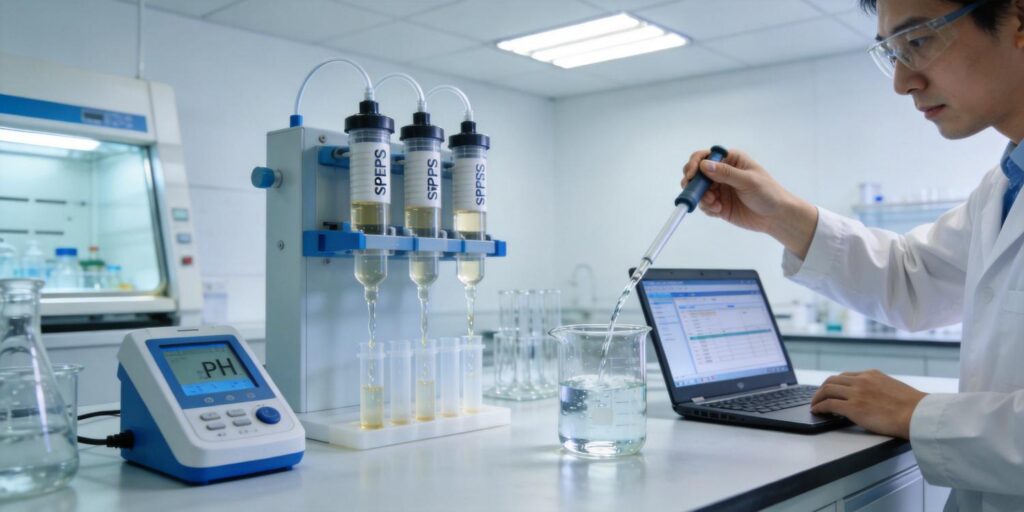
Large sample volumes are necessary to achieve adequate detection limits for EDCs at environmental concentrations. Sample loading should be performed at controlled flow rates (typically 5-10 mL/min) to ensure efficient analyte retention. For 200-500 mL samples, this may require 20-60 minutes of loading time.
Research indicates that maintaining consistent flow rates is crucial for reproducible recoveries. Automated SPE systems or vacuum manifolds with flow control valves can help maintain optimal loading conditions. The sample pH should be adjusted to match the conditioning solvent pH (typically pH 2-3) to ensure proper retention of acidic and neutral compounds.
7. Washing with Aqueous Solvent to Remove Salts
After sample loading, a washing step removes matrix interferences while retaining target analytes. For EDC analysis in water samples, a 5-10 mL wash with acidified water (pH 2-3) or 5-10% methanol in water effectively removes inorganic salts and highly polar matrix components.
As noted in SPE literature, the wash solvent should be sufficiently strong to remove interferences but not so strong as to elute target compounds. For HLB cartridges, aqueous washes with up to 10% organic modifier typically provide adequate cleanup without significant analyte loss.
8. Elution Using Methanol or Acetonitrile
Optimizing Elution Conditions
Elution solvent selection depends on the specific EDC targets and subsequent analytical method. Common elution protocols include:
- 2 × 5 mL of methanol for general EDC analysis
- 2 × 5 mL of acetonitrile for improved elution of more polar compounds
- Mixed solvents (e.g., 80:20 methanol:acetonitrile) for comprehensive coverage
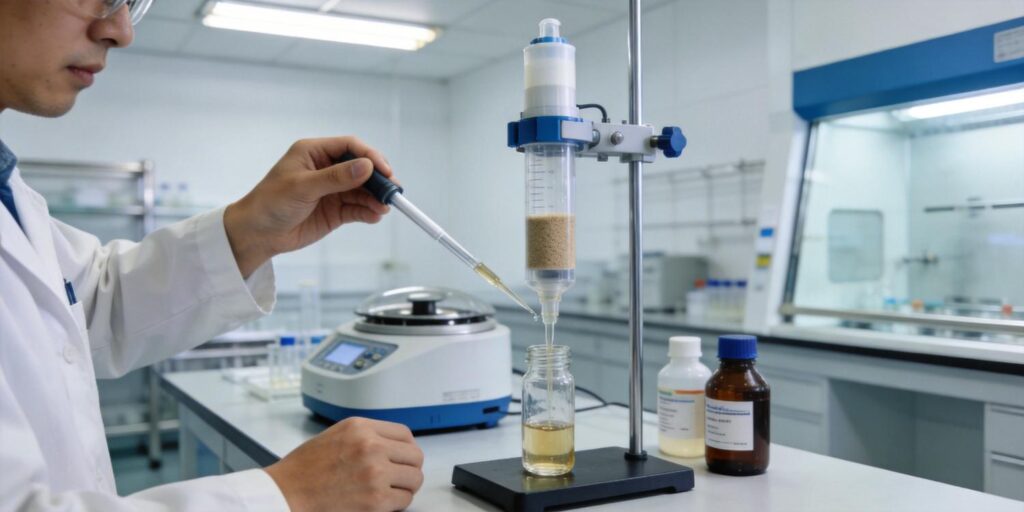
Elution should be performed slowly (1-2 mL/min) to ensure complete analyte recovery. The eluate is typically collected in a clean glass tube and may be evaporated to dryness under gentle nitrogen stream at 30-40°C, then reconstituted in a smaller volume (100-500 μL) of initial mobile phase for LC-MS analysis.
Minimizing Matrix Effects
To reduce matrix effects in LC-MS/MS, some protocols include a second cleanup step using additional SPE cartridges or incorporate internal standards that co-elute with target analytes to correct for ionization suppression.
9. LC-MS/MS Detection of Endocrine Disruptors
Chromatographic Separation
Reverse-phase chromatography using C18 or equivalent columns (e.g., ACQUITY UPLC BEH C18, 1.7 μm, 2.1 × 100 mm) provides excellent separation for EDCs. Gradient elution with water/methanol or water/acetonitrile mobile phases containing 0.1% formic acid or ammonium acetate facilitates ionization in both positive and negative modes.
Mass Spectrometric Detection
Triple quadrupole mass spectrometers operating in multiple reaction monitoring (MRM) mode offer the sensitivity and selectivity required for EDC analysis at trace levels. Typical instrument parameters include:
- Electrospray ionization (ESI) in positive or negative mode
- Capillary voltage: 1-3 kV
- Desolvation temperature: 400-500°C
- Collision gas: Argon at 3.5 mBar
Method Validation and Quality Control
Comprehensive EDC methods should include method validation with parameters such as linearity (r² > 0.99), recovery (70-120%), precision (RSD < 15%), and limits of detection/quantification. Quality control samples (blanks, spikes, duplicates) should be processed with each batch to monitor method performance.
As demonstrated in environmental monitoring applications, the combination of optimized SPE sample preparation with sensitive LC-MS/MS detection enables reliable quantification of EDCs at environmentally relevant concentrations, supporting water quality assessment and regulatory compliance monitoring.
Additional Resources
For laboratories seeking to implement or optimize EDC analysis methods, Poseidon Scientific offers comprehensive HLB SPE cartridges and related products. Our technical support team can provide guidance on method development and troubleshooting for specific applications.
Related products that may complement your EDC analysis workflow include our MCX cartridges for basic compounds and 96-well SPE plates for high-throughput applications.