
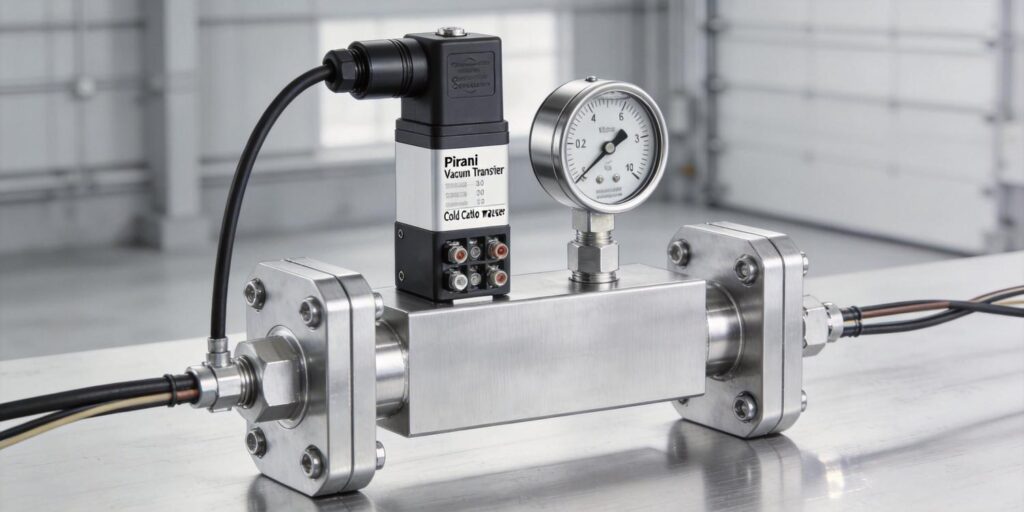
In hybrid vacuum systems—common in mass spectrometers, scanning electron microscopes, vacuum furnaces, and research coating chambers—engineers must monitor pressure continuously from atmosphere down to 10⁻⁷ Torr. A single gauge type cannot cover the entire range with acceptable accuracy and response time. The VG-SP205 Pirani Vacuum Transmitter excels from atmosphere to 10⁻³ Torr, while the VG-SM225 Cold Cathode Vacuum Gauge takes over from 10⁻³ to 10⁻⁷ Torr. Together they deliver seamless, full-range coverage at a fraction of the cost of imported solutions.
This article compares the two technologies side-by-side, explains why hybrid configurations dominate modern vacuum systems, and shows how the Poseidon pair optimizes performance, maintenance, and total cost of ownership. Data draws from field installations, product manuals, and fundamental vacuum metrology principles.
1. Why Hybrid Systems Use Two Gauge Technologies
Vacuum measurement spans six orders of magnitude. Thermal-conductivity gauges like the Pirani respond quickly and accurately near atmosphere but lose sensitivity below 10⁻³ Torr as gas molecules become too sparse for effective heat transfer. Ionization gauges, conversely, require a minimum gas density to sustain a discharge and are inaccurate or unstable above 10⁻³ Torr due to excessive collisions and contamination.
Hybrid systems therefore pair a rough-vacuum sensor (Pirani) with a high-vacuum sensor (cold cathode). The combination avoids the limitations of either technology alone: the Pirani provides fast roughing monitoring and protects the cold cathode from high-pressure operation, while the cold cathode delivers the resolution needed for UHV processes. In mass spectrometry and SEM applications, this dual-sensor approach has become standard because it enables safe pump-down sequences and real-time process control across the full vacuum spectrum.
2. Pressure Range Overlap Explanation
The two gauges overlap at the critical transition zone around 10⁻³ Torr (≈0.13 Pa). This is intentional and advantageous:
- VG-SP205 Pirani: Atmosphere to 10⁻³ Torr nominal, with highest linearity and accuracy between 10 Torr and 10⁻² Torr.
- VG-SM225 Cold Cathode: 10⁻³ Torr to 10⁻⁷ Torr, with software protection that automatically disables high voltage above 10⁻³ Torr.
The overlap allows the control system to cross-check readings during transition. At 10⁻³ Torr the Pirani still provides reliable data while the cold cathode begins its Penning discharge. Any discrepancy flags a potential contamination or calibration issue. Because both gauges are calibrated in nitrogen-equivalent units, the overlap region serves as a natural hand-off point without requiring complex gas-correction factors in most air or N₂ applications.
3. Switching Logic Between Rough and High Vacuum
Modern controllers use simple, robust logic to switch between gauges and protect hardware:
- During pump-down, the system relies exclusively on the Pirani until pressure drops below 5 × 10⁻³ Torr.
- At the threshold, the controller enables the cold cathode’s –2500 V startup voltage for ≤30 s.
- Once the cold cathode reports stable operation (ion current within expected range), the system switches primary control to the VG-SM225 and disables high-voltage if pressure rises again.
- The Pirani remains active for continuous cross-validation and over-pressure protection.
The VG-SM225’s built-in software already implements the high-pressure shutdown (>10⁻³ Torr), eliminating the risk of electrode sputtering. RS232 status codes from both gauges feed directly into PLC or LabVIEW logic, making integration straightforward. This approach prevents cold-cathode damage during roughing and ensures the system never operates “blind” during transition.
4. Signal Output Comparison (Analog vs Digital)
Both Poseidon gauges support the industry-standard 0–10 V analog output (usable 2–8 V) and customizable RS232 digital communication. Key differences:
| Feature | VG-SP205 Pirani | VG-SM225 Cold Cathode |
|---|---|---|
| Analog Output | Non-linear full range; linear in 10–10⁻² Torr | Logarithmic; effective 10⁻³–10⁻⁷ Torr |
| Digital Output | RS232 with pressure, status, error codes | RS232 with pressure, HV status, startup timer |
| Protocol | Factory default or custom (5–10 units) | Factory default or custom (5–10 units) |
| Noise Immunity | Good with RC filter | Excellent; digital preferred for arc-prone systems |
Digital RS232 is recommended for hybrid systems because it carries full-resolution data, status flags, and error codes without analog scaling errors. The customizable protocol allows both gauges to share the same communication bus, simplifying cabling and SCADA integration. Analog outputs remain useful for legacy PLCs or quick oscilloscope checks.
5. Long-Term Maintenance Differences
Maintenance is where the two technologies diverge most dramatically:
- Pirani VG-SP205: Truly maintenance-free. Platinum filament is sealed; lifetime 3–5 years depends on vacuum quality and gas environment. Failure mode is filament burnout—detected instantly via status code and resolved by swapping the entire transmitter.
- Cold Cathode VG-SM225: Field-cleanable. Stainless-steel electrodes accumulate carbon or oxide films in contaminated environments. Disassembly takes <15 minutes (no vacuum break required), followed by light polishing with 500-mesh sandpaper until metallic shine returns. Typical life: 3–5 years clean, 1–2 years in aggressive processes.
In hybrid setups the Pirani rarely needs attention, while the cold cathode benefits from scheduled quarterly inspections in high-throughput labs. The net result: far lower labor hours than hot-cathode or imported cold-cathode gauges that require full system venting for service.
6. Cost of Ownership Comparison
Five-year TCO for a typical research lab running 10 hybrid pairs:
| Item | Imported Pair (INFICON/MKS) | Poseidon VG-SP205 + VG-SM225 |
|---|---|---|
| Initial acquisition (10 pairs) | $80,000–$100,000 | $30,000–$35,000 |
| Spare transmitters/heads | $12,000 | $4,000 |
| Labor (cleaning & calibration) | $18,000 | $6,000 |
| Downtime cost (est.) | $25,000 | $8,000 |
| Total 5-year TCO | $135,000–$155,000 | $48,000–$53,000 |
The Poseidon combination delivers 60–65 % lower TCO through lower purchase price, minimal maintenance, and rapid field repair. Custom protocol support further reduces integration engineering costs.
7. Typical Integration in Research Labs
In university and corporate R&D labs the hybrid pair is usually installed as follows:
- Pirani on the roughing line or foreline (KF25 flange) for pump-down monitoring.
- Cold cathode on a side port or chamber wall (KF16) for high-vacuum process control.
- Both gauges wired to the same RS232-to-Ethernet gateway feeding LabVIEW, EPICS, or custom Python scripts.
- Cross-check logic in software: if the two readings differ >20 % at 10⁻³ Torr, trigger an alarm for possible contamination.
This configuration is standard in mass spectrometers (pre-stage + analysis chamber) and SEMs, where the VG-SP205 protects the turbopump and the VG-SM225 ensures UHV conditions before electron-beam operation. The compact size of both units fits easily into space-constrained benchtop instruments.
8. Optimizing VG-SP205 + VG-SM225 Combination
To extract maximum performance from the Poseidon hybrid pair:
- Request custom RS232 protocol during ordering (same baud rate, unified data frame for both gauges).
- Implement 10-point moving-average digital filtering for the cold cathode during arc-prone processes.
- Schedule automated monthly health checks via RS232 status codes; flag cold-cathode startup time >10 min for cleaning.
- Use the Pirani’s fast response to trigger safe interlocks (e.g., close gate valve if pressure >10⁻² Torr).
- Store one spare VG-SP205 and one spare VG-SM225 sensor head per 10 installed units—keeps MTTR under 30 minutes.
With these practices, labs routinely achieve <±10 % accuracy across the full range, zero unplanned downtime from gauge failure, and calibration intervals extended to 12 months.
The VG-SP205 and VG-SM225 were purpose-built as a matched pair: low-cost, compact, customizable, and engineered for exactly the hybrid vacuum systems that power today’s research and industrial processes. Their complementary strengths—maintenance-free roughing plus cleanable high-vacuum measurement—deliver the reliability engineers demand at a price point that fits every budget.
Ready to upgrade your hybrid vacuum monitoring? Download the VG-SP205 User Manual and VG-SM225 User Manual for detailed wiring diagrams and protocol examples. Or contact our applications team for a free system audit and customized RS232 protocol file. Let Poseidon help you build the most cost-effective, reliable hybrid vacuum system in your lab.


