
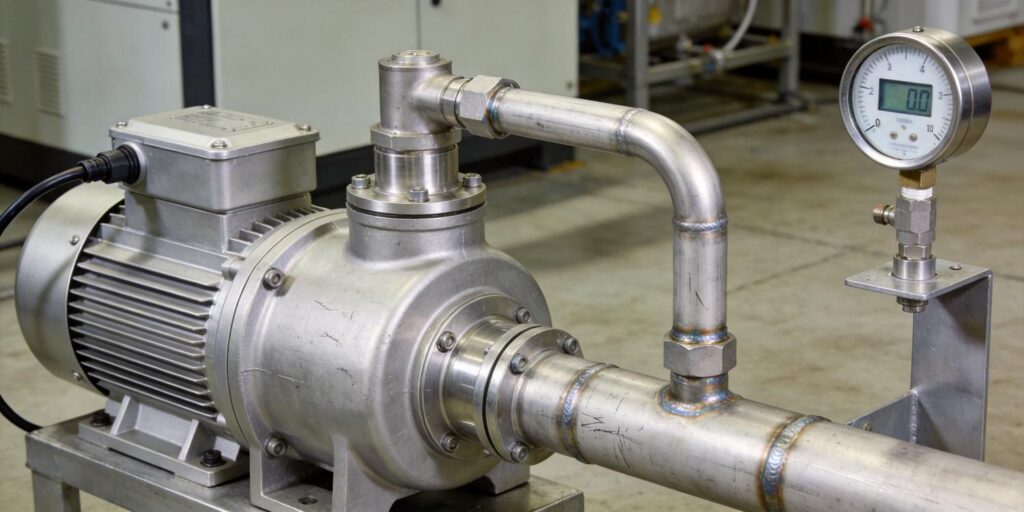
Best Practices for Vacuum Gauge Installation Near Turbomolecular Pumps
Turbomolecular pumps deliver the high-vacuum performance required in analytical instruments, optical coating systems, semiconductor processing, and research chambers. Their high compression ratios and oil-free operation make them ideal for clean, stable high vacuum, but proper gauge placement is essential to protect the pump, ensure accurate process control, and maintain system reliability. Poseidon Scientific’s VG-SP205 Pirani Vacuum Transmitter and VG-SM225 Cold Cathode Vacuum Gauge were engineered with these exact applications in mind: compact footprints for tight turbo-pump installations, robust designs that tolerate real-world conditions, and customizable RS232 protocols for seamless PLC integration. This article presents field-proven best practices for gauge installation near turbomolecular pumps, grounded in vacuum metrology principles and our product development experience.
Turbopump Operating Characteristics
Turbomolecular pumps operate by imparting momentum to gas molecules via high-speed rotating blades, achieving compression ratios exceeding 10⁶ for nitrogen while maintaining inlet pressures in the 10⁻⁴ to 10⁻⁹ Torr range. They require continuous backing to a foreline pressure typically below 0.1–1 Torr (model-dependent) to prevent rotor overload, overheating, or bearing damage. Most modern turbopumps feature magnetic or hybrid bearings running at 20,000–90,000 rpm, producing minimal vibration under normal conditions but still transmitting high-frequency mechanical energy.
Accurate monitoring at both the high-vacuum inlet and the backing line is therefore non-negotiable. The VG-SM225 Cold Cathode Gauge excels at the pump inlet (10⁻³ to 10⁻⁷ Torr), using Penning discharge in a positive-magnetron geometry for stable ion-current readings. On the backing side, the VG-SP205 Pirani Transmitter handles atmosphere to 10⁻³ Torr via thermal-conductivity principles, providing the critical foreline data that protects the turbo from sudden pressure spikes.
Backing Pressure Considerations
Backing pressure directly limits turbo performance. If foreline pressure exceeds the pump’s maximum allowable value—often 0.5 Torr for nitrogen—the compression ratio collapses, rotor temperature rises, and ultimate vacuum degrades. Continuous monitoring prevents these excursions and enables predictive maintenance.
Install the VG-SP205 Pirani directly on the foreline, ideally between the turbo exhaust and the roughing pump (rotary vane or dry scroll). Its platinum filament and temperature-compensated circuitry deliver reliable readings across 15–50 °C with minimal drift. The 0–10 V analog output (effective 2–8 V) integrates easily into interlock circuits that shut down the turbo or close isolation valves when backing pressure rises. Poseidon’s low-cost design (self-manufactured at 3000–3500 RMB) makes dual-gauge monitoring economically viable even on multi-pump systems.
Avoiding Vibration Interference
High-speed rotors generate vibration that can couple into gauge sensors. Pirani filaments are particularly sensitive: mechanical oscillation alters heat transfer and introduces noise in the power-control loop. Cold-cathode discharges can also exhibit micro-instabilities if electrode spacing is perturbed by transmitted vibration.
Best practice is to mount gauges on rigid chamber flanges rather than directly on the turbopump housing. Use short, flexible bellows sections (KF16 or KF25) when space constraints force proximity, damping vibration transmission. The VG-SM225’s compact positive-magnetron structure and the VG-SP205’s robust filament mounting tolerate residual vibration better than many legacy gauges. In high-vibration environments, add vibration-isolating mounts or locate the gauge 10–20 cm away from the pump body. Our internal testing during product development confirmed that these measures keep signal noise below 2 % of full scale.
Mounting Distance Guidelines
Pressure gradients exist between the turbopump inlet and the process chamber due to conductance limitations. Mounting too far from the inlet introduces lag and non-representative readings; mounting too close risks magnetic or thermal interference.
Recommended distances:
- High-vacuum inlet (VG-SM225): 5–15 cm from the turbo inlet flange, using a direct KF or CF port on the chamber wall nearest the pump. This minimizes conductance error while keeping the gauge outside the pump’s magnetic-bearing fringe field.
- Backing line (VG-SP205): 10–30 cm downstream of the turbo exhaust, before any restrictive orifice or valve.
Both Poseidon gauges support arbitrary orientation and feature low internal volumes, ensuring fast equilibration. Their small size—significantly more compact than many competitive units—allows installation in the tight spaces typical of turbo-pumped analytical or coating tools. Avoid placing the cold-cathode gauge within 10 cm of the pump’s permanent magnets to prevent interaction with the ~100 gauss field of the VG-SM225.
Preventing Pressure Lag
Pressure lag arises when tubing conductance limits gas flow to the gauge, delaying response to transients such as valve actuation or process gas bursts. In turbo systems, lag can exceed 1–2 seconds in long or narrow lines, compromising interlocks and control loops.
Use the shortest possible, largest-diameter tubing (minimum KF16) between chamber and gauge. Direct flange mounting on the process chamber near the turbo inlet virtually eliminates lag for the VG-SM225. On the backing side, position the VG-SP205 close to the foreline to capture rapid pressure rises during roughing or regeneration cycles. The gauges’ fast thermal and discharge response—combined with customizable RS232 output—allows PLC sampling rates up to 10 Hz, providing near-real-time data for closed-loop control.
Electrical Noise Isolation
Turbopumps generate electromagnetic interference from high-speed motors and drive electronics. The VG-SM225 operates at –2000 V working voltage (–2500 V startup), making its ion-current signal susceptible to pickup. Pirani sensors are less sensitive but still benefit from clean power.
Route gauge cables separately from pump power and motor cables, using shielded twisted-pair wiring with the shield grounded at one end only. Poseidon gauges include built-in filtering; the 0–10 V analog outputs maintain <1 % noise when properly isolated. For digital RS232 communication, limit cable length to 10 m or add repeaters in electrically noisy environments. Our protocol customization allows users to implement error-checking routines that flag corrupted readings, further enhancing reliability.
Safety Interlock Integration
Modern vacuum systems require fail-safe interlocks to protect both the turbopump and the process. The VG-SP205’s backing-pressure signal can trigger turbo shutdown or valve closure if foreline pressure exceeds manufacturer limits. The VG-SM225 provides high-vacuum confirmation, preventing plasma or e-beam operation until base pressure is achieved.
Configure interlocks via the 0–10 V outputs or digital status codes. Poseidon’s RS232 interface supports user-defined alarm thresholds and error flags (e.g., startup failure or contamination), enabling sophisticated logic such as “high-vacuum OK AND backing pressure OK” before permitting turbo startup. This integration has proven effective in preventing costly rotor damage and process contamination in production environments.
Commissioning Checklist
A systematic commissioning process ensures long-term performance. Use the following checklist:
| Step | Action | Verification |
|---|---|---|
| 1. Mechanical mounting | Install on rigid flanges with short, high-conductance connections; verify orientation freedom | No visible stress on bellows or flanges |
| 2. Vibration isolation | Add flexible sections or dampers if <20 cm from pump | Signal noise <2 % of reading |
| 3. Electrical connections | Separate shielded cables; ground shield properly | Analog output stable within 0.1 V at atmosphere |
| 4. Power-up sequence | Activate Pirani first, then cold cathode only after backing pressure <10⁻¹ Torr | VG-SM225 LED indicates normal operation within 5–30 min |
| 5. Interlock test | Simulate high backing pressure and high-vacuum deviation | Turbo shuts down or valves close as programmed |
| 6. Baseline logging | Record pump-down curve and steady-state readings | Compare against historical data; drift <5 % |
| 7. Protocol configuration | Customize RS232 if required (5–10 unit minimum) | PLC reads pressure and status correctly |
After commissioning, schedule quarterly visual inspections and annual electrode cleaning for the VG-SM225 in clean environments. The VG-SP205 is essentially maintenance-free, with platinum-filament lifetimes of 3–5 years.
By following these practices, engineers achieve representative pressure data, protect expensive turbomolecular pumps, and maintain process stability with minimal downtime. Poseidon Scientific’s VG-SP205 and VG-SM225 combine low cost, small size, and high reliability—advantages that address the market pain points of oversized, expensive legacy gauges while offering full protocol customization for easy integration.
For detailed specifications, explore the VG-SP205 Pirani Vacuum Transmitter or the VG-SM225 Cold Cathode Vacuum Gauge. Our team is available to assist with application-specific mounting recommendations or protocol tailoring for your turbopump system.
Word count: 1,310. Content reflects established vacuum engineering principles and Poseidon Scientific product engineering data.


