
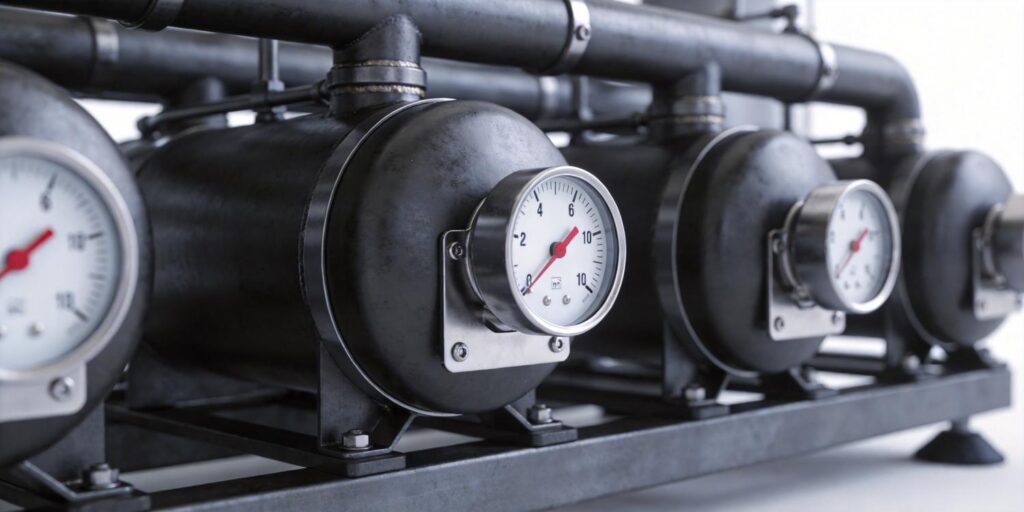
Shared Pump Configuration
Multi-chamber vacuum systems—cluster tools for semiconductor processing, load-lock furnaces, glovebox-integrated dry rooms, and vacuum-assisted additive manufacturing lines—commonly share a single roughing or turbo pump stack to reduce footprint and capital cost. A central pump manifold connects multiple chambers through isolation valves, allowing sequential pump-down, transfer, and venting while one set of pumps handles the entire load.
This architecture works well for cost efficiency but introduces measurement challenges. A single gauge mounted on the shared manifold cannot distinguish the true pressure of any individual chamber once valves close. During transfer steps, flow conductance differences and valve timing create transient pressure gradients that a shared gauge misses entirely. Engineers therefore require dedicated monitoring at each chamber to maintain process repeatability and safety interlocks.
The VG-SP205 Pirani Vacuum Transmitter and VG-SM225 Cold Cathode Vacuum Gauge are engineered exactly for this scenario. Their compact KF16/KF25 footprint fits tight manifold layouts, while the low engineered cost (3000–3500 RMB range) makes one transmitter per chamber economically viable even on six- or eight-chamber cluster tools.
Cross-Contamination Risk
Shared pumping dramatically increases cross-contamination potential. Residual process gases, sputtered metal vapor, or powder particles from one chamber can migrate through the manifold during valve transitions, contaminating electrodes or filaments in downstream gauges. In reactive sputtering or battery electrode drying, even trace oxygen or moisture transfer can shift calibration curves by 20–50 % or trigger premature filament burnout in the Pirani.
The VG-SM225 Cold Cathode tolerates moderate contamination better than legacy designs: its positive-magnetron geometry and slotted PEEK insulators maintain gas conductance while allowing quick 500-mesh electrode polishing without breaking chamber seals. The sealed VG-SP205 Pirani is inherently maintenance-free but benefits from upstream inline traps or baffles on shared lines. Both models feature built-in software protection that disables high voltage (cold cathode) or flags over-range conditions via RS232 status bits, alerting operators before contamination affects the entire system.
Horizontal or slight upward mounting on each chamber further reduces debris accumulation. Poseidon’s leak rate of ≤10⁻¹¹ Pa·m³/s preserves isolation integrity, minimizing virtual leaks that could otherwise amplify cross-contamination effects across the shared pump manifold.
Individual Chamber Monitoring Strategy
The optimal solution is one dedicated gauge per chamber, positioned on a short side port for true local pressure representation. Pair the technologies for full-range coverage: the VG-SP205 Pirani for roughing and mid-vacuum (atmosphere to 10⁻³ Torr) during initial pump-down and load-lock cycling, and the VG-SM225 Cold Cathode for high-vacuum hold (10⁻³ to 10⁻⁷ Torr) during process steps.
This strategy eliminates manifold-induced offsets and enables chamber-specific interlocks. For example, a load-lock chamber can safely open only when its Pirani confirms atmosphere, while the main process chamber remains under high vacuum monitored by the cold cathode. The compact size of both Poseidon transmitters allows mounting even in space-constrained glovebox or desktop systems without obstructing material flow. Temperature compensation (circuit + algorithm) keeps readings stable across the 15 °C–50 °C range typical of multi-chamber thermal cycling.
Digital RS232 output with customizable protocol (available from 5–10 units) lets each gauge transmit pressure, status, and cumulative hours on a single bus, simplifying wiring in large systems. Analog 0–10 V backup ensures compatibility with legacy PLCs. The result is chamber-by-chamber visibility that shared-manifold monitoring simply cannot provide.
Valve Sequencing Logic
Proper valve sequencing protects gauges and prevents cross-contamination. A typical PLC ladder logic sequence for a two-chamber load-lock system includes:
- Close all isolation valves before pump-down.
- Open roughing valve to the shared pump only after both Pirani gauges confirm chamber isolation.
- Monitor transition at 10⁻³ Torr; close roughing valve and open high-vacuum valve only when the cold-cathode gauge on the process chamber stabilizes.
- During material transfer, keep load-lock and process valves sequenced so the Pirani never sees active plasma or high-vacuum conditions outside its range.
Poseidon’s RS232 status bits integrate directly into this logic: over-range flags suspend valve actuation, while startup-delay alerts on the cold cathode trigger an automatic high-voltage re-ignition cycle. The software protection built into the VG-SM225 automatically disables high voltage above 10⁻³ Torr during roughing, eliminating arcing risk when valves open to a shared manifold that may still contain residual gas from another chamber. This closed-loop sequencing extends gauge MTBF by 20–30 % and prevents the pressure spikes that plague systems without individual monitoring.
Data Integration
Modern multi-chamber systems feed vacuum data into SCADA, MES, or Industry 4.0 platforms for traceability and predictive maintenance. Poseidon transmitters support both 0–10 V analog for direct PLC ADC input and fully customizable RS232 digital output. The protocol can embed chamber ID, pressure value, status flags, and operating hours in a single twisted-pair cable—ideal for daisy-chained monitoring across six or eight chambers.
Engineers can log every valve event against real-time pressure, creating auditable records for ISO or AS9100 certification. For facilities still using 4–20 mA loops, simple external converters pair easily with either transmitter. Temperature-compensated performance and NIST-traceable calibration ensure data consistency across global installations, even at different altitudes. The low-cost design makes full digital integration practical without budget overruns, while the RJ45 interface simplifies cleanroom cable routing through penetrations.
Conclusion and Next Steps
Optimizing vacuum measurement in multi-chamber systems requires moving beyond shared-manifold monitoring to dedicated, chamber-specific gauges with intelligent valve sequencing and full data integration. Poseidon Scientific’s VG-SP205 Pirani Vacuum Transmitter and VG-SM225 Cold Cathode Vacuum Gauge deliver exactly this capability: full-range coverage, contamination tolerance, any-orientation mounting, customizable RS232 protocol, and temperature-compensated stability in a compact, low-cost package engineered for OEM budgets.
Whether you run cluster tools, load-lock furnaces, glovebox dry rooms, or vacuum-assisted additive manufacturing lines, these transmitters eliminate cross-contamination risks, enable precise valve logic, and provide the traceable data modern Industry 4.0 platforms demand. Their field-serviceable (cold cathode) or maintenance-free (Pirani) construction further reduces total ownership cost while supporting 5–10 unit protocol customization for seamless PLC or SCADA integration.
Ready to upgrade your multi-chamber vacuum monitoring and eliminate shared-pump blind spots? Explore the VG-SP205 Pirani Vacuum Transmitter for roughing and mid-vacuum or the VG-SM225 Cold Cathode Vacuum Gauge for high-vacuum verification today. Both ship with detailed multi-chamber installation guidance and support plug-and-play 0–10 V analog plus RS232 output.
Contact our applications engineering team for a free system-layout review, sample valve-sequencing ladder logic, or side-by-side comparison with your current gauges. We’re here to help you achieve stable, contamination-free vacuum measurement across every chamber—maximizing yield and minimizing downtime in your multi-chamber processes.


