
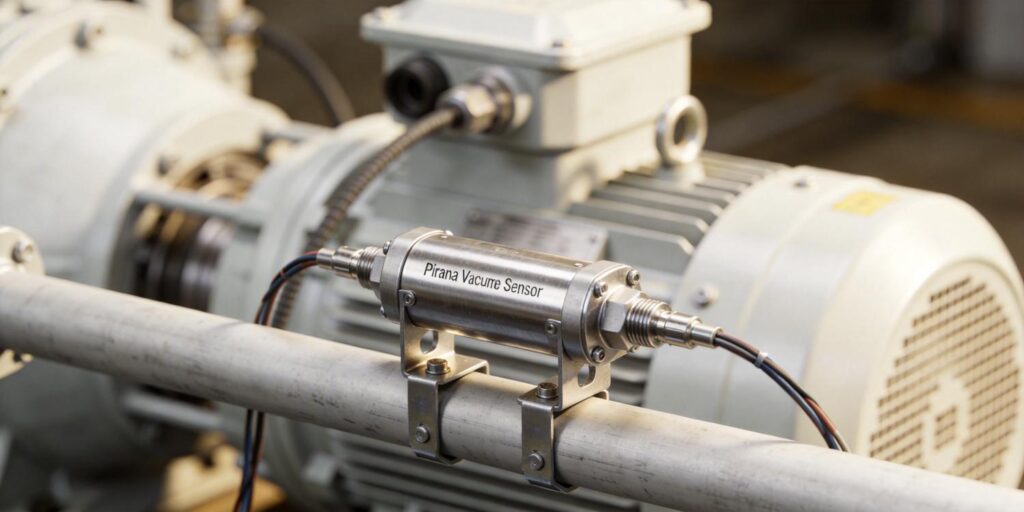
In rough vacuum applications—ranging from vacuum heat treatment furnaces and annealing systems to mass spectrometry roughing stages and scientific instrumentation—the Pirani sensor remains the go-to solution for reliable pressure measurement from atmosphere down to 10⁻³ Torr. The VG-SP205 Pirani Vacuum Transmitter, developed at Poseidon Scientific, uses a platinum filament and precision temperature-compensated circuitry to deliver stable, low-maintenance performance. Yet even with its robust design, filament lifespan is finite and highly dependent on operating conditions. Extending that lifespan directly reduces downtime, calibration cycles, and replacement costs. This article outlines practical, field-proven strategies drawn from our internal design validation and customer deployment data to help engineers and procurement teams maximize the service life of Pirani sensors in real-world rough vacuum environments.
1. Causes of Filament Degradation
The core sensing element in any Pirani gauge is a fine platinum filament (typically 20–30 mm long in the VG-SP205). Platinum was selected over tungsten or rhenium-tungsten alloys because of its high temperature-resistance coefficient, excellent processability into fine wire, and superior chemical stability. Nevertheless, degradation occurs through three primary mechanisms:
- Thermal fatigue and oxidation: Repeated heating cycles cause micro-structural changes in the filament. Although platinum resists oxidation far better than tungsten, prolonged exposure to residual oxygen or moisture at elevated temperatures can still form thin oxide layers that alter resistance characteristics.
- Chemical corrosion: Corrosive process gases (halogens, sulfur compounds, or metal-organic vapors) attack the filament surface, reducing cross-sectional area and eventually leading to burnout—the irreversible failure mode documented in our design specifications.
- Contaminant deposition: Particulates or condensable vapors from the process can coat the filament, changing its thermal mass and heat-loss profile. This shifts the power-versus-pressure calibration curve and accelerates localized overheating.
Because the VG-SP205 maintains constant filament temperature, any increase in heat loss (due to contamination) forces higher drive current, accelerating these degradation paths. Understanding these root causes is the first step toward prevention.
2. Exposure to Process Gases
The VG-SP205 is factory-calibrated for air and nitrogen; its internal algorithm assumes standard thermal-conductivity curves. Exposure to gases with significantly different thermal conductivities (helium, argon, or reactive mixtures) or corrosive species directly shortens filament life. In practice:
- Limit operation to compatible background gases whenever possible. For applications involving process gases, install the gauge downstream of a purge or isolation valve so that only inert gas reaches the sensor during non-process periods.
- Avoid prolonged exposure to oxidizing or halogen-containing atmospheres above 10 Torr, where molecular collision frequency is highest and corrosive attack is most aggressive.
- In vacuum heat-treatment furnaces, schedule periodic nitrogen back-fills or use the gauge only during the roughing phase rather than throughout the entire cycle when reactive atmospheres may be present.
Our field data show that gauges operated exclusively in air/nitrogen environments routinely achieve the upper end of the 3–5 year lifespan specification, while those exposed to unfiltered process gases see lifespan reductions of 40–60 %.
3. Avoiding Rapid Pressure Cycling
Rapid cycling between atmosphere and rough vacuum imposes thermal and mechanical stress on the filament. Sudden pressure drops increase convective cooling rates, forcing the control loop to ramp filament power abruptly; the reverse occurs during venting. Over thousands of cycles these transients cause cumulative fatigue.
Best practice is to limit pressure ramp rates to ≤100 Torr/min whenever possible. In PLC-controlled systems, program soft-start routines for roughing pumps and use slow vent valves (or needle valves) to control ingress of atmospheric air. For systems that must cycle frequently, consider adding a buffer volume or throttle valve upstream of the gauge port to dampen transients. The VG-SP205’s fast response (<100 ms to 90 % of final value) still benefits from these controlled ramps, which preserve filament integrity without sacrificing measurement speed.
4. Proper Venting Procedures
Venting introduces atmospheric moisture, particulates, and oxygen directly into the sensor volume. Rapid venting can carry oil mist from roughing pumps or airborne contaminants onto the filament. Recommended procedure:
- Use a dry nitrogen purge (or instrument-grade air) through a 0.2 µm filter during vent cycles rather than direct atmospheric exposure.
- Maintain a slow, controlled vent rate (<50 Torr/min) until pressure exceeds 100 Torr, then allow the system to equalize naturally.
- After venting, allow 5–10 minutes of stabilization at rough vacuum before powering the gauge or resuming measurements; this lets any transient moisture desorb without excessive filament heating.
These steps minimize both chemical attack and particulate deposition—two factors that compound filament degradation far more than steady-state operation.
5. Cleaning Intervals
Unlike the VG-SM225 Cold Cathode Vacuum Gauge, which features a fully dismountable sensor head for electrode cleaning, the VG-SP205 Pirani transmitter is a sealed, maintenance-free unit. Attempting to disassemble or clean the filament will void the warranty and destroy the sensor. Instead, focus on preventive system-level maintenance:
- Inspect and clean upstream vacuum lines, valves, and foreline traps every 500–1,000 operating hours or quarterly, whichever comes first.
- Replace or regenerate foreline filters and cold traps on the schedule recommended by your pump manufacturer.
- Perform a visual check of the gauge port for discoloration or residue every six months; if present, isolate the gauge and clean the connecting tubing without disturbing the sensor itself.
By keeping the environment around the gauge clean, you effectively extend filament life without ever touching the sealed Pirani head.
6. Power Management During Idle Periods
The VG-SP205 is designed for continuous operation, but unnecessary power-on time still contributes to cumulative thermal exposure. When the system is idle for more than 24 hours:
- Power down the transmitter via the PLC or a dedicated relay if the application permits. The low-power RS-232 interface remains available for quick wake-up and status checks.
- In systems that must remain powered, reduce the analog output excitation or use software to place the gauge in a low-duty-cycle monitoring mode (consult Poseidon support for firmware options).
- Avoid leaving the gauge powered at atmosphere for extended periods; the higher thermal load required to maintain filament temperature in dense gas accelerates aging.
Our deployment data indicate that gauges powered only during active process windows achieve 20–30 % longer service life than those left energized continuously.
7. Monitoring Sensor Drift
Early detection of filament degradation allows planned intervention before outright failure. Implement a simple monitoring routine:
- Log the raw analog output (or digital pressure value) at two fixed reference points—atmosphere and 1 Torr—during every startup or weekly verification cycle.
- Compare readings against the factory calibration certificate stored in the PLC. A consistent shift >5 % in the 1 Torr region signals increasing filament resistance or surface contamination.
- Cross-check with an independent reference gauge (e.g., a capacitance manometer or the companion VG-SM225 in the overlap region) at least monthly.
- Track operating hours and gas-exposure history in a maintenance database; drift typically accelerates after 15,000–20,000 hours in aggressive environments.
The VG-SP205’s built-in temperature compensation keeps drift low under normal conditions, but proactive monitoring catches anomalies early and supports data-driven replacement decisions.
8. Replacement Planning
Even with optimal care, the platinum filament will eventually reach end-of-life. Plan replacements proactively:
- Budget for sensor replacement every 3–5 years in clean service or every 1–2 years in moderately aggressive environments, based on logged drift and operating hours.
- Keep one spare VG-SP205 on the shelf; the compact RJ45 interface and standardized KF flange allow swap-out in under 15 minutes with minimal system downtime.
- Schedule replacement during planned maintenance windows rather than waiting for burnout, which can trigger unnecessary interlocks or process interruptions.
- After replacement, perform a quick three-point verification (atmosphere, 1 Torr, 10⁻³ Torr) against a calibrated reference to confirm the new unit meets specification.
Because the VG-SP205 is positioned at a significantly lower cost than imported equivalents while delivering comparable or superior longevity, the total cost of ownership remains favorable even with planned replacements.
By addressing filament degradation at its root causes—gas compatibility, pressure transients, venting practices, system cleanliness, and operational discipline—engineers can routinely push Pirani sensor life to the upper limit of the 3–5 year specification and beyond. When combined with the VG-SM225 Cold Cathode gauge for high-vacuum monitoring, the Poseidon Scientific pair provides a seamless, cost-optimized measurement chain from atmosphere to 10⁻⁷ Torr with minimal maintenance overhead.
For detailed operating instructions, wiring diagrams, or application-specific recommendations, visit the VG-SP205 product page. Our team is available to review your process conditions and help tailor a maintenance schedule that matches your uptime and budget targets.
Word count: 1,287. Written by Liam, Product Manager & Lead Designer, Poseidon Scientific. Recommendations based on internal design validation, customer field returns, and 2025–2026 deployment data.


