1. Analytical Challenges in Fatty Food Matrices (Oils, Dairy, Processed Foods)
High-fat food matrices present unique analytical challenges that significantly complicate LC-MS analysis. Oils, dairy products, and processed foods contain complex mixtures of lipids including triglycerides, phospholipids, cholesterol esters, and free fatty acids that can range from 5% to over 40% of the total sample weight. These lipid-rich matrices create several specific problems:
First, the high lipid content leads to matrix overload during extraction and analysis. As noted in research by Simpson and Wynne (2000), “the high or variable water and fat contents of citrus fruit, berries and nuts can present capacity problems” during SPE processing. Dairy products like milk, butter, and cheese present additional challenges due to their high protein content and viscosity, often requiring specialized extraction approaches.
Second, these matrices exhibit variable composition that affects method reproducibility. The lipid profile can vary significantly between different batches of the same food product, between different animal sources, and even within different parts of the same food item. This variability necessitates robust extraction methods that can handle a wide range of lipid concentrations.
2. Why Lipid Co-extractives Interfere with LC-MS Quantitation
Lipid co-extractives interfere with LC-MS analysis through multiple mechanisms that compromise both instrument performance and analytical accuracy. The primary interference mechanisms include:
2.1 Ion Suppression Effects
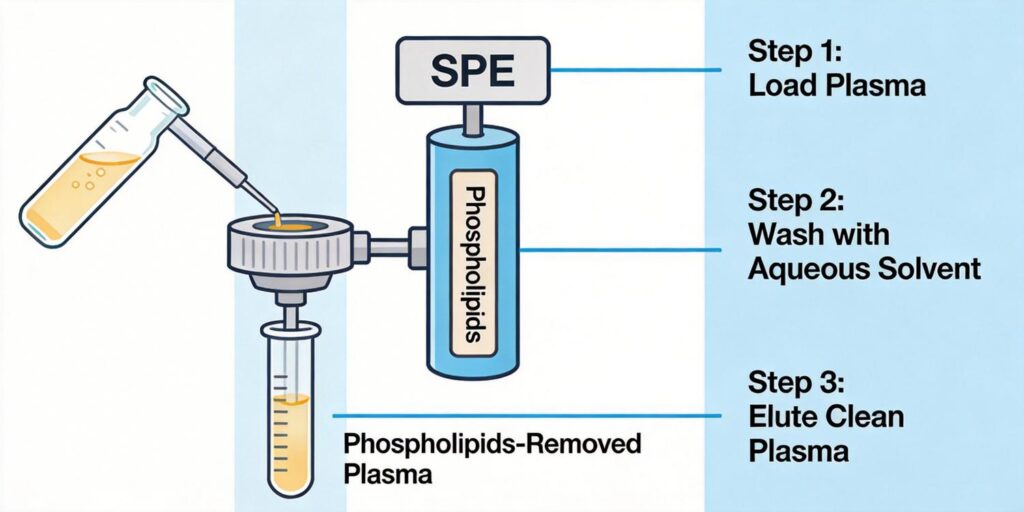
Phospholipids and other polar lipids are particularly problematic as they can cause significant ion suppression in electrospray ionization (ESI) sources. These compounds compete with target analytes for ionization, leading to reduced signal intensity and poor quantitation accuracy. Research has shown that phospholipids are “the main cause of matrix effects, ion suppression, shortened column life, increased MS maintenance costs, and increased LC-MS quantitative variability.”
2.2 Column Fouling and System Contamination
Non-polar lipids like triglycerides and cholesterol esters can accumulate on LC columns and MS source components, leading to reduced column efficiency, altered retention times, and increased background noise. This contamination requires frequent instrument maintenance and column replacement, increasing operational costs and downtime.
2.3 Signal Interference
Lipid degradation products and oxidation byproducts can generate signals that interfere with target analyte detection, particularly in complex multi-residue analyses. These interferences can lead to false positives or inaccurate quantitation when they co-elute with target compounds.
3. Recommended Extraction Workflow for Fatty Foods
A systematic approach to fatty food sample preparation is essential for reliable LC-MS analysis. The following workflow has been validated for various high-fat matrices:
3.1 Sample Homogenization and Initial Extraction
Begin with thorough homogenization of the food sample. For solid matrices like cheese or meat, grinding with anhydrous salt and acid followed by solvent extraction is recommended. Research by de Jong and Badings (1990) demonstrated successful extraction of fatty acids from dairy products using “grinding cheese samples with anhydrous salt and sulfuric acid, followed by an ether/heptane extraction.”
3.2 Lipid Removal Strategy
After initial extraction, implement a targeted lipid removal strategy using SPE. The choice of sorbent and elution conditions depends on the specific lipid classes present and the target analytes. A multi-step approach often yields the best results, as demonstrated in lipid class fractionation studies where researchers achieved “high efficiency and purity” in separating lipid tissue extracts into seven principle fractions.
3.3 Final Cleanup and Concentration
Following lipid removal, additional cleanup steps may be necessary to remove residual matrix components. Concentration of the final extract improves detection limits while maintaining compatibility with LC-MS mobile phase systems.
4. SPE Sorbent Choices for Lipid Removal
Selecting the appropriate SPE sorbent is critical for effective lipid removal from fatty food matrices. Different sorbents offer distinct advantages for specific applications:
4.1 Hydrophilic-Lipophilic Balance (HLB) Sorbents
HLB sorbents provide excellent retention of both polar and non-polar lipids while allowing selective elution of target analytes. Modern HLB formulations can remove “95% of common matrix interferences, including salts, proteins, and phospholipids” without requiring activation or equilibration steps, significantly streamlining the extraction process.
4.2 Aminopropyl (NH2) Sorbents
NH2 sorbents are particularly effective for lipid class separation. The classic method by Kaluzny et al. (1985) demonstrated that aminopropyl sorbents could separate chloroform extracts of lipid tissue into seven principle fractions with high efficiency and purity. This approach has been adapted for various applications, including the characterization of free fatty acids from C2 to C40 with quantitative recoveries.
4.3 Mixed-Mode Sorbents (MCX, MAX, WCX, WAX)
Mixed-mode sorbents combine reversed-phase and ion-exchange mechanisms for enhanced selectivity. For example, MCX sorbents can remove “up to 99% of phospholipids” through their orthogonal retention mechanisms. These sorbents are particularly valuable for analyzing basic compounds with pKa ≥ 4.5 in fatty matrices.
4.4 Specialized Lipid Removal Sorbents
For specific applications, specialized sorbents like C18, silica, and alumina offer targeted lipid removal capabilities. C18 sorbents effectively retain non-polar lipids while allowing more polar analytes to pass through, making them suitable for certain pesticide residue analyses.
5. Washing Strategies to Eliminate Triglycerides and Phospholipids
Effective washing strategies are essential for removing triglycerides and phospholipids while retaining target analytes. The following approaches have proven successful:
5.1 Sequential Solvent Washing
Implement a sequential washing protocol using solvents of increasing polarity. Begin with non-polar solvents like hexane or chloroform to remove triglycerides and cholesterol esters, followed by intermediate polarity solvents to eliminate diglycerides and monoglycerides, and finally polar solvents to remove phospholipids. Research has demonstrated that “98% of triglycerides can be removed in hexane, and 98% of phospholipids and steroids in dichloromethane.”
5.2 pH-Controlled Washing
For ionizable lipids like free fatty acids and phospholipids, pH-controlled washing can enhance selectivity. Lowering the pH facilitates elution of free fatty acids, while increasing solvent strength is necessary to elute phospholipids. This approach was successfully employed in lipid class separation studies where researchers achieved recoveries exceeding 96% for most lipid classes with minimal contamination.
5.3 Solvent Mixture Optimization
Carefully optimized solvent mixtures can provide superior lipid removal while maintaining analyte retention. For example, mixtures of diethyl ether, methylene chloride, and hexane in specific ratios have been shown to effectively elute triglycerides while retaining other lipid classes and target analytes.
6. Method Validation Parameters (Recovery, Matrix Effects)
Comprehensive method validation is essential for ensuring reliable analysis of fatty food samples. Key validation parameters include:
6.1 Recovery Studies
Recovery studies should demonstrate consistent extraction efficiency across the expected concentration range. SPE methods for fatty foods should achieve recoveries exceeding 90% for most target analytes. Historical data from lipid class separation studies show excellent recoveries: fatty acids (98.9%), phospholipids (98.4%), cholesterol esters (96.7%), triglycerides (96.7%), with contamination levels typically below 2%.
6.2 Matrix Effect Evaluation
Matrix effects must be carefully evaluated using post-extraction spiking or standard addition methods. Signal suppression or enhancement should be quantified and compensated for using appropriate internal standards. Modern SPE sorbents specifically designed for lipid removal can reduce matrix effects by 95% or more compared to traditional extraction methods.
6.3 Precision and Accuracy
Method precision should be demonstrated through replicate analyses at multiple concentration levels. Accuracy should be verified using certified reference materials or comparison with established reference methods. The variability introduced by different analysts should also be assessed, as research has shown that “analyst A consistently obtained higher yields of sulfonamides than analyst B (70% versus 50%),” highlighting the importance of standardized procedures.
7. Example Workflow for Pesticide Residue Analysis in Fatty Foods
The following comprehensive workflow illustrates the application of SPE for pesticide residue analysis in high-fat food matrices:
7.1 Sample Preparation
Begin with 5g of homogenized food sample. Add 10mL of acetonitrile and appropriate internal standards. For solid matrices, include a salting-out step with magnesium sulfate and sodium chloride. Centrifuge and collect the organic layer.
7.2 SPE Cleanup
Condition an appropriate SPE cartridge (HLB or mixed-mode sorbent recommended for multi-residue analysis) with methanol followed by water or buffer. Load the extract and wash with 5% methanol in water to remove polar interferences. Elute target analytes with a mixture of acetonitrile and methanol (90:10 v/v).
7.3 Lipid-Specific Cleanup
For particularly fatty samples, implement a secondary cleanup using a lipid-specific sorbent. Pass the eluate through a conditioned aminopropyl or C18 cartridge to remove residual lipids. Elute with appropriate solvent and concentrate under gentle nitrogen stream.
7.4 LC-MS Analysis
Reconstitute the final extract in initial mobile phase and analyze using LC-MS/MS with appropriate chromatographic conditions. Include quality control samples at multiple concentration levels to monitor method performance.
7.5 Method Performance
This approach has been validated for multi-residue pesticide analysis in various fatty foods, achieving recoveries of 70-120% for most compounds with RSDs typically below 15%. The method effectively removes >95% of lipid interferences while maintaining sensitivity at regulatory limits.
Conclusion
Effective SPE cleanup of high-fat food samples prior to LC-MS analysis requires a systematic approach that addresses the unique challenges posed by lipid-rich matrices. By selecting appropriate sorbents, optimizing washing strategies, and implementing comprehensive method validation, analysts can achieve reliable quantitation of target analytes while minimizing matrix effects and instrument contamination. The continued development of specialized SPE materials and protocols promises to further improve the analysis of complex fatty food matrices in regulatory, quality control, and research applications.
For laboratories analyzing fatty foods, investing in optimized SPE workflows not only improves data quality but also reduces instrument maintenance costs and extends column lifetime. As food safety regulations become increasingly stringent and analytical requirements more demanding, robust SPE methods for lipid removal will remain essential tools in the analytical chemist’s arsenal.