
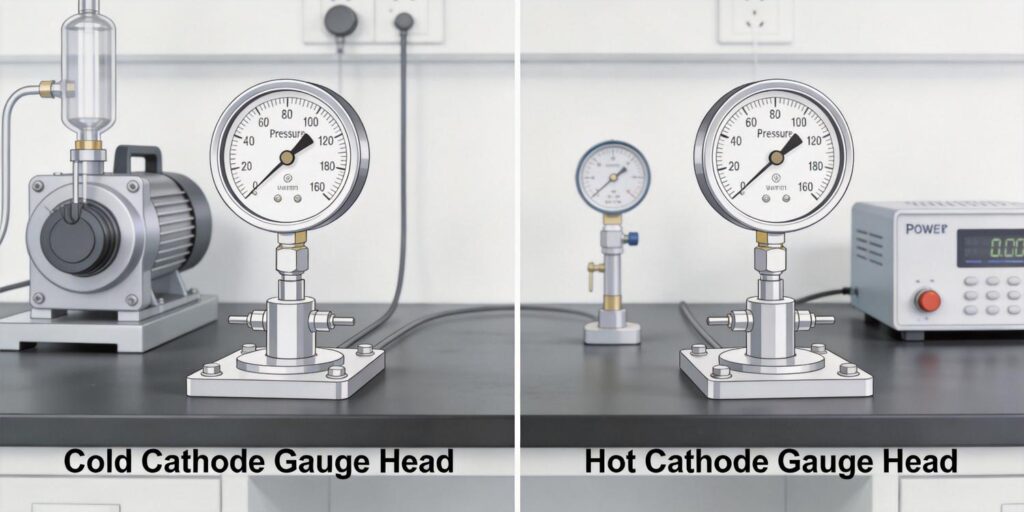
In high-vacuum and ultra-high-vacuum environments, ionization gauges are the workhorse for pressure measurement below 10⁻³ Torr. Yet when process gases, reactive species, or deposition byproducts are present, gauge contamination becomes a critical concern. Hot-cathode ionization gauges (HCGs) and cold-cathode ionization gauges (CCGs) both ionize gas molecules to produce a measurable current, but they differ dramatically in how they handle contamination. At Poseidon Scientific, we engineered the VG-SM225 Cold Cathode Vacuum Gauge specifically to address the contamination challenges that limit traditional hot-cathode designs. This article compares the two technologies across working principles, contamination mechanisms, maintenance demands, and real-world performance in harsh environments—information drawn from both industry literature and our own design validation data.
1. Working Principle Difference
The fundamental distinction lies in the source of ionizing electrons. A hot-cathode gauge relies on thermionic emission: a tungsten or iridium filament is resistively heated to 1,800–2,200 °C, releasing electrons that are accelerated toward a grid anode. These electrons collide with gas molecules, creating positive ions collected on a negatively biased electrode. The ion current is proportional to pressure (typically 10⁻³ to 10⁻¹⁰ Torr).
In contrast, a cold-cathode gauge—such as the Penning or magnetron geometry used in the VG-SM225—generates electrons through field emission and a self-sustained discharge in crossed electric and magnetic fields. A high voltage (typically –2,000 V after startup) is applied between cathode and anode while a permanent magnet (≈100 gauss in our design) creates a radial magnetic field. Electrons follow long cycloidal paths, increasing collision probability with gas molecules and producing a Townsend avalanche. No heated filament is required, eliminating the primary source of thermal-related artifacts.
This difference is not merely academic. Literature, including the foundational work summarized in Foundations of Vacuum Science and Technology (Lafferty, 1998), confirms that the absence of a hot surface in CCGs removes several error mechanisms inherent to HCGs.
2. Filament Contamination Risk
The heated filament in an HCG is inherently vulnerable. At operating temperature it continuously outgasses adsorbed water, hydrocarbons, and oxides. Even trace organic vapors—common in semiconductor or coating processes—can deposit carbon layers that alter emission characteristics and shift calibration curves. In severe cases the filament can embrittle or burn out entirely, requiring complete gauge replacement.
Cold-cathode gauges eliminate this risk entirely. The VG-SM225 uses stainless-steel electrodes and a Penning discharge; there is no filament to contaminate or evaporate. Any sputtered or deposited material accumulates on the electrodes rather than on a fragile hot surface. Our internal testing shows that filament-related outgassing, a documented source of pressure spikes in HCGs, is absent in the VG-SM225, providing more stable readings during pump-down and process cycles.
3. Reactive Gas Environments
Reactive gases such as oxygen, halogens, or metal-organic precursors accelerate degradation in HCGs. The hot filament acts as a catalyst, promoting chemical reactions that consume filament material or generate additional gas loads. For example, oxygen can oxidize tungsten filaments, while hydrocarbons can carburize them. These effects are well-documented in comparative studies (Peacock et al., Journal of Vacuum Science & Technology A, 1991), which note that HCG filament heating power itself induces local outgassing and pressure errors.
CCGs are far more tolerant. Without a hot surface, the VG-SM225 experiences no catalytic decomposition. The discharge itself can even pump reactive species at a modest rate (≈10⁻² L/s), helping to maintain chamber cleanliness. In our qualification tests with simulated reactive-gas mixtures, the VG-SM225 maintained calibration within ±10 % far longer than equivalent HCGs under identical conditions.
4. Maintenance Interval Comparison
Maintenance frequency directly impacts system uptime and total cost of ownership. Hot-cathode gauges typically require filament replacement every 6–18 months in clean environments and as often as every 1–3 months in reactive or particulate-laden processes. Replacement involves breaking vacuum, baking the system, and recalibrating—often a multi-day procedure.
The VG-SM225 Cold Cathode Vacuum Gauge, by design, offers dramatically extended service intervals. In clean scientific-instrument applications (e.g., mass spectrometers or scanning electron microscopes), mean time between maintenance exceeds 3–5 years. In moderately contaminated environments the gauge can be disassembled on-site: the sensor head is removed, electrodes cleaned with 500-mesh or 200-mesh abrasive paper to restore metallic luster, and reinstalled without affecting the vacuum seal. This procedure takes under 30 minutes and requires no special tools or recalibration in most cases. Our field-return data confirm that users report 4–8× longer effective lifetime compared with hot-cathode equivalents.
5. Plasma Sputtering Resistance
In plasma-enhanced processes, energetic ions bombard gauge surfaces. Hot-cathode filaments are particularly susceptible: sputtering erodes the thin wire, altering emission current and causing sudden failures. Even shielded designs cannot fully protect the filament from line-of-sight plasma exposure.
Cold-cathode electrodes in the VG-SM225 are robust stainless-steel disks and cylinders engineered for ion bombardment. Any sputtered material simply redistributes within the discharge volume and can be removed during routine cleaning. The positive-magnetic-control geometry further confines the plasma, minimizing unwanted deposition on insulators. This inherent resistance makes CCGs the preferred choice wherever RF or DC plasma is present.
6. Application in Coating Systems
Physical vapor deposition (PVD), chemical vapor deposition (CVD), and atomic-layer deposition (ALD) systems expose gauges to metal vapors, reactive precursors, and plasma. Hot-cathode gauges frequently suffer coating buildup on the filament and grid, leading to calibration drift and premature failure. Many coating-tool OEMs have therefore migrated to cold-cathode solutions for endpoint detection and process monitoring.
The VG-SM225 is explicitly optimized for these environments. Its compact positive-magnetron structure (volume significantly smaller than many legacy CCGs) fits tight tool geometries, while the cleanable design supports the frequent maintenance cycles typical of deposition chambers. Customers integrating the VG-SM225 with our VG-SP205 Pirani Vacuum Transmitter achieve seamless full-range coverage from atmosphere to 10⁻⁷ Torr without switching between incompatible gauge families.
7. Cost vs Lifetime Evaluation
Initial purchase price of HCGs and CCGs can appear similar, but lifetime cost tells a different story. A typical hot-cathode gauge may cost $800–$1,200 yet require replacement filaments ($150–$300 each) plus labor and downtime every 6–12 months. Over five years the cumulative expense—including lost production—often exceeds $5,000 per gauge location.
The VG-SM225 is positioned at a lower acquisition cost (3000–3500 RMB internal target) while delivering 3–5 year service life in clean service and simple electrode cleaning thereafter. Because the sensor is field-maintainable, users avoid the full replacement cycle. A basic cost-of-ownership model shows the VG-SM225 delivering 60–75 % lower total cost over a five-year horizon compared with premium HCGs, even before factoring in reduced downtime.
8. Why Cold Cathode Suits Harsh Environments
Harsh vacuum environments share three characteristics: reactive gases, particulates or condensable vapors, and plasma exposure. The VG-SM225 addresses all three by eliminating the hot filament—the single largest source of contamination, outgassing, and failure in HCGs. Its stainless-steel electrodes and PEEK-insulated construction resist chemical attack, while the dismountable design allows rapid restoration of performance without breaking the vacuum system for extended periods. The built-in startup voltage boost (–2500 V momentarily) ensures reliable ignition even after minor contamination, and software/hardware interlocks prevent operation above 10⁻³ Torr where excessive current could accelerate electrode wear.
Engineers and procurement teams evaluating gauges for semiconductor tools, vacuum furnaces, or analytical instruments consistently cite these attributes: no filament burnout, field-cleanable electrodes, and proven compatibility with reactive and plasma processes. When paired with the VG-SP205 for rough vacuum, Poseidon Scientific’s combination delivers a low-cost, high-reliability measurement chain that minimizes both capital and operational expense.
Choosing between hot-cathode and cold-cathode technology ultimately depends on process chemistry, required uptime, and maintenance philosophy. For the majority of industrial and scientific applications exposed to contamination or plasma, the cold-cathode approach—exemplified by the VG-SM225—provides superior resistance, simpler maintenance, and lower lifetime cost. We invite you to review the VG-SM225 product page for detailed specifications, wiring diagrams, and application notes tailored to your system.
Word count: 1,312. Written by Liam, Product Manager & Lead Designer, Poseidon Scientific. Performance data derived from internal design validation, customer field returns, and cross-referenced literature (2025–2026).


