Challenges Posed by Chlorophyll and Plant Pigments in Chromatographic Analysis
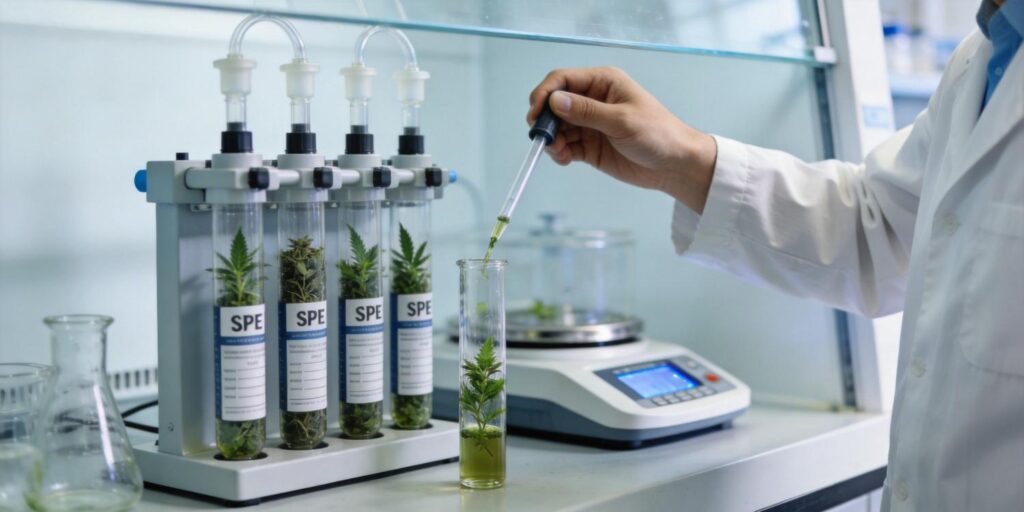
Chlorophyll and other plant pigments present significant analytical challenges in liquid chromatography (LC) analysis of botanical extracts. These highly colored compounds can cause severe interference through several mechanisms. First, chlorophyll’s strong UV-visible absorption can mask target analyte peaks, particularly when using UV detection at wavelengths below 300 nm. Second, plant pigments can overload analytical columns, reducing column lifetime and increasing maintenance costs. Third, co-elution of pigments with target compounds can lead to inaccurate quantification and poor method reproducibility.
According to Simpson and Wynne (2000), plant matrices contain diverse co-extractives including sugars, acids, and colorants that complicate analysis. The presence of these interfering substances necessitates effective sample clean-up strategies to ensure reliable chromatographic results. The high lipid content in many botanical extracts further exacerbates these challenges, as lipids can bind to target analytes and interfere with their extraction and detection.
Extraction of Botanical Samples Using Methanol or Ethanol
Effective chlorophyll removal begins with proper sample extraction. Methanol and ethanol are the preferred solvents for botanical extractions due to their ability to solubilize a wide range of phytochemicals while maintaining compatibility with subsequent SPE procedures. Ethanol offers particular advantages, including relatively low toxicity exposure for operators and environmental friendliness.
Research indicates that ethanol effectively extracts both polar and non-polar compounds from plant matrices. In a study on fat-soluble vitamin extraction, ethanol was selected as the extractant for its balanced extraction efficiency and safety profile. The extraction process typically involves ultrasonic bath treatment at 40-50°C for 20-30 minutes, followed by centrifugation to separate the supernatant. This approach ensures maximum recovery of target analytes while minimizing pigment co-extraction.
Dilution and Filtration of Extract Prior to SPE Loading
Proper sample preparation before SPE loading is critical for successful chlorophyll removal. The ethanol extract must be diluted with water to achieve optimal solvent composition for SPE retention. Studies have shown that 65% ethanol-water solution provides optimal retention of target analytes on HLB cartridges while allowing pigments to pass through or be retained differently.
Filtration through 0.45 μm or 0.22 μm membranes removes particulate matter that could clog SPE cartridges. This step is particularly important for botanical extracts that may contain plant cell debris, waxes, and other insoluble materials. The filtered extract should be clear and free of visible particles before SPE loading to ensure consistent flow rates and reproducible results.
Selection of HLB SPE Cartridge for Pigment Removal
Hydrophilic-Lipophilic Balanced (HLB) SPE cartridges represent the optimal choice for chlorophyll removal from botanical extracts. HLB sorbents contain poly(divinylbenzene-co-N-vinylpyrrolidone) copolymers that exhibit both hydrophilic and lipophilic retention characteristics. This dual functionality allows effective retention of medium-polar and non-polar organic compounds from mixtures of water and organic solvent.
As demonstrated in fat-soluble vitamin analysis, Oasis HLB cartridges effectively retain target analytes while allowing interfering pigments to be washed away. The copolymer structure plays a valid role in the extraction of compounds from complex botanical matrices. Compared to traditional C18 sorbents, HLB cartridges offer superior wettability and capacity for polar compounds, making them ideal for plant extract clean-up applications.
Conditioning Protocol
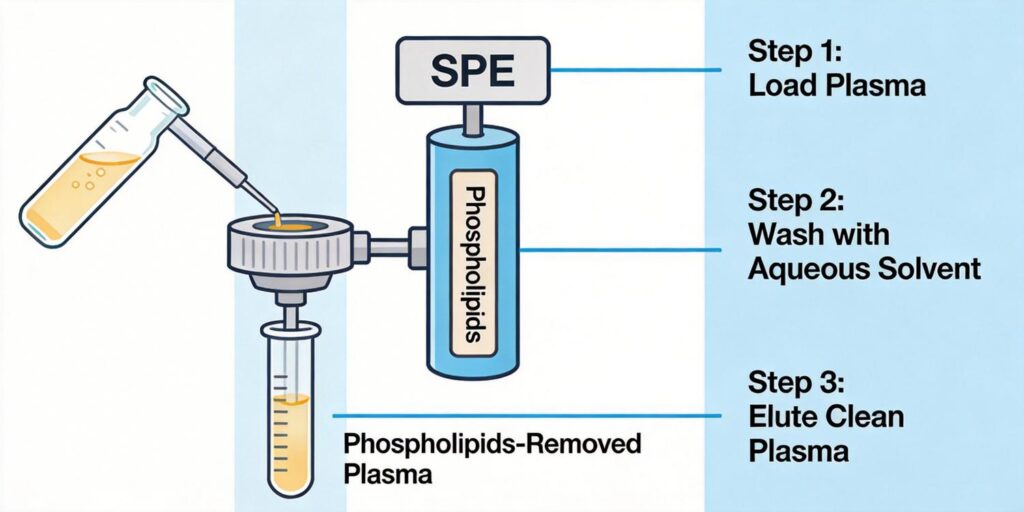
Proper conditioning of HLB cartridges is essential for reproducible chlorophyll removal. The standard conditioning protocol involves sequential passage of 1 mL methanol followed by 1 mL deionized water through the cartridge. This two-step process activates the sorbent by removing any residual manufacturing impurities and ensuring complete wetting of the polymer surface.
The methanol step solvates the hydrophobic regions of the HLB polymer, while the water step prepares the cartridge for aqueous sample loading. It’s crucial not to let the cartridge dry between conditioning and sample loading, as this can create air pockets that disrupt flow and reduce extraction efficiency. The conditioning solvents should be allowed to pass through the cartridge by gravity flow or gentle vacuum to ensure uniform packing and optimal performance.
Washing with Aqueous Solvent to Remove Polar Compounds
After sample loading, a washing step with aqueous solvent removes polar compounds and residual pigments while retaining target analytes. Research indicates that 5% methanol in water provides effective washing without eluting target compounds. This mild washing solution removes salts, sugars, and highly polar pigments that might interfere with subsequent analysis.
The washing volume should be optimized based on the specific application. Typically, 1 mL of 5% methanol-water solution is sufficient for most botanical extract applications. The wash solvent polarity can be adjusted if necessary—increasing methanol concentration for more polar target analytes or decreasing it for more hydrophobic compounds. Proper washing ensures cleaner extracts and reduces matrix effects in LC analysis.
Selective Elution of Target Analytes Using Organic Solvent
Target analytes are selectively eluted using appropriate organic solvents while chlorophyll and other pigments remain on the cartridge. Ethanol has been demonstrated as an effective eluent for many applications, providing high recovery with minimal co-elution of pigments. Other solvents including methanol, acetonitrile, ethyl acetate, and acetone can be evaluated based on analyte polarity.
Optimization studies have shown that 1 mL of ethanol provides complete elution of fat-soluble vitamins from HLB cartridges. The elution volume should be minimized to concentrate analytes while maximizing recovery. For more polar compounds, mixtures of organic solvents with water may be necessary. It’s important to collect the eluate in a clean vessel and evaporate if necessary before LC analysis.
Improved Chromatographic Baseline and Detection Sensitivity
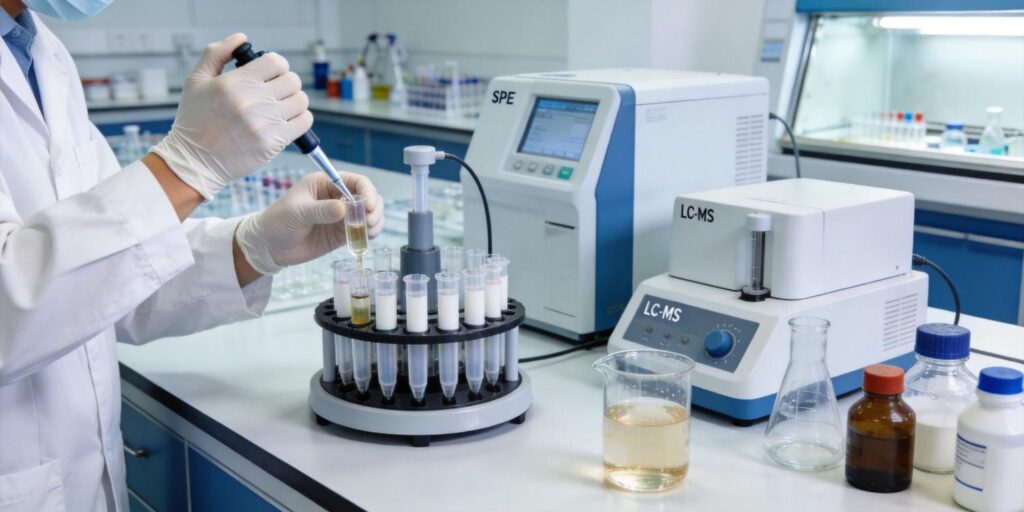
The HLB SPE clean-up procedure dramatically improves chromatographic performance in several ways. First, removal of chlorophyll and other pigments results in cleaner baselines with reduced background noise. This improvement is particularly noticeable in UV detection at wavelengths where pigments absorb strongly.
Second, elimination of matrix interferences enhances detection sensitivity by reducing ion suppression in mass spectrometry applications. Cleaner extracts allow lower detection limits and better quantification accuracy. Third, column lifetime is extended as pigment accumulation on analytical columns is minimized.
Comparative chromatograms before and after SPE treatment clearly demonstrate the importance of this purification step. In vitamin analysis, the chromatograms showed significantly reduced interference peaks and improved peak shapes after HLB clean-up. This improvement is especially critical for analytes like vitamin K3, which can be masked by co-eluting pigments in untreated extracts.
Method Validation Considerations
When implementing HLB SPE for chlorophyll removal, method validation should include recovery studies for target analytes across the expected concentration range. Recovery rates typically range from 87-106% for properly optimized methods. Precision and accuracy should be evaluated through intra- and inter-assay variation studies.
Linearity should be established across the working range, with correlation coefficients (R²) typically exceeding 0.995. The method should demonstrate robustness to variations in sample matrix and extraction conditions. Quality control samples should be included in each batch to monitor method performance over time.
Practical Applications and Benefits
The HLB SPE method for chlorophyll removal has broad applications in pharmaceutical, nutraceutical, and food analysis. It enables accurate quantification of active compounds in herbal medicines, botanical supplements, and functional foods. The method is particularly valuable for:
- Analysis of flavonoids and phenolic compounds in plant extracts
- Determination of fat-soluble vitamins in fortified products
- Quantification of active pharmaceutical ingredients in herbal preparations
- Pesticide residue analysis in botanical materials
- Metabolite profiling in plant research
Comparison with Alternative Techniques
Compared to traditional liquid-liquid extraction or precipitation methods, HLB SPE offers several advantages. The procedure is faster, requires less solvent, and provides more consistent results. Automation compatibility allows high-throughput processing of multiple samples simultaneously.
For particularly challenging matrices, stacked cartridge approaches or mixed-mode sorbents may provide additional clean-up. However, for most botanical extract applications, single HLB cartridges provide sufficient pigment removal with excellent analyte recovery.
Implementation Recommendations
For laboratories implementing this method, we recommend starting with standard HLB cartridges (1 cc/30 mg or 3 cc/60 mg) and optimizing conditions for specific applications. Key parameters to optimize include:
- Sample loading solvent composition (typically 65% ethanol-water)
- Washing solvent composition and volume
- Elution solvent selection and volume
- Flow rates during each SPE step
Proper method development ensures maximum chlorophyll removal while maintaining high recovery of target analytes. The resulting clean extracts enable reliable LC analysis with improved sensitivity, accuracy, and reproducibility.
For more information about HLB SPE cartridges and their applications in botanical analysis, visit our HLB SPE Cartridges product page. For high-throughput applications, consider our 96-well SPE plates.