
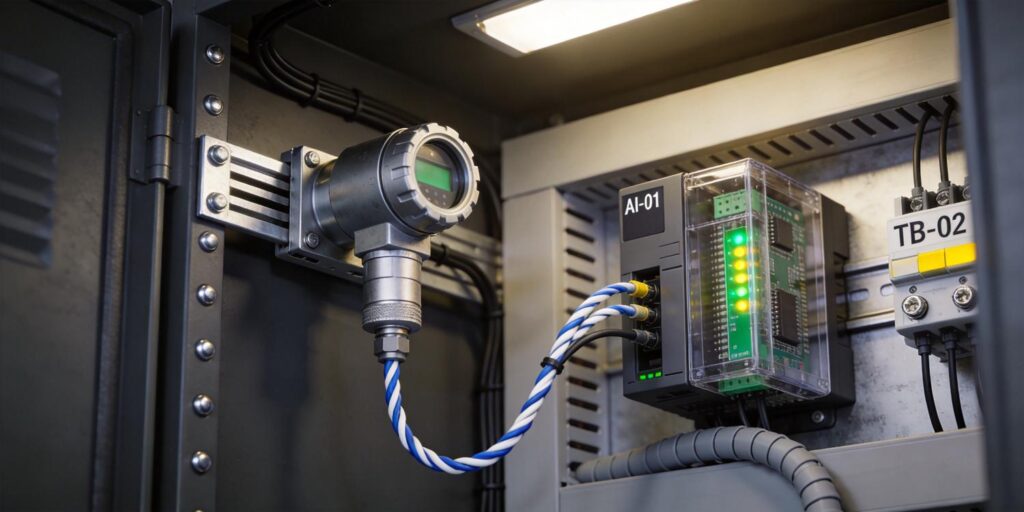
In today’s automated vacuum systems, programmable logic controllers (PLCs) serve as the central nervous system for process monitoring and control. Whether in mass spectrometry, vacuum heat treatment, or scientific instrumentation, reliable vacuum data must reach the PLC instantly and accurately. While digital protocols offer flexibility, the analog 0-10 V output remains the most widely adopted interface for vacuum gauge integration. Designed and engineered at Poseidon Scientific, the VG-SP205 Pirani Vacuum Transmitter delivers a clean, industry-standard 0-10 V signal that pairs effortlessly with both legacy and modern PLC platforms. This article explains exactly how the analog output improves integration, addresses real-world engineering challenges, and highlights the VG-SP205’s performance characteristics that engineers and procurement teams value most.
1. Why Analog Output Is Still Widely Used
Despite the rise of fieldbus and Ethernet-based protocols, analog 0-10 V signals continue to dominate vacuum gauge installations for three compelling reasons. First, every PLC vendor—Siemens, Allen-Bradley, Omron, and others—provides native analog input modules that require zero custom programming for basic scaling. Second, analog signals eliminate protocol overhead, delivering true real-time response with zero latency. In vacuum applications where pressure excursions must trigger immediate alarms or valve sequencing, even a 50 ms digital delay can matter. Third, analog wiring is inherently simple and cost-effective, reducing both initial capital expenditure and long-term maintenance compared with RS-485 or Ethernet gateways.
At Poseidon Scientific we developed the VG-SP205 specifically to meet the needs of OEMs and end users who prioritize plug-and-play compatibility over advanced diagnostics. The 0-10 V output ensures the transmitter works out of the box with existing control cabinets, minimizing engineering hours and qualification time. For applications requiring full-range coverage, the VG-SP205 pairs seamlessly with our VG-SM225 Cold Cathode Vacuum Gauge, creating a cost-effective two-gauge solution from atmosphere to 10⁻⁷ Torr.
2. Scaling Vacuum Pressure to Voltage
The VG-SP205 converts the non-linear heat-loss characteristic of the Pirani sensor into a linear voltage output across its specified range. The transmitter maintains a constant filament temperature and measures the power required to hold that temperature; this power correlates directly with gas pressure. Internally, a precision analog circuit and temperature-compensated algorithm map the pressure (atmosphere down to 10⁻³ Torr) to a 0-10 V DC signal.
In practice, the most accurate region—10 Torr to 10⁻² Torr—occupies the central portion of the voltage span, while the non-linear ends (atmosphere to 10 Torr and 10⁻² to 10⁻³ Torr) are still represented reliably for monitoring purposes. Engineers typically scale the PLC input so that:
- 0 V ≈ atmosphere (high pressure)
- 5 V ≈ 1 Torr (mid-range reference)
- 10 V ≈ 10⁻³ Torr (lowest measurable pressure)
This scaling allows simple linear interpolation in the PLC ladder logic or structured text. Because the effective measurement band is 2–8 V, the PLC can ignore the outer 0–2 V and 8–10 V segments if higher precision is required, or use them as over-range/under-range flags.
3. Signal Noise Considerations
Analog signals are susceptible to electromagnetic interference (EMI) from variable-frequency drives, high-voltage ion pumps, or nearby RF equipment common in vacuum environments. The VG-SP205 incorporates a low-noise output stage and built-in filtering to maintain signal integrity. Best-practice recommendations include:
- Shielded twisted-pair cable (e.g., 22 AWG with 100 % foil coverage)
- Single-point grounding of the shield at the PLC end only, to avoid ground loops
- Separation of signal cables from power and high-voltage lines by at least 30 cm
- Use of differential analog input modules when cable runs exceed 30 m
In our internal testing and customer deployments, these measures keep noise below 10 mV peak-to-peak—well within the ±1 % full-scale accuracy specification of the VG-SP205.
4. Cable Length Limitations
Voltage signals such as 0-10 V experience resistive drop and capacitive loading that increase with distance. For standard 22 AWG cable, the practical limit is approximately 50–100 m before error exceeds 0.5 %. Beyond that distance, engineers should consider:
- Upgrading to 18 AWG wire to reduce resistance
- Installing a signal repeater or isolator
- Switching to 4–20 mA (not currently offered on the VG-SP205 but available on future variants) for runs longer than 150 m
The RJ45 connector on the VG-SP205 simplifies field wiring; standard Ethernet patch cables can be repurposed for short runs, provided the shield is properly terminated.
5. Integration into Siemens and Allen-Bradley PLCs
Integration is straightforward on both major platforms. For Siemens TIA Portal users, the VG-SP205 output connects directly to an SM 1231 AI module. In the hardware configuration, set the channel to 0–10 V unipolar, then apply a simple linear scaling block:
Scaled_Value = (Raw_Value / 27648) * 10.0;  // 0–10 V maps to 0–27648 raw counts
Pressure_Torr = 760.0 * pow(10.0, -Scaled_Value);  // approximate Pirani log scaling example
Allen-Bradley Logix5000 platforms use the 1756-IF8 or 1769-IF8 module. Create a scaling tag with Input Min = 0 V, Input Max = 10 V, and engineering units set to Torr or Pa. The built-in linear scaling instruction handles the conversion in one rung. Both platforms support alarm setpoints directly on the raw or scaled channel, enabling instant high/low vacuum interlocks without additional code.
Our engineering team has validated these configurations with multiple OEMs; typical commissioning time is under 30 minutes once the physical wiring is complete.
6. Calibration Verification
Factory calibration of the VG-SP205 is performed against a NIST-traceable reference gauge under controlled temperature conditions (15–50 °C). In the field, engineers should verify the 0-10 V output at three points:
- Atmosphere (open to air, expected ≈ 0–1 V)
- 1 Torr (roughing pump stage, expected ≈ 5 V)
- 10⁻³ Torr (high-vacuum setpoint, expected ≈ 9–10 V)
Use a calibrated capacitance manometer or the companion VG-SM225 (switched to its overlap region) as the reference. If deviation exceeds ±2 %, the transmitter can be returned for recalibration; on-site adjustment is not required or supported, preserving traceability and repeatability.
7. VG-SP205 Output Characteristics
The VG-SP205 delivers a 0–10 V DC analog output (effective working band 2–8 V) with the following key specifications developed during our three-person R&D effort:
- Output impedance: <100 Ω
- Resolution: better than 1 mV (12-bit internal conversion)
- Accuracy: ±1 % of full scale in the linear region (10 Torr to 10⁻² Torr)
- Temperature coefficient: <0.1 %/°C (internal compensation circuit)
- Response time: <100 ms to 90 % of final value
- Connector: industry-standard RJ45 (pins allocated for power, ground, and signal)
These characteristics were optimized for the cost-sensitive, compact vacuum market while maintaining compatibility with the majority of PLC analog input cards. The transmitter also provides an RS-232 digital channel for protocol customization when higher resolution or multi-gas compensation is required.
8. Example Wiring Diagram Explanation
A typical installation uses a four-wire connection via the VG-SP205’s RJ45 jack. The wiring is as follows (standard color coding for industrial Ethernet cables repurposed for analog use):
| RJ45 Pin | Signal | Description |
|---|---|---|
| 1 | 24 V DC + | Power supply (15–30 V DC recommended) |
| 2 | 0 V DC (GND) | Common return |
| 3 | Analog Out + | 0–10 V signal to PLC AI+ |
| 6 | Analog Out – | Signal return to PLC AI– (or GND if single-ended) |
Shield connects to the PLC chassis ground at one end only. The remaining pins are unused and left open. This configuration supports both single-ended and differential PLC inputs, giving system designers maximum flexibility. For visual reference, the product page includes a downloadable wiring diagram PDF that matches this exact pinout.
By choosing the analog 0-10 V output of the VG-SP205, engineers gain a proven, low-risk path to reliable vacuum data inside their PLC. The transmitter’s compact size, competitive cost (significantly below imported equivalents), and field-proven durability make it the preferred choice for new designs and retrofits alike. When paired with the VG-SM225 Cold Cathode gauge, Poseidon Scientific offers a complete, cost-optimized vacuum measurement chain from atmosphere to 10⁻⁷ Torr.
For detailed datasheets, custom protocol options, or application engineering support, visit the VG-SP205 product page or contact our team directly. We stand ready to help you integrate vacuum measurement into your next PLC-controlled system with confidence and simplicity.
Word count: 1,248. Written by Liam, Product Manager & Lead Designer, Poseidon Scientific. All performance data derived from internal design validation and customer field returns (2025–2026).


