1. Identification of Common Biological Matrix Interferences
Biological samples present unique challenges for solid-phase extraction due to their complex composition. The primary matrix interferences that must be addressed during SPE wash optimization include:
Lipids and Phospholipids
Lipids represent one of the most significant sources of matrix suppression in LC-MS analysis. These hydrophobic compounds can accumulate in the ion source and cause signal suppression through competitive ionization. Phospholipids, in particular, are notorious for causing matrix effects due to their amphiphilic nature and tendency to form micelles that trap analytes.
Proteins and Peptides
Proteins present multiple challenges: they can bind to analytes, clog SPE cartridges, and cause carryover between samples. As noted in SPE literature, “with a plasma sample, the first wash must be aqueous to remove the plasma proteins.” Protein removal is essential not only for clean extracts but also for preventing fluid path blockage in automated systems.
Salts and Ionic Compounds
Endogenous salts and ionic compounds can cause ion suppression in mass spectrometry and interfere with chromatographic separation. These include sodium, potassium, chloride, and various organic acids that are naturally present in biological fluids.
Endogenous Metabolites
Compounds such as urea, creatinine, amino acids, and various metabolic byproducts can co-elute with target analytes and cause interference in both chromatographic separation and detection.
2. Selection of SPE Sorbent Depending on Analyte Chemistry
The choice of SPE sorbent is fundamental to successful wash optimization. Different sorbents interact with matrix components in distinct ways:
Reversed-Phase Sorbents (C18, C8, HLB)
For non-polar to moderately polar analytes, reversed-phase sorbents like Poseidon Scientific’s HLB SPE cartridges provide excellent retention. HLB (Hydrophilic-Lipophilic Balance) sorbents are particularly effective for a wide range of compounds due to their balanced retention of both polar and non-polar analytes.
Mixed-Mode Sorbents (MCX, MAX, WCX, WAX)
For ionizable compounds, mixed-mode sorbents combine reversed-phase and ion-exchange mechanisms. MCX cartridges (mixed-mode cation exchange) are ideal for basic compounds, while MAX cartridges (mixed-mode anion exchange) target acidic compounds. Weak ion-exchange variants like WCX and WAX offer different selectivity profiles for specific applications.
Sorbent Selection Strategy
As emphasized in method development literature, “the physicochemical properties of the analyte and of the sorbent are of paramount importance to the retention of the analyte on a particular sorbent material.” The selection should consider:
- Analyte pKa and ionization state at sample pH
- Hydrophobicity (logP/logD values)
- Functional groups and potential secondary interactions
- Matrix composition and competing compounds
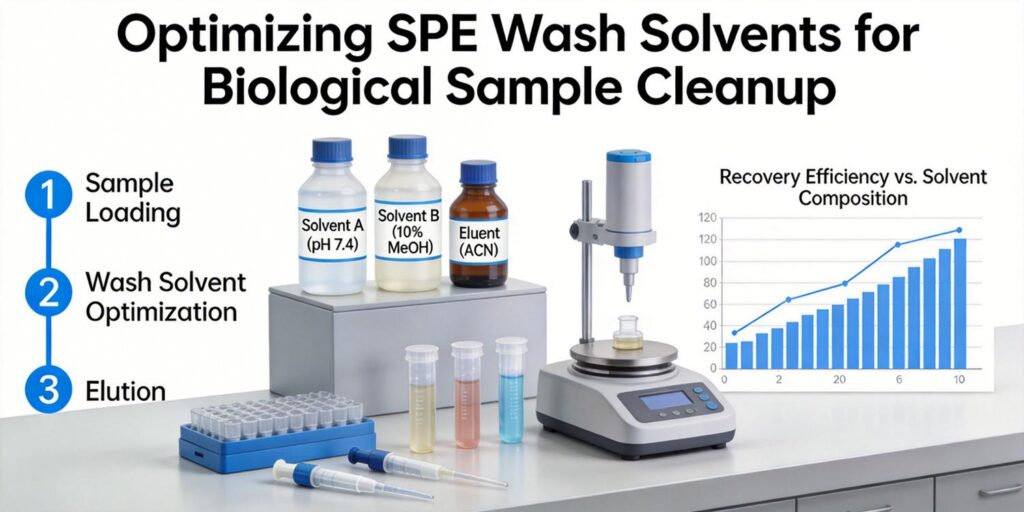
3. Testing Aqueous Wash Solutions with Varying Organic Content
Wash optimization begins with systematic testing of aqueous solutions containing controlled amounts of organic modifier:
Organic Modifier Selection
Methanol and acetonitrile are the most commonly used organic modifiers in wash solutions. Methanol provides stronger elution strength for polar compounds, while acetonitrile offers better protein precipitation and lower backpressure. The choice depends on the specific analyte-sorbent interaction and matrix composition.
Optimization Protocol
A systematic approach involves testing wash solutions with organic content ranging from 0% to 30% (v/v). For each condition:
- Prepare spiked samples at relevant concentrations
- Apply wash solutions in increasing organic strength
- Collect wash fractions and analyze for analyte breakthrough
- Evaluate matrix removal efficiency through LC-MS analysis
Critical Parameters
As noted in SPE optimization literature, “wash selection is based on the polarity and solubility characteristics of the matrix and the target compounds. It is recommended to use the strongest and the greatest volume of wash solvents that do not cause desired isolates to migrate or elute.”
4. Sequential Wash Design to Maximize Impurity Removal
Effective wash strategies employ sequential steps targeting different classes of interferences:
Primary Aqueous Wash
The initial wash should be purely aqueous or contain minimal organic modifier (≤5%). This step removes water-soluble interferences such as salts, sugars, and polar metabolites while retaining the analyte on the sorbent.
Intermediate Polarity Wash
A wash containing 5-15% organic modifier targets moderately polar interferences including some endogenous metabolites and protein fragments. This step requires careful optimization to avoid analyte breakthrough.
Lipid-Removal Wash
For samples with significant lipid content, a wash containing 20-30% organic modifier or specific lipid-removal solvents (such as hexane or methyl tert-butyl ether) can be employed. As noted in troubleshooting guides, “multiple small volume washes are more effective than a single, high-volume wash.”
pH-Adjusted Washes
For mixed-mode sorbents, pH-adjusted washes can selectively remove interferences while maintaining analyte retention. For example, a slightly acidic wash (pH 4-5) can remove weakly basic interferences from MCX cartridges without eluting strongly basic analytes.
5. Monitoring Analyte Breakthrough During Wash Optimization
Analyte breakthrough monitoring is critical to ensure wash conditions don’t compromise recovery:
Breakthrough Testing Methods
Two primary approaches are used:
- Fractional Collection: Collect wash fractions separately and analyze each for analyte content
- Mass Balance: Compare total analyte recovered (wash + elution) to initial loaded amount
Acceptable Breakthrough Limits
Generally, less than 5% analyte loss during wash steps is acceptable for most applications. For trace analysis or regulatory methods, more stringent limits (≤2%) may be required.
Flow Rate Considerations
As emphasized in SPE literature, “flows that are too slow can allow matrix components to trap inside terminal pores, potentially resulting in increased interferences and lower recovery. Recommended flow rates for sample application are about 1–2 mL/min.” Wash flow rates should be optimized similarly, typically in the 1-3 mL/min range.
6. LC-MS Evaluation of Matrix Suppression Effects
LC-MS provides the most sensitive evaluation of wash optimization effectiveness:
Matrix Effect Assessment
Matrix effects are evaluated using post-extraction spiking or the post-column infusion method. The matrix factor (MF) is calculated as:
MF = (Peak area in matrix extract) / (Peak area in neat solution)
Values close to 1.0 indicate minimal matrix suppression or enhancement.
Ion Suppression Mapping
Post-column infusion allows visualization of suppression regions throughout the chromatographic run. This helps identify whether matrix effects are caused by co-eluting compounds that could be removed through improved wash conditions.
Phospholipid Monitoring
Specific MRM transitions for common phospholipids (e.g., m/z 184→184 for phosphocholines) can be monitored to assess lipid removal efficiency. Effective wash protocols should significantly reduce phospholipid signals in the final extract.
7. Implementation in Validated Analytical Methods
Once optimized, wash conditions must be validated and implemented consistently:
Method Validation Parameters
Wash optimization should be validated through:
- Recovery: Demonstrate consistent analyte recovery across the calibration range
- Precision: Show reproducible matrix removal (RSD ≤15% for matrix factors)
- Specificity: Confirm removal of key interferences through comparison with blank matrices
- Robustness: Test wash conditions under slight variations in organic content, volume, and flow rate
High-Throughput Implementation
For laboratories processing large sample batches, optimized wash protocols can be implemented using 96-well SPE plates. Automated systems provide consistent wash application and improve reproducibility compared to manual methods.
Documentation and Training
Proper documentation of wash optimization experiments is essential for method transfer and regulatory compliance. This includes:
- Detailed experimental protocols
- Raw data and calculations
- LC-MS chromatograms demonstrating matrix removal
- Validation summary reports
Continuous Improvement
As noted in method development literature, “based on results of the optimization experiments, it may become necessary to repeat previous steps under different conditions.” Regular review of method performance and occasional re-optimization may be needed as sample matrices or analytical requirements change.
Effective SPE wash optimization represents a critical investment in analytical method quality. By systematically addressing matrix interferences through strategic wash design, laboratories can achieve cleaner extracts, improved sensitivity, and more reliable quantitative results in biological sample analysis.