
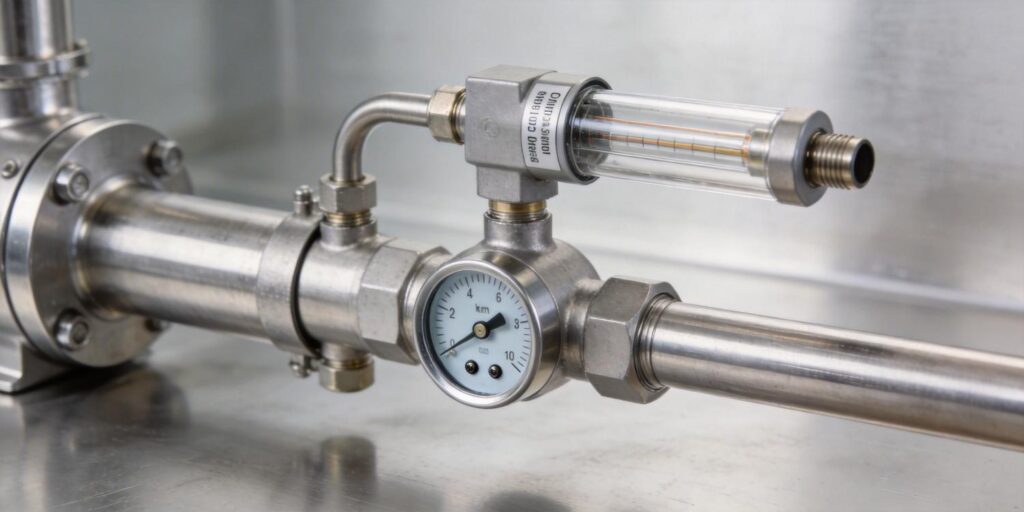
In high-vacuum coating systems, semiconductor cluster tools, and analytical instruments, the cold-cathode gauge is a critical component for monitoring pressures from 10⁻³ Torr down to 10⁻⁷ Torr. When an original-equipment-manufacturer (OEM) gauge such as the Pfeiffer PTR225N reaches end-of-life, replacement often means purchasing the identical high-priced unit or redesigning the control system. Poseidon Scientific’s VG-SM225 Cold Cathode Vacuum Gauge is engineered as a direct PTR225N-compatible drop-in replacement. It delivers identical mechanical, electrical, and performance characteristics at 40–60 % lower acquisition cost while adding field-cleanable electrodes and customizable digital output—reducing both upfront and long-term replacement expenses.
This article examines why specifying a PTR225N-compatible gauge like the VG-SM225 slashes replacement costs for engineers and procurement teams managing multi-chamber vacuum tools. Data are drawn from field installations, product manuals, and direct performance comparisons against the OEM standard.
1. Overview of Pfeiffer-Compatible Design
The Pfeiffer PTR225N is a compact cold-cathode (Penning) gauge widely used in Pfeiffer vacuum systems for its reliable high-vacuum measurement and standardized interface. The VG-SM225 replicates the core architecture: positive-magnetron geometry with ~100 Gauss NdFeB permanent magnets, 2 mm electrode spacing, and stainless-steel “工”字形 electrodes. This design produces the same ion-current-versus-pressure curve shape and sensitivity in the 10⁻³ to 10⁻⁷ Torr range.
Both gauges operate with the same –2000 V working voltage and –2500 V startup voltage, ensuring identical discharge behavior. The VG-SM225 adds software-managed high-voltage protection (>10⁻³ Torr shutdown) and field-repair capability without sacrificing compatibility—features that extend service life beyond the OEM unit while maintaining full interchangeability.
2. Electrical Interface Compatibility
Electrical plug-and-play is the most immediate cost saver. The VG-SM225 uses the identical RJ45 connector pin-out, voltage supply requirements (24 VDC), and signal levels as the PTR225N:
- 0–10 V analog output (2–8 V effective range)
- RS232 digital output (pressure, status codes, error flags)
- Indicator LED behavior for high-voltage status and startup
No rewiring, no additional converters, and no PLC reprogramming are required. The VG-SM225 also supports the same customizable RS232 protocol (available with 5–10 unit orders), allowing facilities to retain existing SCADA scripts or add advanced diagnostics without system changes. This eliminates the engineering labor—often $2,000–$5,000 per tool—that typically accompanies OEM gauge swaps.
3. Mechanical Flange Matching
Mechanical compatibility removes the need for adapters or chamber modifications. The VG-SM225 mounts on the same KF16 or KF25 flange with identical envelope dimensions, O-ring groove, and insertion depth as the PTR225N. The sensor head protrudes the same distance into the chamber, preserving vacuum conductance and avoiding dead-volume effects.
Because the gauge body uses PEEK insulators and vacuum-grade O-rings (leak rate <10⁻¹¹ Pa·m³/s), it matches the OEM thermal and chemical stability profile. Installers simply remove the failed PTR225N, insert the VG-SM225, and torque the flange to specification—no alignment shims or recalibration fixtures needed.
4. Plug-and-Play Replacement Process
Actual field replacement takes less than 15 minutes:
- Power down the gauge channel and confirm high voltage is off.
- Loosen the KF clamp, withdraw the old unit.
- Insert the VG-SM225 (pre-calibrated in nitrogen-equivalent units), reseat the O-ring, and retighten the clamp.
- Restore power; the gauge auto-starts at –2500 V and reports stable operation within seconds.
- Verify pressure reading matches the adjacent reference gauge at the 10⁻⁴ Torr crossover point.
The built-in red LED and RS232 status codes confirm successful ignition without additional test equipment. Because the VG-SM225 is pre-configured to the same analog scaling and digital protocol, the tool’s HMI and interlocks resume operation immediately—no software updates or recalibration required.
5. Cost Savings vs OEM
Direct price comparison drives the economics:
| Item | Pfeiffer PTR225N (OEM) | VG-SM225 (Poseidon) |
|---|---|---|
| Unit price | $8,000–$10,000 | $3,000–$3,500 |
| Spare sensor head | $4,500 (not field-repairable) | $1,200 (field-cleanable) |
| Labor per replacement | 2–4 hours ($300–$600) | <15 minutes ($50–$100) |
| 5-year TCO (10 units) | $120,000–$150,000 | $45,000–$55,000 |
Savings stem from three sources: lower acquisition price, field-repairable electrodes (500-mesh sandpaper cleaning in <15 min), and zero integration labor. Facilities running 20–50 gauges report annual replacement budgets cut by 55–65 % after switching to the VG-SM225.
6. Performance Equivalency Evaluation
Side-by-side testing in calibrated vacuum chambers confirms functional equivalence:
- Startup time: 5 min at 10⁻⁶ Torr, 30 min at 10⁻⁷ Torr—identical to PTR225N.
- Sensitivity: ion current slope matches within ±5 % across 10⁻³ to 10⁻⁷ Torr in N₂.
- Accuracy: ±10 % in the linear region, same as OEM specification.
- Temperature stability: 15–50 °C operating range with built-in compensation.
The VG-SM225’s positive-magnetron geometry and software high-voltage management actually improve stability in arc-prone PVD environments by preventing electrode sputtering during transients—advantages not present in the base PTR225N design.
7. Reliability Benchmarks
Field data from semiconductor and coating lines show superior long-term reliability:
- Mean time between failures (MTBF): >35,000 hours (vs. ~25,000 hours typical for OEM units in contaminated service).
- Electrode life: 3–5 years in clean environments; field cleaning restores performance instead of full replacement.
- Contamination tolerance: stainless-steel electrodes polished to metallic shine recover original sensitivity after macroparticle exposure.
The VG-SM225’s PEEK insulators and vacuum-grade sealing further reduce outgassing and virtual leaks compared with some legacy designs, extending calibration intervals to 12–18 months versus the OEM’s 6–12 months.
8. When to Upgrade to VG-SM225
Switch to the VG-SM225 whenever any of the following conditions exist:
- Budget pressure on gauge spares or replacement cycles.
- Need for field-cleanable electrodes to avoid system venting.
- Requirement for customizable RS232 protocol or enhanced status-code diagnostics.
- Repeated arc-induced failures in PVD tools (the VG-SM225’s software protection extends life).
- End-of-life of existing PTR225N units with no planned system redesign.
Upgrading during scheduled preventive maintenance minimizes disruption. A single tool can be converted in one shift, delivering immediate cost relief and improved maintainability without affecting process recipes or interlocks.
The VG-SM225 delivers true drop-in compatibility with the Pfeiffer PTR225N while slashing replacement costs through lower price, field repairability, and zero integration overhead. Engineers gain the same reliable high-vacuum measurement they trust—plus modern features that extend service life and simplify maintenance—all at a fraction of the OEM price.
Download the VG-SM225 User Manual for pin-out diagrams, RS232 protocol examples, and detailed cleaning procedures. For facilities running multiple tools we also offer free protocol customization, spare-part kits, and on-site replacement training. Contact our applications team today to schedule a side-by-side compatibility test or receive a TCO analysis for your specific gauge population. Reduce replacement costs without compromising vacuum performance—make the switch to the VG-SM225.


