
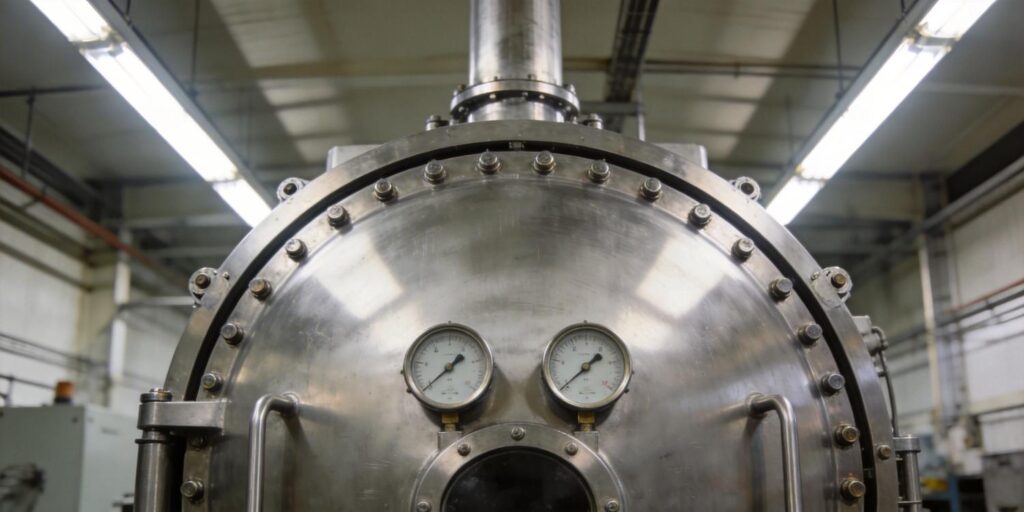
How to Size Vacuum Gauges for Large Industrial Chambers
Large industrial vacuum chambers—whether for vacuum heat treatment furnaces, large-scale PVD coaters, aerospace simulation vessels, or semiconductor batch tools—present unique sizing challenges. Chamber volumes often exceed 1 m³, conductance paths are long, and pump-down times must be minimized without compromising measurement accuracy. Incorrect gauge selection or placement can result in slow response, non-representative readings, or unnecessary cost. Poseidon Scientific’s VG-SP205 Pirani Vacuum Transmitter and VG-SM225 Cold Cathode Vacuum Transmitter (PTR225N-compatible) are designed specifically for these demanding applications. Their compact size, wide-range capability, 0–10 V analog output, and customizable RS232 protocols simplify sizing while delivering reliable, cost-effective performance. This article provides engineers and system designers with a practical, step-by-step methodology to correctly size and locate vacuum gauges in large chambers.
1. Calculating Chamber Volume and Conductance
Begin every sizing exercise with accurate chamber volume \( V \) and effective conductance \( C \). Volume is calculated from internal dimensions:
\[ V = L \times W \times H \times K \]
where \( K \) is a correction factor (typically 0.85–0.95) to account for internal fixtures and baffles. For complex geometries, 3D CAD integration or water-fill calibration yields the most precise value.
Conductance \( C \) (in L/s) determines how quickly pressure equilibrates between the gauge and the pumping port. For molecular flow (dominant below 10⁻³ Torr), the long-tube approximation is:
\[ C = 3.81 \sqrt{\frac{T}{M}} \frac{d^3}{L} \]
where \( T \) is temperature (K), \( M \) is molar mass (g/mol), \( d \) is tube diameter (cm), and \( L \) is length (cm). In large chambers, conductance limitations often make the gauge reading differ from true chamber pressure by 10–30 %. Poseidon’s small-footprint transmitters minimize this error when mounted with short, high-conductance KF16/KF25 stubs.
2. Pump Capacity vs Measurement Range
Pump speed \( S \) (L/s) and chamber volume dictate pump-down time and the required gauge range. The classic relation for pump-down time from initial pressure \( P_1 \) to final pressure \( P_2 \) is:
\[ t = \frac{V}{S} \ln\left(\frac{P_1}{P_2}\right) \]
For a 5 m³ chamber with a 2000 L/s turbomolecular pump, crossover from roughing to high vacuum typically occurs near 10⁻³ Torr. The VG-SP205 Pirani covers atmosphere to 10⁻³ Torr with peak accuracy in the 10–10⁻² Torr linear band—precisely where roughing pumps operate at maximum load. The VG-SM225 Cold Cathode then takes over from 10⁻³ to 10⁻⁷ Torr, matching the high-vacuum pump’s ultimate capability. Matching gauge range to pump capacity prevents over-ranging (cold cathode) or insufficient resolution (Pirani) during critical transitions.
3. Required Pressure Resolution
Large chambers demand resolution sufficient to detect small leaks or outgassing changes. Target resolution is typically 1 % of operating pressure or better. The VG-SP205 delivers <5 % accuracy in its linear region (10–10⁻² Torr), while the VG-SM225 provides <8 % across its full range. For a 10 m³ chamber targeting 5 × 10⁻⁶ Torr base pressure, the cold-cathode gauge must resolve ~5 × 10⁻⁸ Torr steps. Poseidon’s 16-bit effective output (via 0–10 V span) and internal compensation easily meet this requirement. Always verify against process tolerance: optical coating chambers may need 0.1 % resolution, while heat-treatment furnaces tolerate 5 %.
4. Roughing and High Vacuum Stages
Multi-stage pumping requires staged monitoring. Roughing stage (rotary vane or dry pump) uses the VG-SP205 Pirani mounted near the roughing port to track pump-down and trigger crossover at ~1 Torr. High-vacuum stage (turbomolecular or diffusion pump) uses the VG-SM225 Cold Cathode at the chamber dome or opposite the high-vacuum port. Overlap at 10⁻³ Torr enables automatic valve logic and cross-validation. Poseidon’s 0–10 V output (2–8 V active) maps directly to PLC analog inputs for both stages, while customizable RS232 allows the controller to receive engineering units without additional scaling blocks.
5. Gauge Placement Relative to Pump Port
Placement is critical for representative readings. In large chambers, pressure gradients can reach 20–50 % between pump port and far wall due to conductance limits. Best practice:
- Roughing gauge (VG-SP205): 20–30 cm from roughing inlet, on a short KF stub.
- High-vacuum gauge (VG-SM225): opposite the high-vacuum port or at the geometric center, elevated 10–20 cm above the floor to avoid particulates.
Avoid direct line-of-sight to the pump throat to reduce oil or debris contamination. Poseidon’s arbitrary mounting orientation and compact size simplify optimal placement even in space-constrained large chambers. For very large vessels (>10 m³), install multiple gauges at opposite ends and average readings via PLC logic.
6. Cable Length and Signal Integrity
Long cable runs (often 10–30 m in large systems) introduce noise and voltage drop. Use shielded twisted-pair cable with the shield grounded at the controller end only. Poseidon transmitters output low-impedance 0–10 V signals (<100 Ω), tolerating runs up to 30 m with <0.2 % error when properly shielded. For distances >30 m, switch to the RS232 digital output (custom protocol available) to eliminate analog noise entirely. Ferrite cores on power and signal lines further suppress EMI from nearby VFDs or RF heaters common in industrial plants.
7. Redundancy Planning for Large Systems
Large chambers justify redundancy to protect against single-point failures. Implement 2oo3 voting with three VG-SM225 units at 120° intervals around the chamber perimeter, plus dual VG-SP205 units on the roughing manifold. Poseidon’s low unit cost (3000–3500 RMB) makes full redundancy economical—total hardware for a 10-gauge system remains well below one premium OEM equivalent. Independent 24 VDC supplies and optical isolators ensure channel isolation. Cross-check diagnostics between Pirani and cold-cathode pairs at crossover provide continuous health monitoring without added sensors.
8. Recommended Pirani and Cold Cathode Pairing
The optimal pairing for large chambers is one VG-SP205 Pirani per roughing line plus one VG-SM225 Cold Cathode per 3–5 m³ of chamber volume. This configuration delivers:
| Chamber Volume | Recommended Pirani Units | Recommended Cold Cathode Units | Total Estimated Cost (RMB) |
|---|---|---|---|
| 1–5 m³ | 1 | 1–2 | 6000–10500 |
| 5–15 m³ | 2 | 3 | 15000–21000 |
| >15 m³ | 2–3 | 4–6 | 24000–42000 |
The pairing ensures full coverage from atmosphere to 10⁻⁷ Torr with seamless crossover, field serviceability for the cold cathode, and plug-and-play 0–10 V integration. Custom RS232 protocols allow all gauges to speak the same digital language, simplifying large-system SCADA programming.
Sizing vacuum gauges for large industrial chambers is a balance of volume, conductance, pump capacity, and process requirements. Poseidon Scientific’s VG-SP205 Pirani and VG-SM225 Cold Cathode transmitters are purpose-built to meet these demands at low cost and with minimal integration effort. Their compact design, wide dynamic range, field-cleanable architecture, and flexible outputs enable accurate, reliable monitoring even in the largest chambers—without the premium pricing or service complexity of legacy solutions.
By following the calculation, placement, and pairing guidelines above, engineers can specify gauges that deliver representative readings, fast response, and long-term stability while protecting production uptime and controlling budget. Poseidon continues to refine these products through ongoing R&D, ensuring they remain the practical choice for next-generation large-scale vacuum systems.
References & Further Reading
Lafferty, J. M. (Ed.). (1998). Foundations of Vacuum Science and Technology. John Wiley & Sons.
Peacock, R. N., et al. (1991). “Comparison of hot cathode and cold cathode ionization gauges.” Journal of Vacuum Science & Technology A, 9(3), 1977.
Redhead, P. A. (1959). “The magnetron gauge: A cold-cathode vacuum gauge.” Canadian Journal of Physics, 37(11), 1260.
Need help sizing gauges for your large industrial chamber? Poseidon applications engineers provide free volume/conductance calculations, placement recommendations, and customized system layouts. Contact us today to schedule a no-obligation technical review and receive a tailored gauge specification package for your exact chamber and pump configuration.


