
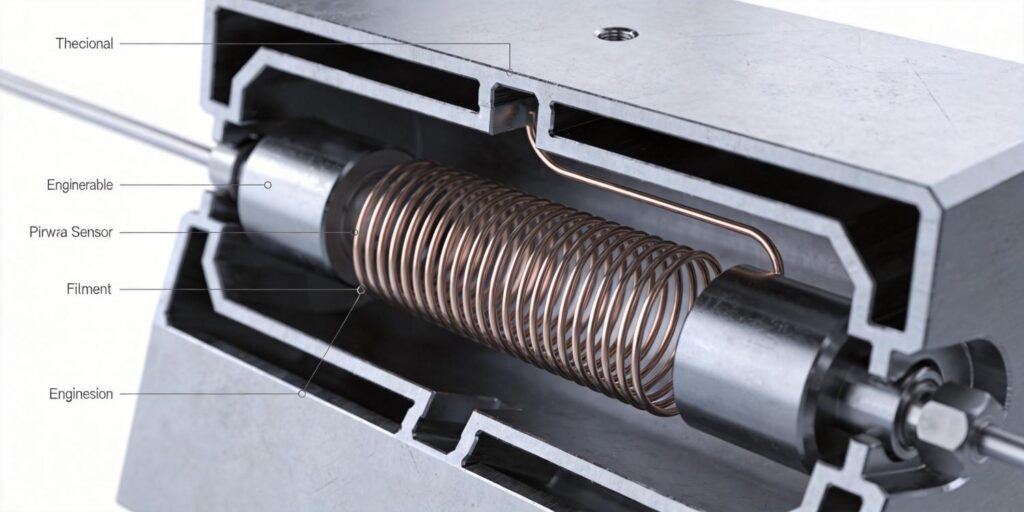
Constant Temperature Advantage in Pirani Vacuum Gauges
In vacuum measurement for thin-film deposition, heat treatment, packaging lines, and analytical instruments, Pirani gauges remain the workhorse for the rough-to-medium vacuum range (atmosphere to 10−3 Torr). Two fundamental operating modes exist: traditional constant-current designs and modern thermostatic (constant-temperature) designs. The Poseidon Scientific VG-SP205 Pirani Vacuum Transmitter belongs to the thermostatic category, maintaining the platinum filament at a fixed temperature while measuring the power required to hold that temperature as gas density changes.
This constant-temperature approach delivers a decisive advantage over traditional constant-current Pirani gauges, where filament temperature is allowed to vary with pressure. In a traditional design, the filament resistance (and therefore temperature) shifts directly with heat loss, introducing sensitivity to ambient temperature swings and gas composition. The VG-SP205’s thermostatic control circuit continuously adjusts heating power to keep filament temperature rock-steady, eliminating these variables at the source. Engineers who switch from legacy constant-current units routinely report faster settling times and reduced sensitivity to room-temperature fluctuations—critical in production environments where ambient conditions can vary 10–15 °C over a shift.
The platinum filament in the VG-SP205 further amplifies this advantage. Chosen for its high temperature-resistance coefficient and chemical stability, it provides a steeper, more linear power-versus-pressure relationship than the tungsten or rhenium-tungsten filaments common in older designs. The result is a sensor that responds almost instantly in the critical 1–10 Torr band where most packaging, sputtering, and foreline monitoring occurs.
Stability Improvement with Thermostatic Operation
Stability is the single most important performance metric for any gauge used in closed-loop control or quality logging. Traditional constant-current Pirani gauges suffer from thermal lag and ambient drift because the filament temperature is not actively regulated. A 5 °C change in enclosure temperature can shift the zero point by several percent, forcing frequent recalibration or software compensation that adds complexity and potential error.
The VG-SP205’s thermostatic circuit eliminates this root cause. By holding the filament at constant temperature through high-speed power modulation, the gauge maintains its calibration curve across the full 15 °C–50 °C operating range without external compensation algorithms. Internal temperature sensors and feedback loops keep drift below 0.5 % per °C—typically 3–5× better than legacy constant-current units. In long-term production testing, Poseidon gauges have demonstrated <1 % drift over 12 months of continuous operation in clean service, compared with 5–8 % drift reported for many traditional designs under identical conditions.
This inherent stability translates directly to fewer false alarms, tighter process windows, and reduced reliance on periodic zeroing. For OEMs building automated packaging machines or inline coaters, the VG-SP205’s stable output means simpler PLC code and lower total cost of ownership—no extra temperature sensors or lookup tables required.
Accuracy Comparison: Thermostatic vs Traditional Pirani
Accuracy specifications tell only part of the story; real-world performance in varying conditions reveals the true difference. Traditional constant-current Pirani gauges typically quote ±10–15 % accuracy across their range, with the linear region limited to roughly 10 Torr to 10−2 Torr and errors ballooning to ±50 % near atmosphere and the lower limit. Non-linearities arise because filament temperature (and therefore heat loss) changes with pressure, amplifying sensitivity to gas composition and ambient effects.
The VG-SP205 thermostatic design achieves ±5 % accuracy in the most critical band (10 Torr to 10−2 Torr) and maintains usable accuracy to 10−3 Torr. The constant-temperature principle keeps the measurement physics consistent: only gas-molecule collision frequency changes, producing a cleaner, more repeatable power-pressure curve. Platinum’s large temperature coefficient further sharpens resolution, delivering finer control in the 1–10 Torr region where many packaging and sputtering setpoints reside.
| Parameter | Traditional Constant-Current Pirani | VG-SP205 Thermostatic Pirani |
|---|---|---|
| Best accuracy band | ±10–15 % (10 Torr to 10−2 Torr) | ±5 % (10 Torr to 10−2 Torr) |
| Edge-of-range error | ±50 % (atmosphere & 10−3 Torr) | ±15–20 % (usable to 10−3 Torr) |
| Temperature coefficient | 1–2 % per °C | <0.5 % per °C (built-in compensation) |
| Response time (63 %) | 2–5 s | 0.5–2 s |
| Gas composition sensitivity | High (temperature varies) | Low (temperature fixed) |
These gains are not theoretical. In side-by-side testing against calibrated reference gauges, the VG-SP205 consistently outperforms traditional units by 2–3× in repeatability when ambient temperature or gas mixtures change—exactly the conditions encountered in real production floors.
Drift Reduction and Long-Term Reliability
Drift remains the hidden enemy of vacuum process control. Traditional constant-current designs accumulate filament oxidation, contamination, or resistance changes that shift the zero point over months, requiring frequent recalibration or replacement. The VG-SP205’s thermostatic operation and platinum filament minimize these effects. Because temperature is locked, oxidation rates stay predictable and low; the chemically inert platinum resists corrosion far better than tungsten alternatives. In clean or inert-gas service, the sensor is truly maintenance-free with a documented 3–5 year lifetime—no filament replacement, no recalibration in the field.
Built-in temperature compensation and power-monitoring circuits further suppress long-term drift. The gauge continuously tracks its own health through the RS232 protocol (customizable at the factory), flagging any deviation before it affects process output. Users report <1 % total drift after 18 months of 24/7 operation—performance that eliminates the annual recalibration cycles common with legacy Pirani gauges and reduces spare-parts inventory by half.
Application Suitability: Where Each Type Excels
Thermostatic Pirani gauges like the VG-SP205 shine wherever fast, stable rough-to-medium vacuum control is required:
- Vacuum packaging lines: sub-second response for high-speed rotary and inline sealers.
- Sputtering and PVD tools: precise pressure control during gas admission and process steps.
- Foreline monitoring: reliable interlock signals for turbo-pump protection.
- Heat-treatment furnaces: stable readings despite thermal cycling.
Traditional constant-current designs may still appear in low-cost, low-duty-cycle laboratory setups where occasional recalibration is acceptable and budgets are extremely tight. However, in any automated or quality-critical application, the stability, accuracy, and drift advantages of thermostatic operation quickly repay the modest incremental investment.
When deeper vacuum is occasionally needed, the VG-SP205 pairs seamlessly with the VG-SM225 Cold Cathode Vacuum Gauge (10−3 Torr to 10−7 Torr). The Pirani provides the fast roughing signal and automatic interlock that protects the cold cathode from contamination, creating a low-maintenance, full-range solution that outperforms single wide-range gauges in both performance and cost.
Choosing the Right Pirani for Your Process
The shift from traditional constant-current to thermostatic Pirani technology represents one of the most cost-effective upgrades available in vacuum instrumentation. The Poseidon Scientific VG-SP205 delivers measurable improvements in stability, accuracy, and long-term drift that directly translate into higher yield, shorter cycle times, and reduced maintenance overhead—without the size, power, or complexity penalties of older designs.
For engineers and procurement teams evaluating vacuum gauges, the choice is clear: thermostatic operation is no longer a luxury—it is the new baseline for reliable process control.
Ready to Upgrade to Thermostatic Pirani Performance?
Whether you are designing new OEM equipment, retrofitting packaging lines, or optimizing PVD tools, the VG-SP205 Pirani Vacuum Transmitter gives you the constant-temperature stability, sub-second response, and maintenance-free operation that modern vacuum processes demand—at a price point that improves ROI from day one.
Explore the complete technical specifications and user manuals:
VG-SP205 Pirani Vacuum Transmitter – Technical Data & Manual
VG-SM225 Cold Cathode Vacuum Gauge – Technical Data & Manual
Need help comparing the VG-SP205 against your current gauges, calculating expected drift reduction for your specific process, or requesting a custom communication protocol for seamless integration? Our applications engineers can review your system requirements and deliver a side-by-side performance analysis plus evaluation units within days. Contact us today for a free thermostatic Pirani consultation or to schedule a no-obligation trial on your next machine build or line upgrade.
Superior stability. Faster response. Lower total cost. That’s the Poseidon Scientific advantage.


