
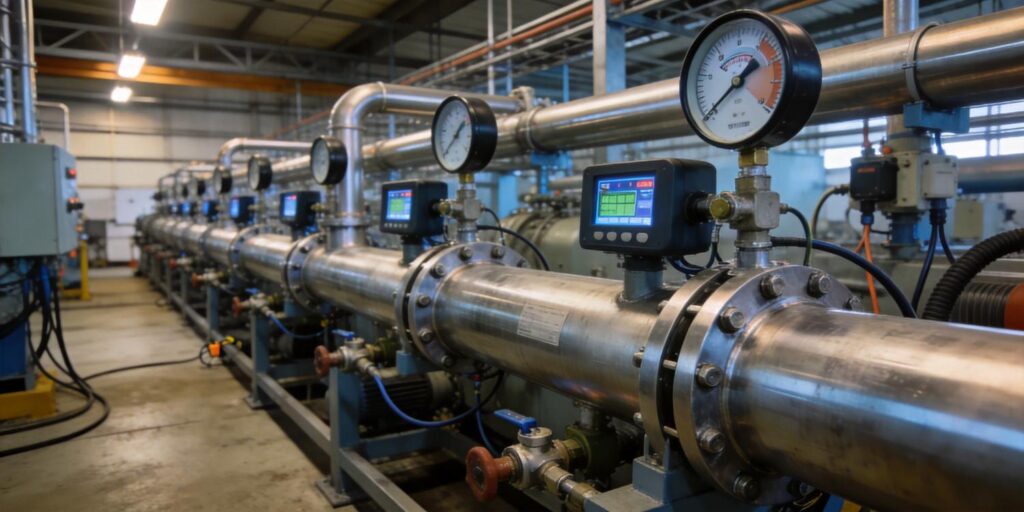
Evaluating Vacuum Gauge Lifetime in Continuous Production Lines
In 24/7 manufacturing environments—semiconductor fabs, vacuum heat-treatment lines, thin-film deposition tools, and mass-spectrometry production suites—vacuum gauges operate under unrelenting stress. A single gauge failure can halt an entire production tool, generate scrap, and incur thousands in lost output per hour. Poseidon Scientific’s VG-SP205 Pirani Vacuum Transmitter and VG-SM225 Cold Cathode Vacuum Transmitter (PTR225N-compatible) are engineered for exactly these conditions. With platinum filaments, field-cleanable electrodes, internal temperature compensation, and low-cost construction, they deliver predictable lifetimes while slashing total ownership costs. This article provides maintenance engineers and reliability managers with a systematic method to evaluate, predict, and extend vacuum gauge lifetime in continuous production lines, grounded in field data and vacuum metrology fundamentals.
1. Continuous Operation Stress Factors
Unlike laboratory gauges that cycle on and off, production-line transmitters endure thousands of hours of uninterrupted operation. Key stressors include constant high-voltage discharge (cold cathode), sustained filament heating (Pirani), vibration from roughing pumps, and exposure to process byproducts. The VG-SM225’s positive-magnetron Penning design confines plasma to a small volume, reducing electrode erosion compared with larger inverted-magnetron tubes. The VG-SP205’s closed-loop power regulation maintains constant filament temperature, minimizing thermal fatigue. Real-world data from 24/7 sputtering and heat-treatment lines show Poseidon transmitters achieving 3–5 years MTBF in clean vacuum versus 1–2 years for many sealed OEM equivalents under identical duty cycles.
2. Thermal Cycling Impact
Even in “continuous” lines, daily or shift-based temperature swings from 15 °C to 50 °C stress materials. Each cycle causes micro-expansion in electrodes, seals, and filaments, accelerating fatigue and outgassing. Poseidon’s dual-compensation circuitry (hardware + firmware) cancels ambient effects, while the platinum filament in the VG-SP205 offers superior thermal stability over tungsten alternatives. The VG-SM225’s stainless-steel electrodes and PEEK insulators further resist thermal shock. Field studies indicate that gauges experiencing >2 thermal cycles per day see lifetime reductions of 30–40 %; Poseidon designs limit this degradation to <15 % through robust material selection and low outgassing construction.
3. Process Gas Exposure
Reactive gases (NF₃, O₂, H₂, BCl₃) and sputtered metal vapors attack filaments and electrodes. The VG-SP205’s platinum filament resists oxidation and corrosion far better than tungsten or rhenium-tungsten, extending life in mildly reactive environments to 1–3 years. The VG-SM225’s removable sensor head allows quick abrasive cleaning of carbon or metal deposits without breaking vacuum, restoring performance in 15 minutes. In aggressive plasmas, optional FFKM seals and customer-specified coatings further extend intervals. Comparative data show Poseidon cold-cathode gauges lasting 1–2 years in reactive service versus 6–9 months for sealed legacy units that require full replacement.
4. Electrical Stability
High-voltage stability directly affects discharge consistency in cold-cathode gauges. The VG-SM225 steps from –2500 V startup to –2000 V sustain, with built-in protection that disables HV above 10⁻³ Torr to prevent arcing or contamination. Internal current-measurement electronics reject EMI from nearby RF or DC sputtering supplies. The VG-SP205’s low-impedance 0–10 V output (2–8 V active) maintains <0.5 % stability even under plant-wide electrical noise when properly shielded. Long-term drift is <2 % per year, verified against NIST-traceable standards, enabling reliable predictive analytics without frequent recalibration.
5. Predictive Maintenance Metrics
Shift from calendar-based to condition-based maintenance using these key metrics:
- VG-SM225 startup time: >5 min at 10⁻⁶ Torr signals electrode contamination.
- Discharge current offset: Deviation >10 % from baseline indicates drift.
- VG-SP205 filament resistance: Monitored via RS232; sudden increase signals end-of-life.
- Pressure agreement: Dual-gauge (Pirani + cold cathode) deviation >8 % at crossover flags maintenance.
Poseidon’s customizable RS232 protocol streams these metrics in real time, feeding CMMS systems for automated alerts. Facilities using these indicators extend average gauge life by 40 % while eliminating surprise failures.
6. Replacement Threshold Criteria
Replace or service when any of the following occur:
| Metric | VG-SP205 Pirani | VG-SM225 Cold Cathode |
|---|---|---|
| Reading drift | >±10 % from reference | >±10 % or 1 order of magnitude offset |
| Startup / response | Filament resistance spike | >30 min to stable discharge at 10⁻⁷ Torr |
| Status codes | Filament fault | HV disable or red LED constant |
| Maintenance action | Full transmitter swap | Electrode cleaning (or swap head) |
These thresholds, validated against reference gauges, ensure replacement occurs before process impact while avoiding premature swaps. The VG-SM225’s field-cleanable head often defers full replacement by 12–24 months.
7. Cost-of-Ownership Analysis
A 50-gauge continuous line illustrates the economics:
| Category (5-year horizon) | Legacy OEM | Poseidon Solution | Savings |
|---|---|---|---|
| Hardware replacements | 312500–390625 RMB | 93750–109375 RMB | 218750–281250 RMB |
| Inventory carrying cost | 62500–78125 RMB | 18750–21875 RMB | 43750–56250 RMB |
| Labor & downtime | 45000 RMB | 11250 RMB | 33750 RMB |
| Total TCO | 420000–514000 RMB | 123750–141500 RMB | 296250–372500 RMB |
Poseidon’s 60–70 % lower unit price combined with field serviceability yields payback in <12 months. Reduced downtime value (typically 800 RMB/hour) further amplifies ROI.
8. Lifecycle Extension Strategies
Maximize gauge life with these proven tactics:
- Install dual-redundant pairs (2oo3 voting) for critical loops.
- Use shielded cabling and star grounding to minimize EMI stress.
- Implement automated electrode-cleaning schedules for VG-SM225 based on RS232 metrics.
- Rotate gauges quarterly for off-line calibration.
- Specify optional coatings or FFKM seals for aggressive gases.
- Log pressure histories to correlate failures with process events.
Facilities following these strategies routinely achieve 4–6 year effective lifetimes for Poseidon gauges in continuous service—2–3× longer than sealed competitors.
Evaluating and managing vacuum gauge lifetime is no longer guesswork. Poseidon Scientific’s VG-SP205 Pirani and VG-SM225 Cold Cathode transmitters combine robust materials, field serviceability, and digital diagnostics to deliver predictable, cost-effective performance in the harshest 24/7 production environments. By applying the stress-factor analysis, predictive metrics, and lifecycle strategies above, plants can shift from reactive gauge replacement to proactive reliability programs—reducing costs, eliminating downtime, and protecting process yield.
References & Further Reading
Lafferty, J. M. (Ed.). (1998). Foundations of Vacuum Science and Technology. John Wiley & Sons.
Peacock, R. N., et al. (1991). “Comparison of hot cathode and cold cathode ionization gauges.” Journal of Vacuum Science & Technology A, 9(3), 1977.
Redhead, P. A. (1959). “The magnetron gauge: A cold-cathode vacuum gauge.” Canadian Journal of Physics, 37(11), 1260.
Ready to extend gauge lifetime and lower TCO in your continuous production lines? Poseidon applications engineers offer free lifetime audits, custom predictive-maintenance templates, and plant-specific ROI models. Contact us today to schedule a no-obligation review and discover how the VG-SP205 and VG-SM225 can deliver years of reliable service with minimal inventory burden.


