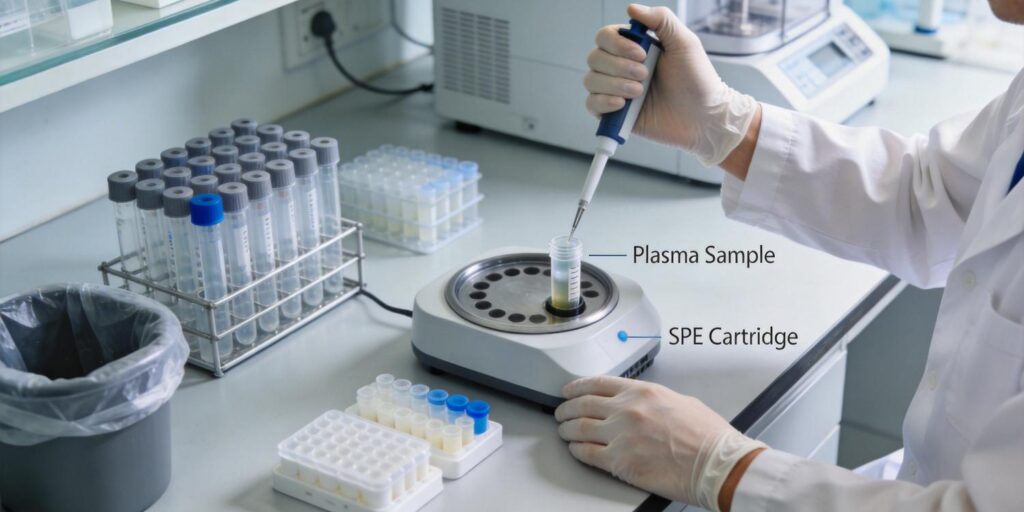
Salt Interference in LC-MS Analysis
In liquid chromatography-mass spectrometry (LC-MS) analysis, salts present in biological samples can cause significant analytical challenges. These inorganic ions interfere with the ionization process in the mass spectrometer, leading to ion suppression or enhancement effects that compromise quantitative accuracy. According to research, atmospheric pressure ionization-MS systems are particularly susceptible to suppression of ionization by co-extracted endogenous interferences from biofluids. The presence of salts can also lead to fouling of the MS interface, reducing instrument uptime and requiring frequent source cleaning.
When samples contain high salt concentrations, they can deposit in the transfer capillary or interface to the MS system, causing rapid decline in signal intensity and spectral quality. This is especially problematic when analyzing biological samples that inherently contain various salts and electrolytes. The goal of SPE desalting is to eliminate these inorganic compounds that may affect the ion sources that induce ionization/fragmentation and remove large molecules that may foul up the interfaces between the sample introduction port and the mass spectrometer.
Sources of Salts in Biological Samples
Biological samples contain salts from multiple sources, each presenting unique challenges for LC-MS analysis. The primary sources include:
Endogenous Electrolytes
Human biological fluids naturally contain electrolytes such as sodium chloride, potassium chloride, calcium chloride, and various phosphate buffers. Plasma and serum typically contain 140-150 mM sodium chloride, while urine contains variable concentrations depending on hydration status and renal function.
Sample Collection and Processing Additives
Many sample collection protocols involve anticoagulants (EDTA, heparin, citrate) and preservatives that introduce additional salts. Buffer systems used in sample storage and processing, such as phosphate-buffered saline (PBS) and Tris buffers, contribute significant salt loads.
Sample Pretreatment Reagents
Protein precipitation methods using acids (trichloroacetic acid, perchloric acid) or organic solvents often leave behind residual salts. Enzymatic digestion protocols may include buffers and salts necessary for optimal enzyme activity.
Matrix Effects
Different biological matrices contain varying salt concentrations. For example, cerebrospinal fluid has lower salt content than plasma, while sweat contains high sodium chloride concentrations. Understanding these variations is crucial for developing effective desalting strategies.
SPE Mechanisms for Desalting
Solid-phase extraction employs several mechanisms to remove salts from biological samples while retaining analytes of interest. The fundamental principle involves exploiting differences in retention behavior between ionic salts and target analytes.
Reversed-Phase Retention
For hydrophobic analytes, reversed-phase SPE cartridges (such as C18, C8, or HLB phases) retain organic compounds while allowing salts to pass through during the loading and washing steps. The hydrophilic-lipophilic balance (HLB) cartridges are particularly effective for a wide range of compounds with varying polarities.
Ion Exchange Mechanisms
Mixed-mode SPE cartridges combine reversed-phase and ion exchange functionalities. For basic compounds, MCX (mixed-mode cation exchange) cartridges retain analytes through both hydrophobic interactions and cation exchange, while salts are washed away. Similarly, MAX (mixed-mode anion exchange) cartridges work for acidic compounds, and WAX/WCX (weak anion/cation exchange) cartridges provide selective retention based on pH-controlled ionization.
Size Exclusion Principles
Some SPE formats utilize size exclusion principles where the sorbent pore structure excludes larger molecules while allowing salts to pass through. This approach is particularly useful for removing salts from protein or peptide samples.
Hydrophilic Interaction
For polar analytes, hydrophilic interaction liquid chromatography (HILIC) principles can be applied in SPE format, where analytes are retained through hydrogen bonding and dipole-dipole interactions while salts are eluted with appropriate wash solvents.
Cartridge Selection for Desalting Workflows
Choosing the appropriate SPE cartridge is critical for successful desalting. The selection depends on analyte properties, sample matrix, and analytical requirements.
HLB (Hydrophilic-Lipophilic Balance) Cartridges
Poseidon Scientific’s HLB SPE cartridges are ideal for broad-spectrum desalting applications. Their balanced chemistry retains both polar and non-polar compounds while allowing salts to pass through. These cartridges are particularly effective for pharmaceutical compounds, environmental contaminants, and metabolites with diverse chemical properties.
Mixed-Mode Cartridges
For targeted desalting of specific compound classes, mixed-mode cartridges offer superior selectivity. MCX cartridges are optimized for basic compounds, combining reversed-phase retention with cation exchange. MAX cartridges work similarly for acidic compounds with anion exchange functionality.
Weak Ion Exchange Cartridges
WAX cartridges and WCX cartridges provide pH-controlled retention for compounds with specific ionization characteristics. These are particularly useful when dealing with zwitterionic compounds or when selective desalting is required.
96-Well Plate Format
For high-throughput applications, 96-well SPE plates offer parallel processing capabilities. This format is essential for modern LC-MS workflows where sample throughput is critical, and it allows for automation integration.
Washing Strategies to Remove Salts Without Analyte Loss
Effective washing protocols are essential for removing salts while maintaining high analyte recovery. The washing strategy must balance salt removal with analyte retention.
Water-Based Washes
Pure water washes are most effective for removing water-soluble salts. For reversed-phase cartridges, 5-10% methanol in water can help maintain cartridge wettability while effectively removing salts. The volume should be sufficient to displace all interstitial salts—typically 3-5 column volumes.
pH-Controlled Washes
For ion exchange cartridges, washing with water adjusted to appropriate pH ensures that analytes remain ionized and retained while salts are removed. Maintaining pH at least 2 units away from the analyte’s pKa ensures optimal retention.
Organic Solvent Washes
Low-percentage organic solvent washes (5-20% methanol or acetonitrile in water) can remove some salts while maintaining analyte retention. Higher percentages may be used for more hydrophobic analytes, but careful optimization is required to prevent premature elution.
Sequential Washing
A sequential washing approach often yields best results. Start with pure water to remove bulk salts, followed by a low-organic wash to remove residual salts and some matrix interferences. For mixed-mode cartridges, additional washes with organic solvents containing volatile buffers (like ammonium acetate) can further clean the extract.
Drying Steps
After washing, proper drying of the SPE bed is crucial when changing between aqueous and organic solvents. As noted in forensic applications, “Make certain your column is dry when changing between aqueous solutions and organic solvents. The easiest way to make sure your column is dry is to pull maximum vacuum on the column for 5 min.”
Evaluating Desalting Efficiency
Assessing the effectiveness of desalting protocols is essential for method validation and quality control.
Conductivity Measurements
Measuring conductivity of eluates provides direct assessment of salt removal. A significant decrease in conductivity compared to the original sample indicates effective desalting. Target conductivity should be below 10 μS/cm for most LC-MS applications.
Mass Spectrometry Signal Assessment
Monitor ion suppression effects by comparing analyte signals in desalted versus non-desalted samples. Reduced matrix effects and improved signal-to-noise ratios indicate successful salt removal.
Recovery Studies
Quantify analyte recovery using spiked samples. As noted in SPE literature, “SPE recoveries should exceed 90% absolute recovery. If you don’t get that kind of recovery you are not adjusting other parameters (such as solubility, pH, and solvent strength) correctly.”
Chromatographic Performance
Evaluate peak shape, retention time stability, and baseline noise in chromatograms. Cleaner baselines and more consistent retention times indicate effective desalting.
Long-Term Instrument Performance
Monitor MS source contamination rates and required cleaning frequencies. Effective desalting should extend source cleaning intervals and maintain consistent instrument performance.
LC-MS Performance Improvements
Proper desalting through SPE provides multiple benefits for LC-MS analysis, significantly enhancing overall system performance.
Reduced Ion Suppression
By removing competing ions, desalting minimizes ion suppression effects, leading to more accurate quantification and improved detection limits. Studies have shown that selective SPE extraction applications are required to avoid false negatives caused by ionization suppression.
Extended Instrument Uptime
Reduced salt deposition in the MS interface decreases downtime for source cleaning. Research indicates that SPE significantly increases gas and liquid chromatography column life while reducing downtime on equipment like GC-MS and LC-MS for source cleaning.
Improved Sensitivity
Cleaner extracts allow for better detection of low-abundance analytes. As demonstrated in pharmaceutical applications, sensitivities of 50 pg/mL can be achieved for sample sizes of only 200 μL when proper desalting is implemented.
Enhanced Reproducibility
Consistent salt removal leads to more reproducible ionization efficiency and quantitative results. This is particularly important for regulated environments where method robustness is critical.
Reduced Matrix Effects
Comprehensive desalting minimizes variable matrix effects between different sample types and batches, improving comparability across studies and laboratories.
Compatibility with Advanced MS Techniques
Desalted samples are better suited for advanced MS techniques like MS/MS and high-resolution mass spectrometry, where clean backgrounds are essential for accurate fragment ion detection and identification.
In conclusion, effective SPE desalting strategies are essential for successful LC-MS analysis of biological samples. By understanding salt interference mechanisms, selecting appropriate SPE cartridges, optimizing washing protocols, and rigorously evaluating desalting efficiency, laboratories can achieve significant improvements in analytical performance. Poseidon Scientific’s comprehensive range of SPE products provides the tools necessary to implement these strategies effectively, ensuring reliable results and extended instrument lifetime.