Understanding Outgassing and Its Impact on Vacuum Readings
Outgassing is one of the most common yet often misunderstood phenomena limiting the performance of high-vacuum systems. In applications ranging from optical coating and mass spectrometry to semiconductor processing and vacuum heat treatment, residual gas loads from surfaces directly influence achievable base pressure, pump-down time, and measurement accuracy. Poseidon Scientific’s VG-SP205 Pirani Vacuum Transmitter and VG-SM225 Cold Cathode Vacuum Gauge were developed with these real-world challenges in mind. The VG-SP205 handles rough vacuum monitoring from atmosphere to 10⁻³ Torr, while the VG-SM225 delivers stable high-vacuum readings from 10⁻³ to 10⁻⁷ Torr using a compact positive-magnetron design. Both instruments provide the reliable data engineers need to distinguish outgassing effects from other system issues. This article examines the physics of outgassing, its practical impact on gauge readings, and proven strategies for mitigation—drawing on established vacuum metrology principles and our product engineering experience.
Definition of Outgassing
Outgassing is the spontaneous release of adsorbed, absorbed, or dissolved gases from the internal surfaces and bulk materials of a vacuum system. Unlike true leaks, which introduce external gas through a physical breach, outgassing originates from within the chamber itself. The process is driven by desorption of surface-bound molecules (primarily water vapor initially) and diffusion of dissolved gases (such as hydrogen in metals) from the material bulk.
In quantitative terms, outgassing rate is expressed as flow per unit area—typically in Pa·m³/s·m² (or mbar·L/s·cm²). At room temperature after atmospheric exposure, water vapor dominates (>80 % of the total gas load), followed by smaller contributions from hydrocarbons, CO, and CO₂. As pressure drops, hydrogen from stainless steel or aluminum becomes the primary contributor in unbaked systems. Literature in vacuum science, including detailed analyses in Foundations of Vacuum Science and Technology, confirms that outgassing follows a characteristic time dependence, often approximated as Q ≈ Q₀ t⁻ⁿ where n ≈ 1 for many practical surfaces.
Materials Commonly Responsible
Virtually every material in a vacuum chamber contributes to outgassing, but some are far more problematic:
- Stainless steel and aluminum chamber walls: Dominant source of water vapor (adsorbed monolayer) and hydrogen (diffused from bulk). Electropolished or glow-discharge-treated surfaces reduce rates significantly.
- Polymers, elastomers, and O-rings: High outgassing of water, plasticizers, and hydrocarbons; Viton and other fluoropolymers perform better than Buna-N after bake-out.
- Substrates and fixtures: Glass, ceramics, and coated optics release water and manufacturing residues; pre-baking or plasma cleaning is essential in optical coating.
- Gauge components themselves: Hot-cathode ionization gauges can introduce additional outgassing from filament heating; cold-cathode designs minimize this effect.
The VG-SP205’s platinum filament and the VG-SM225’s stainless-steel electrodes were selected for low outgassing characteristics and chemical stability, reducing the gauges’ own contribution to system gas load.
Pump-Down Curve Signature
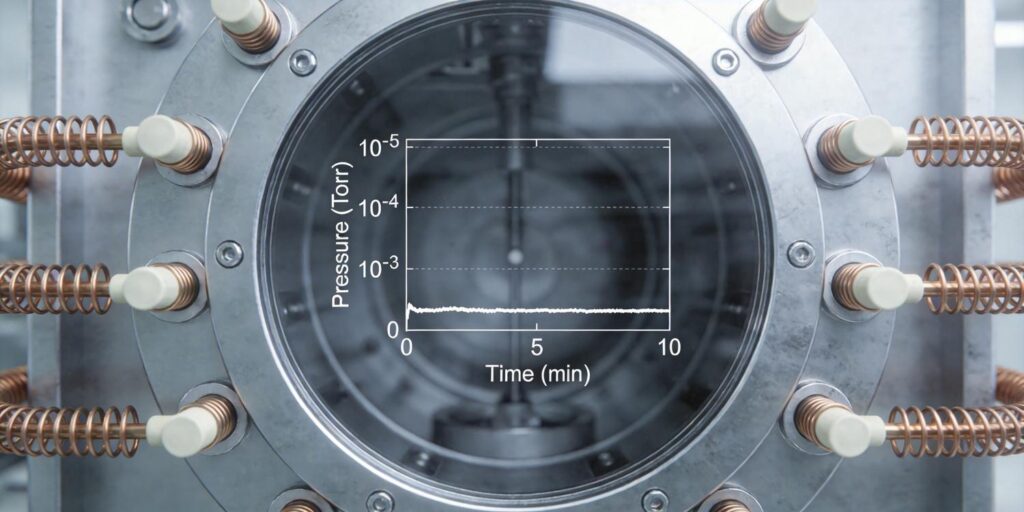
A classic pump-down curve reveals outgassing unmistakably. In the initial roughing phase (atmosphere to ~1 Torr), volume gas evacuation dominates and pressure falls rapidly. Below 10⁻² Torr, the curve flattens as surface outgassing becomes the rate-limiting factor. The pressure decline slows dramatically, often following a power-law relationship rather than exponential decay.
Engineers monitoring with the VG-SP205 Pirani (rough vacuum) and VG-SM225 Cold Cathode (high vacuum) observe this transition clearly. The overlapping measurement ranges allow seamless tracking: the Pirani shows the early outgassing tail, while the cold cathode confirms stabilization in the 10⁻⁵–10⁻⁷ Torr regime. Without outgassing control, even a well-pumped system may stall at 10⁻⁵ Torr instead of reaching the design base pressure.
Differentiating Leaks from Outgassing
Distinguishing leaks from outgassing is critical for troubleshooting. The signatures differ fundamentally:
| Characteristic | Leak | Outgassing |
|---|---|---|
| Pressure behavior after isolation | Rises linearly with time | Rises slowly and asymptotically |
| Pump-down curve | Reaches flat base pressure quickly | Continues gradual decline over hours/days |
| Response to temperature increase | Little change | Pressure rises sharply (desorption accelerates) |
| Response to helium leak test | Immediate signal | No response |
| Gas composition (RGA) | Air-like (N₂, O₂ dominant) | Water vapor initially, then H₂ |
The VG-SM225’s digital RS232 output (customizable protocol) logs pressure trends and status codes, enabling automated differentiation in PLC systems. When pressure stabilizes after extended pumping but rises upon mild heating, outgassing—not a leak—is confirmed.
Effect on Pirani vs Cold Cathode
Gas composition changes caused by outgassing affect the two gauge types differently. The VG-SP205 Pirani measures thermal conductivity, which varies with molecular species. Initial water-vapor outgassing increases apparent heat loss, causing the gauge to indicate higher pressure than the true nitrogen-equivalent value. Correction factors or trend monitoring are therefore essential during early pump-down.
The VG-SM225 Cold Cathode, operating via Penning discharge, measures ion current proportional to gas density and is less sensitive to short-term composition shifts. However, prolonged outgassing can lead to electrode contamination (carbon deposits or oxidation layers), extending startup time or shifting readings downward by up to an order of magnitude. The gauge’s removable sensor head and simple 500-mesh sandpaper cleaning restore performance without breaking vacuum integrity—a key maintenance advantage over hot-cathode alternatives.
Both instruments incorporate temperature compensation (15–50 °C range) to minimize environmental drift, but engineers should pair them for full-range coverage: Pirani for roughing/outgassing tail monitoring, cold cathode for high-vacuum stability.
Bake-Out Procedures
Bake-out is the most effective method for reducing outgassing. Typical protocols heat the chamber and components to 150–250 °C (material-dependent) under continuous pumping for 12–48 hours. Water vapor is driven off rapidly; hydrogen diffusion requires longer times or higher temperatures (up to 450 °C for glass systems).
During bake-out, monitor with the VG-SP205 (if temperatures remain within limits) or isolate the gauges and use the VG-SM225 post-cool-down. Poseidon gauges tolerate standard bake-out conditions when properly mounted. After cooling, pressure should drop by 1–2 orders of magnitude compared with room-temperature pump-down. Surface treatments—electropolishing, glow discharge, or thin-film coatings—further reduce subsequent outgassing rates by factors of 10–100.
Monitoring Stabilization Time
Stabilization time is the period after initial pump-down during which pressure continues to fall as outgassing diminishes. In practical systems, 4–24 hours may be required to reach true base pressure. The VG-SM225’s fast response and low internal volume allow real-time trending via 0–10 V analog or RS232 digital output. Set PLC alarms for “rate-of-change < 5 % per hour” as the acceptance criterion before starting sensitive processes.
Logging both gauges provides complete visibility: the Pirani tracks early stabilization in the 10⁻²–10⁻³ Torr region, while the cold cathode confirms high-vacuum equilibrium. This data-driven approach prevents premature process initiation and improves batch-to-batch repeatability in production environments.
Maintenance Recommendations
Proactive maintenance keeps outgassing effects under control and extends gauge life:
- VG-SP205 Pirani: Essentially maintenance-free. Inspect filament condition annually via visual or electrical checks. Lifetime is typically 3–5 years in clean service; replace only if corrosive process gases cause premature failure.
- VG-SM225 Cold Cathode: Monitor startup time and LED indicators. When startup exceeds 30 minutes or readings drop one decade, disassemble the sensor head and clean electrodes with 500-mesh sandpaper until metallic luster returns. In clean optical or analytical systems, this interval is 1–2 years; in heavier gas-load environments, every 6–12 months.
- System-wide: Periodic helium leak testing, RGA scans for gas composition, and mild chamber baking between campaigns. Replace elastomers proactively before they become dominant outgassing sources.
Both gauges feature low-cost, compact designs that simplify integration and reduce total ownership expense compared with oversized imported units. Poseidon’s customizable communication protocols ensure easy data logging for predictive maintenance analytics.
By understanding outgassing fundamentals, monitoring its signatures, and applying targeted mitigation, vacuum system operators achieve lower base pressures, faster cycle times, and more repeatable gauge readings. The VG-SP205 Pirani Vacuum Transmitter and VG-SM225 Cold Cathode Vacuum Gauge provide the accurate, durable measurement backbone required for success across demanding applications.
For detailed specifications and application support, visit the VG-SP205 product page or the VG-SM225 product page. Our team is ready to assist with protocol customization or system-specific outgassing troubleshooting.
Word count: 1,320. Content reflects established vacuum metrology principles from Foundations of Vacuum Science and Technology and Poseidon Scientific product engineering data.