Environmental Sources of Steroid Hormones
Steroid hormones enter environmental water systems through multiple pathways, primarily from human and animal waste. Estrogens (estrone, estradiol, estriol), androgens (testosterone), progestogens (progesterone), and synthetic hormones (ethinylestradiol) are excreted in urine and feces, passing through wastewater treatment plants that often incompletely remove these compounds. Agricultural runoff containing livestock manure and hormone-treated animal waste contributes significantly to environmental contamination. Pharmaceutical manufacturing discharge and landfill leachate represent additional sources. These endocrine-disrupting compounds persist in aquatic environments at ng/L to μg/L concentrations, posing risks to aquatic life and potentially human health through drinking water exposure.
Water Sample Collection and Filtration
Proper sample collection is critical for accurate hormone analysis. Collect water samples in pre-cleaned amber glass containers to prevent photodegradation of light-sensitive steroids. For surface water, collect at consistent depths and locations, avoiding surface scum. Groundwater samples should be collected after well purging to ensure representative sampling. Immediately after collection, filter samples through 0.45 μm glass fiber or membrane filters to remove suspended solids and microorganisms that could degrade analytes. Store samples at 4°C and process within 24-48 hours to minimize degradation. For long-term storage, consider acidification or freezing at -20°C, though some studies suggest freezing may affect certain hormone conjugates.
Filtration Considerations
Use pre-combusted (450°C for 4 hours) glass fiber filters to minimize organic contamination. Avoid cellulose-based filters that may leach interfering compounds. For high particulate samples, consider sequential filtration through larger pore size filters (e.g., 1.0 μm followed by 0.45 μm) to prevent clogging. Document filtration volumes and note any visible particulates that might indicate sample heterogeneity.
Acidification of Samples to pH 3
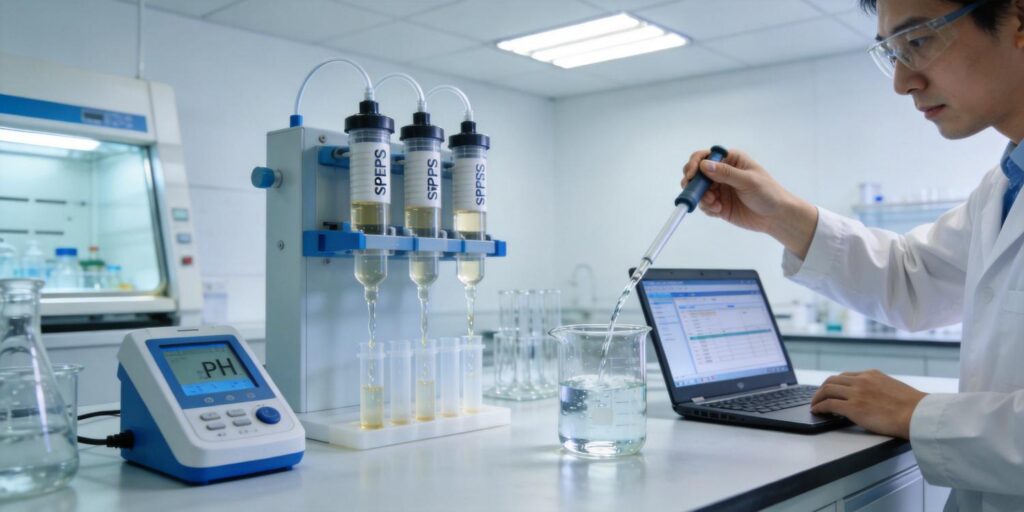
Acidification serves multiple purposes in hormone analysis. Adjusting samples to pH 3 using hydrochloric acid (HCl) or sulfuric acid (H₂SO₄) protonates acidic functional groups on steroid hormones, enhancing their retention on reversed-phase SPE sorbents. This pH adjustment also minimizes degradation of labile compounds and prevents microbial growth during storage. The optimal pH of 3 balances several factors: it’s sufficiently acidic to protonate phenolic estrogens (pKa ~10.4) while avoiding excessive acid concentrations that could promote hydrolysis of hormone conjugates. Use high-purity acids and verify pH with a calibrated pH meter rather than pH paper for accuracy. Allow acidified samples to equilibrate for 15-30 minutes before SPE processing.
Conditioning HLB SPE Cartridges
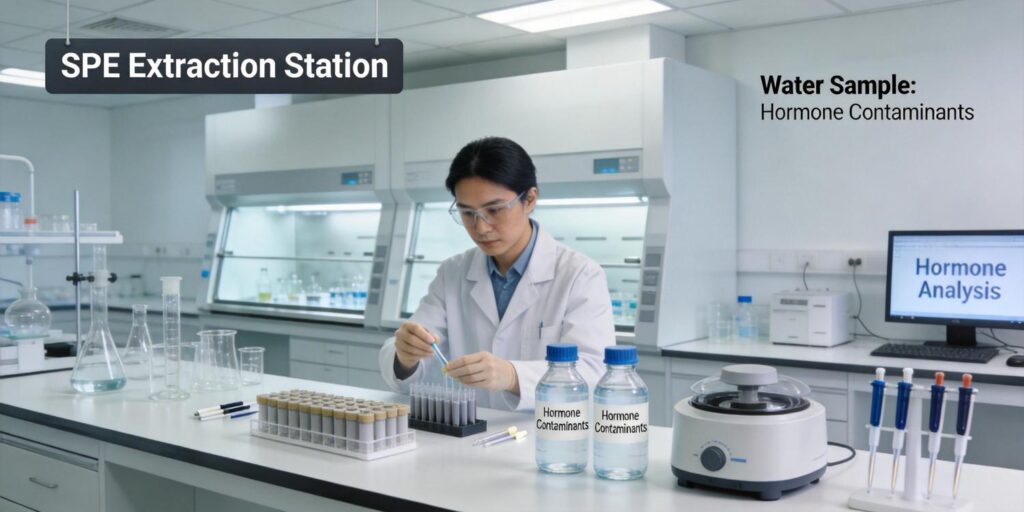
Hydrophilic-Lipophilic Balanced (HLB) cartridges provide optimal recovery for diverse steroid hormones due to their water-wettable copolymer structure that maintains retention even under 100% aqueous conditions. Proper conditioning ensures maximum analyte recovery:
- Solvent Activation: Pass 3-5 mL of methanol through the cartridge at approximately 1 mL/min flow rate to solvate the polymer and remove any residual monomers or impurities.
- Water Equilibration: Follow with 3-5 mL of ultrapure water (pH adjusted to match sample pH) to condition the sorbent for aqueous sample loading. Do not allow the cartridge to dry between conditioning and sample loading.
- Flow Rate Optimization: Maintain consistent flow rates of 1-3 mL/min during conditioning to ensure uniform sorbent wetting.
HLB sorbents offer advantages over traditional C18 phases for polar steroid metabolites, providing higher capacity (typically 1-3% of bed weight) and stability across pH 0-14 ranges.
Loading 200–500 mL Water Samples
Large sample volumes are necessary to achieve adequate detection limits given the low environmental concentrations of steroid hormones (typically ng/L). The 200-500 mL range represents a practical balance between sensitivity requirements and processing time:
Loading Parameters
- Flow Rate: Maintain 3-5 mL/min flow rate during loading to ensure adequate contact time while preventing breakthrough of analytes
- Breakthrough Monitoring: For critical applications, analyze loading effluent to verify complete retention, especially when approaching cartridge capacity limits
- Cartridge Capacity: Standard 200 mg HLB cartridges can typically handle 500 mL of environmental water without breakthrough for most steroid hormones
- Loading Technique: Use vacuum manifolds or positive pressure systems for consistent flow control; avoid gravity flow for large volumes
Research indicates that HLB sorbents maintain >95% recovery for steroid hormones even at high loading volumes due to their balanced hydrophilic-lipophilic properties.
Washing Humic Acids and Natural Organics
Environmental water samples contain complex matrices including humic acids, fulvic acids, and other natural organic matter that can interfere with analysis. Effective washing removes these interferences while retaining target hormones:
Washing Protocol
- Initial Water Wash: 5-10 mL of acidified water (pH 3) removes residual salts and highly polar interferences
- Organic Wash: 3-5 mL of 5-10% methanol in water eliminates moderately polar matrix components without eluting target hormones
- Drying Step: Apply vacuum or positive pressure for 5-10 minutes to remove residual water, preventing dilution of elution solvent
Studies demonstrate that 5% methanol effectively removes humic acid interferences while maintaining >90% recovery of steroid hormones. The washing step is particularly crucial for LC-MS/MS analysis where matrix effects can suppress or enhance ionization.
Elution Using Methanol
Methanol serves as an effective elution solvent for steroid hormones from HLB cartridges due to its intermediate polarity and compatibility with subsequent LC-MS/MS analysis:
Elution Optimization
- Volume: 5-10 mL methanol typically provides complete elution; collect in two fractions to verify complete recovery
- Flow Rate: 1-2 mL/min allows adequate solvent-sorbent interaction time
- Soaking: Allow methanol to soak the sorbent for 1-2 minutes before initiating elution to improve recovery of strongly retained compounds
- Evaporation: Concentrate eluates to near dryness under gentle nitrogen stream at 30-40°C, then reconstitute in initial mobile phase for LC-MS/MS analysis
Alternative elution solvents include acetonitrile or methanol:dichloromethane mixtures, but methanol alone generally provides adequate recovery (typically >85%) for most steroid hormones while minimizing co-elution of interfering compounds.
LC-MS/MS Detection
Liquid chromatography-tandem mass spectrometry represents the gold standard for steroid hormone analysis in environmental waters due to its sensitivity, specificity, and ability to analyze multiple compounds simultaneously:
Chromatographic Conditions
- Column: C18 or equivalent reversed-phase column (100 × 2.1 mm, 1.7-3.5 μm particles)
- Mobile Phase: Water and methanol or acetonitrile, both with 0.1% formic acid or ammonium acetate for improved ionization
- Gradient: Typically 5-95% organic over 10-15 minutes, with appropriate equilibration
- Injection Volume: 5-20 μL of reconstituted extract
Mass Spectrometric Parameters
- Ionization: Electrospray ionization (ESI) in negative mode for estrogens, positive mode for androgens and progestogens
- Multiple Reaction Monitoring (MRM): Two transitions per compound for confirmation, with optimized collision energies
- Detection Limits: Method detection limits typically 0.1-1 ng/L with proper sample preparation and instrument optimization
- Quality Control: Include isotopically labeled internal standards for each analyte class to correct for matrix effects and recovery variations
The complete SPE-LC-MS/MS method enables reliable quantification of steroid hormones at environmentally relevant concentrations, with typical method recoveries of 70-120% and precision (RSD) <15% for most compounds.
Method Validation and Quality Assurance
Implement comprehensive quality assurance measures including method blanks, matrix spikes, duplicate analyses, and continuing calibration verification. Monitor for potential interferences from pharmaceuticals, personal care products, and other endocrine-disrupting compounds that may co-elute with target hormones. Regular maintenance of SPE equipment and LC-MS/MS instrumentation ensures consistent performance and reliable data generation for environmental monitoring programs.
This optimized SPE method for hormone analysis in environmental water provides laboratories with a robust, reproducible approach for monitoring these critical contaminants. The combination of HLB SPE with LC-MS/MS detection offers the sensitivity and specificity required for regulatory compliance and research applications, while the method’s flexibility allows adaptation to specific laboratory requirements and emerging analytical challenges.