Define Absolute Pressure Reference
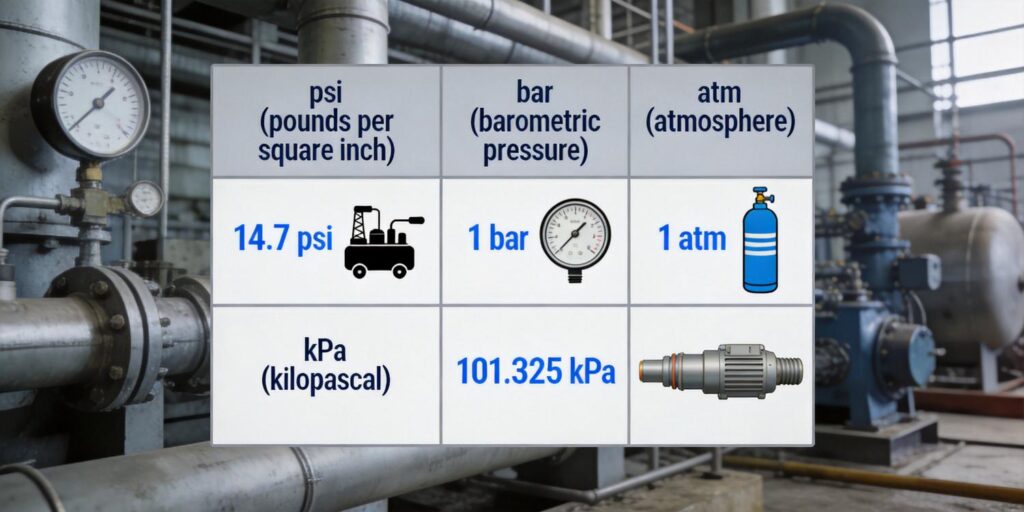
Vacuum measurement begins with a fundamental distinction: absolute pressure is always referenced to a perfect vacuum—zero molecules, zero pressure. This zero point is universal and unchanging, independent of location, weather, or altitude. In contrast, relative (or gauge) pressure uses local atmospheric pressure as its zero reference. At sea level on a standard day, atmospheric pressure equals approximately 760 Torr (101.325 kPa). A gauge-pressure reading of zero therefore means “equal to atmosphere,” while negative values indicate vacuum relative to that local barometric pressure.
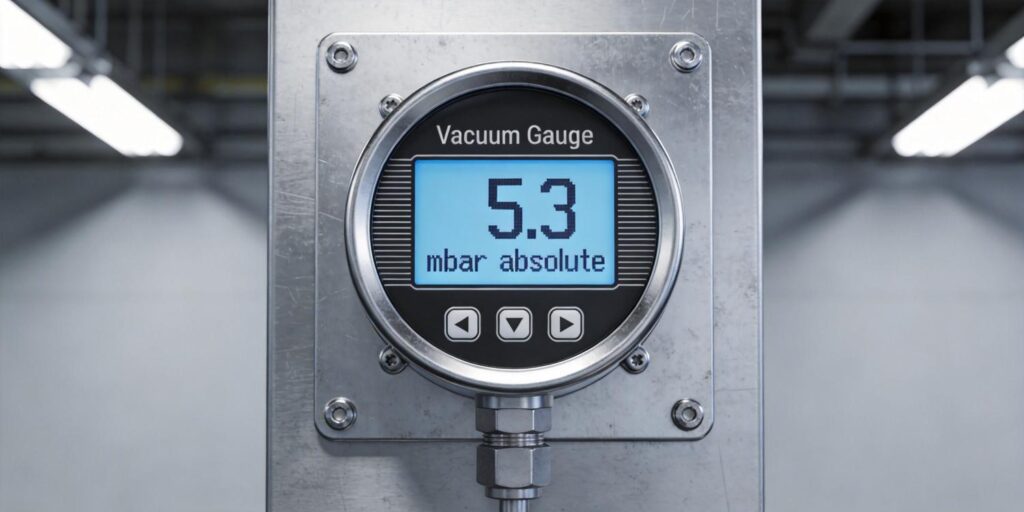
Absolute vacuum gauges, including Poseidon Scientific’s VG-SP205 Pirani Vacuum Transmitter and VG-SM225 Cold Cathode Vacuum Gauge, report pressure directly against the absolute zero reference. Their output—whether 0–10 V analog or customizable RS232 digital—corresponds to true molecular density inside the chamber. This absolute scale is the only practical choice once pressure drops below a few Torr, where atmospheric variations of even ±10 Torr would otherwise swamp the measurement.
Atmospheric Reference Differences
Atmospheric pressure fluctuates daily with weather systems and changes systematically with elevation. At 1 000 m altitude it already falls to ~674 Torr; at 3 000 m it is only ~526 Torr. A relative-pressure instrument calibrated at sea level would therefore read a false vacuum even when the chamber is open to local air. In high-vacuum applications—mass spectrometry, scanning electron microscopy, or vacuum heat treatment—this error is unacceptable because process physics (mean free path, ionization probability, sputtering rates) depend strictly on absolute molecular density.
Engineers accustomed to compressed-air systems or HVAC often default to gauge-pressure thinking. They expect “0” to mean atmosphere and “–30 inHg” to mean perfect vacuum. Vacuum gauges invert that mental model: at atmosphere they output full scale (~760 Torr or 10 V on Poseidon transmitters), and at perfect vacuum they read zero. Poseidon’s factory calibration uses NIST-traceable absolute standards, ensuring every unit delivers consistent absolute readings regardless of installation site or barometric conditions.
Why Vacuum Gauges Measure Absolute
The physical principles underlying both Pirani and cold-cathode technologies inherently produce absolute measurements. The VG-SP205 Pirani maintains a platinum filament at constant temperature and measures the power required to offset gas-molecule cooling. Heat transfer scales directly with molecular collision frequency—purely a function of absolute density. No atmospheric reference enters the equation.
The VG-SM225 Cold Cathode relies on Penning discharge in a crossed electric-magnetic field. Ion current generated by electron–molecule collisions is again proportional to absolute gas density. Literature (including foundational texts such as Lafferty’s Foundations of Vacuum Science and Technology) confirms that all ionization and thermal-conduction vacuum gauges measure absolute pressure; relative scales are impossible without an external barometer reference that would introduce new error sources.
This absolute nature eliminates the need for on-site barometric compensation and guarantees repeatability across global installations—critical for OEMs shipping mass spectrometers or vacuum furnaces to customers at any altitude.
Misinterpretation in Industrial Context
Procurement and maintenance teams sometimes assume vacuum gauges behave like mechanical Bourdon gauges. A common mistake: reading a Poseidon transmitter at 5×10⁻³ Torr and interpreting it as “–5 mTorr gauge” instead of absolute. The resulting control-loop setpoint error can exceed 760 Torr, crashing processes or triggering false alarms.
Another frequent confusion arises during system commissioning. Operators open the chamber to air expecting the gauge to read zero; when it correctly displays ~760 Torr they suspect a failed sensor. Poseidon’s user manuals explicitly state the full-scale atmospheric reading and include a simple verification step: expose the gauge to atmosphere and confirm output near 10 V (or the digital equivalent). Digital RS232 also transmits status bits that flag over-range conditions, helping users distinguish true atmosphere from sensor faults.
In semiconductor or PVD/CVD lines, where gas composition changes, some engineers attempt to “correct” readings for different gases. While Pirani response does vary slightly by gas type (currently calibrated for air), the underlying measurement remains absolute density. Poseidon recommends process-specific calibration only when extreme accuracy is required; for most monitoring applications the factory absolute curve suffices.
Conversion Example
Consider a reactive sputtering process requiring a stable working pressure of 5×10⁻³ Torr absolute. An engineer familiar only with gauge vacuum might request “–29.9 inHg.” Let’s convert correctly:
Standard atmosphere = 760 Torr = 29.92 inHg
Desired absolute pressure = 0.005 Torr
Gauge vacuum equivalent = 760 – 0.005 = 759.995 Torr below atmosphere
In inches of mercury: (759.995 / 760) × 29.92 ≈ 29.919 inHg vacuum
Thus the Poseidon VG-SP205 (Pirani range) or VG-SM225 (cold-cathode verification) should read 0.005 Torr absolute, not –29.9 inHg. If the PLC is programmed in gauge units, a simple offset conversion block is required:
Absolute_Torr = Gauge_inHg × 25.4 + 760
Failure to apply this offset once caused a thin-film lab to run at 760 Torr instead of 5 mTorr, destroying an entire batch of optical coatings. Switching to Poseidon transmitters with native absolute output and RS232 eliminated the conversion step and the associated risk.
For international projects, Poseidon units ship with selectable units (Torr, Pa, mbar) via the digital interface, further reducing misinterpretation across global teams.
Conclusion and Next Steps
Absolute pressure is the only meaningful reference in vacuum technology because it directly reflects molecular density, remains independent of weather and altitude, and matches the physics of every high-vacuum process. Relative gauge scales, while intuitive for positive-pressure work, introduce unacceptable errors once pressures drop below a few Torr. Poseidon Scientific’s VG-SP205 Pirani Vacuum Transmitter and VG-SM225 Cold Cathode Vacuum Gauge are engineered from the ground up to deliver accurate, absolute readings in a compact, low-cost package—exactly what engineers and procurement teams need for mass spectrometers, vacuum furnaces, and coating systems.
Both transmitters provide 0–10 V analog and customizable RS232 digital output, temperature-compensated performance from 15 °C to 50 °C, and factory calibration traceable to absolute standards. Their symmetric designs and contamination-tolerant construction further ensure stable absolute measurements even in real-world industrial environments.
Ready to eliminate gauge-pressure confusion and achieve repeatable vacuum control? Explore the VG-SP205 Pirani Vacuum Transmitter for atmosphere to 10⁻³ Torr or the VG-SM225 Cold Cathode Vacuum Gauge for 10⁻³ to 10⁻⁷ Torr today. Both support plug-and-play integration with any modern PLC or SCADA system.
Contact our applications engineering team for a free pressure-scale conversion worksheet, mounting recommendations, or a side-by-side comparison with your current gauges. We’re here to help you measure vacuum the right way—absolute, accurate, and cost-effective—every time.