SPE Extraction of Mycotoxins from Grain Samples
Mycotoxin contamination in grains such as wheat, corn, rice, and barley is a critical food safety concern worldwide. The most prevalent mycotoxins include aflatoxins (B1, B2, G1, G2) and ochratoxin A (OTA), both produced by Aspergillus and Penicillium species. These compounds are carcinogenic and strictly regulated. Solid phase extraction (SPE) is the gold standard for sample cleanup prior to LC-MS/MS analysis, effectively removing matrix interferences while concentrating target analytes.
1. Major Mycotoxins Found in Grains
Aflatoxins are difuranocoumarin derivatives that fluoresce under UV light. Aflatoxin B1 is the most toxic and is classified as a Group 1 carcinogen by IARC. Ochratoxin A (OTA) is a nephrotoxic polyketide mycotoxin that also exhibits immunosuppressive properties. Both mycotoxins are thermally stable and persist through grain processing, making effective extraction and cleanup essential for accurate quantitation.
2. Challenges in Cereal Matrix Extraction
Grains present a complex matrix high in starch, proteins, fibers, and pigments like chlorophyll and carotenoids. These co-extractives can cause severe ion suppression or enhancement in mass spectrometry, damage analytical columns, and produce false positives. Efficient SPE cleanup must selectively retain mycotoxins while washing away these interferents without causing breakthrough.
3. Solvent Extraction of Grain Samples
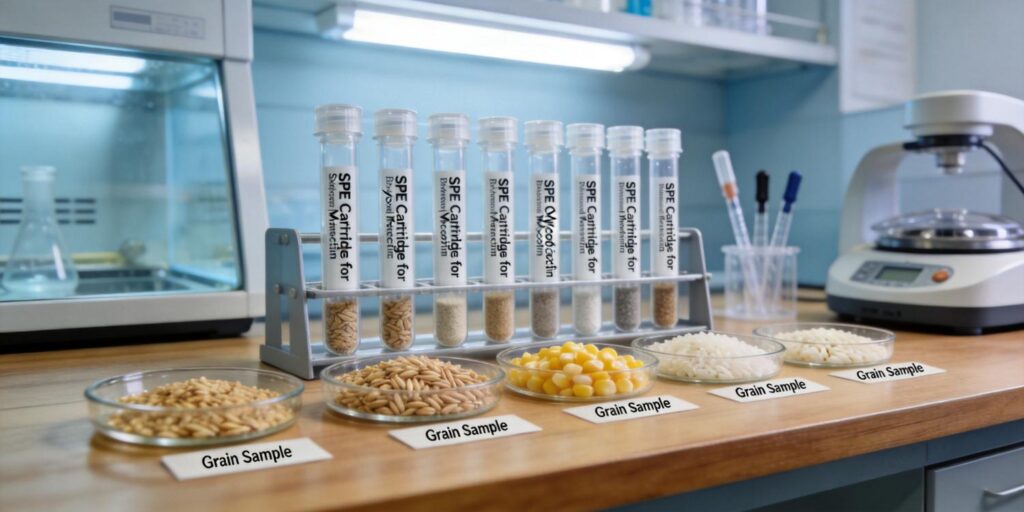
Typical extraction uses a mixture of acetonitrile/water (80:20, v/v) or methanol/water (70:30) with 0.1% formic acid. Ground grain samples (2 g) are extracted with 10 mL solvent, shaken for 30 min, then centrifuged or filtered. The supernatant is diluted with water to reduce organic solvent strength to ≤30% before SPE loading, ensuring proper retention on the sorbent.
4. SPE Cartridge Selection for Mycotoxin Cleanup
For mycotoxin cleanup, HLB (Hydrophilic-Lipophilic Balanced) SPE cartridges from Poseidon Scientific are the first choice. The HLB sorbent (a copolymer of N-vinylpyrrolidone and divinylbenzene) provides excellent retention for both polar and non-polar mycotoxins via reversed-phase and water-wettable interactions. For more selective cleanup, MAX (Mixed-Mode Anion Exchange) or MCX (Mixed-Mode Cation Exchange) cartridges can be used if the sample pH is adjusted to ionize the target compounds. However, for routine multi-mycotoxin methods, the HLB 200 mg/6 mL cartridge offers optimal capacity and flow rate. Explore our full range at HLB SPE Cartridges and MAX SPE Cartridges.
5. Conditioning and Sample Loading Procedures
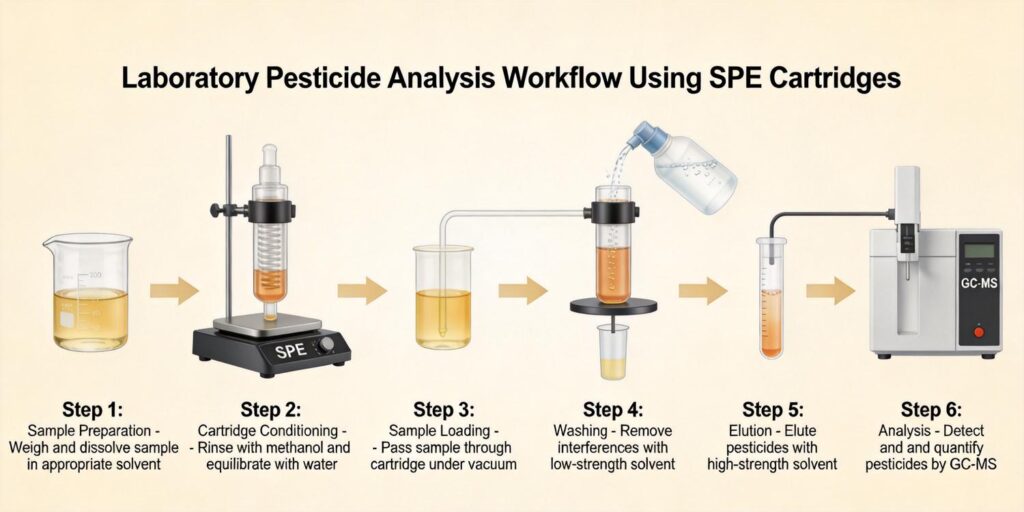
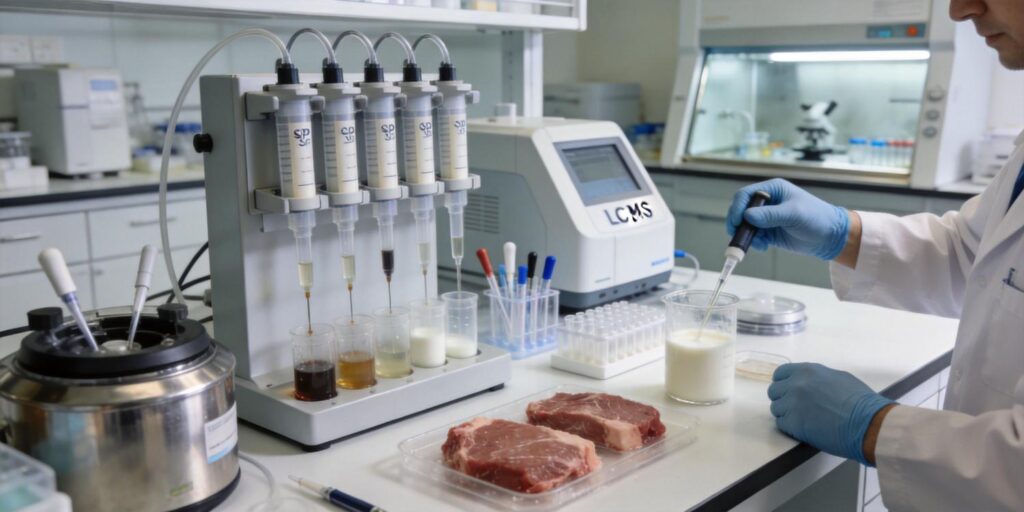
Condition the HLB cartridge with 3 mL methanol followed by 3 mL water, without letting the bed dry. Load the diluted extract (e.g., 10 mL) at a flow rate of 1–2 mL/min. A vacuum manifold set to −10 inHg ensures consistent flow. The mycotoxins are retained on the sorbent while sugars and salts pass through.
6. Washing Steps Removing Proteins and Pigments
After loading, wash with 5% methanol in water (2 mL) to remove polar matrix components like salts and small proteins. For pigment removal, a second wash with 0.1% formic acid in water (2 mL) helps dissociate protein-bound mycotoxins without eluting them. Air-dry the cartridge for 5 min under full vacuum to remove residual water.
7. Elution and Concentration Steps
Elute mycotoxins with 3 mL methanol (or acetonitrile) containing 0.1% formic acid. Collect the eluate in a glass tube and evaporate under a gentle nitrogen stream at 40°C until dry. Reconstitute in 200 µL of mobile phase (e.g., 70:30 water/methanol with 0.1% formic acid) for LC-MS/MS injection. This achieves a 50-fold concentration factor from a 10 mL load.
8. LC-MS/MS Detection Workflow
Separate mycotoxins on a C18 reversed-phase column (2.1 × 100 mm, 1.7 µm) with a gradient of water and methanol (both with 0.1% formic acid). Use a triple quadrupole mass spectrometer in positive ESI mode with MRM transitions: for aflatoxin B1 (m/z 313.1 > 285.1, quantifier; 313.1 > 241.1, qualifier), for OTA (m/z 404.2 > 239.1, quantifier; 404.2 > 358.1, qualifier). Quantify using matrix-matched calibration curves. For detailed methods, refer to our 96-Well SPE Plates for high-throughput workflows.
By following this optimized SPE protocol with Poseidon Scientific HLB cartridges, laboratories can achieve recoveries above 85% with RSD <5%, ensuring compliance with regulatory limits (e.g., EU Regulation 1881/2006). For further assistance on cartridge selection or method development, contact our technical team.