Why Monitoring Pesticides in Groundwater Matters
Groundwater is a critical resource for drinking water and agriculture, serving as the primary water source for nearly 50% of the global population. The widespread use of pesticides in agriculture inevitably leads to their leaching into subsurface aquifers, posing significant health risks such as endocrine disruption and carcinogenicity. Regulatory bodies like the U.S. Environmental Protection Agency (EPA) and the European Union’s Water Framework Directive mandate strict monitoring of pesticide residues in groundwater, with maximum concentration limits often in the sub-ppb range. Effective monitoring relies on robust sample preparation techniques, and solid-phase extraction (SPE) has become the gold standard due to its ability to concentrate trace analytes while removing matrix interferences.
Sample Collection and Preservation
Proper sample collection and preservation are essential to maintain analyte integrity. Groundwater samples should be collected in pre-cleaned amber glass bottles to prevent photodegradation. Immediately after collection, adjust the pH to 2–3 using HCl or H₂SO₄ to stabilize acid-labile pesticides like sulfonylureas. Store samples at 4°C and extract within 48 hours; for longer storage, freeze at -20°C. Field blanks and trip blanks should accompany each batch to monitor contamination. Filter samples through 0.45 μm glass fiber filters prior to SPE to remove particulates that could clog cartridges.
Selecting the Right SPE Sorbent for Pesticide Residues
The choice of sorbent is crucial for achieving high recoveries. For multi-residue analysis covering a wide polarity range (e.g., from polar glyphosate to non-polar DDT), a mixed-mode sorbent like HLB (hydrophilic-lipophilic balance) is ideal. HLB offers a balanced retention for both polar and non-polar compounds. For acidic pesticides (e.g., 2,4-D, dicamba), MAX (mixed-mode anion exchange) provides strong retention via ion-exchange. Similarly, MCX (cation exchange) targets basic pesticides like atrazine. For neutral hydrophobic compounds, C18 is a cost-effective option. Multi-bed cartridges combining HLB and ion-exchange sorbents can further enhance selectivity.
Conditioning Cartridges for Large-Volume Extraction
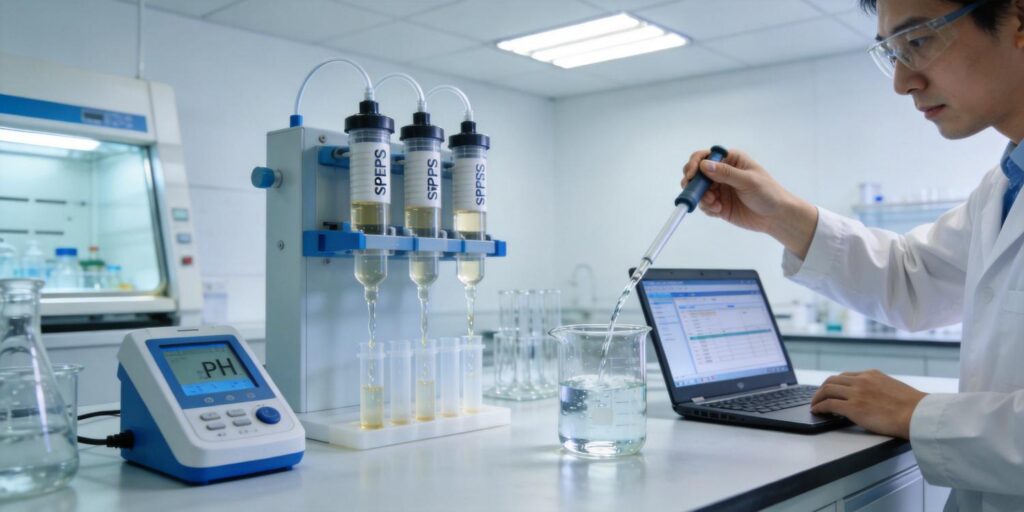
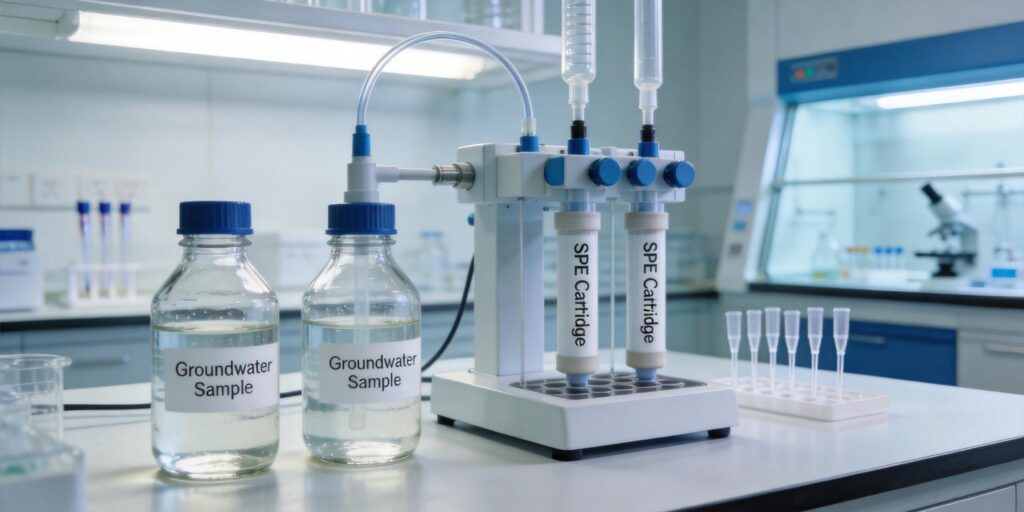
Groundwater samples often range from 500 mL to 2 L, requiring cartridges with sufficient capacity. Condition the cartridge with 5 mL of methanol followed by 5 mL of deionized water (pH adjusted to match sample pH). For large volumes, use a vacuum manifold with a flow rate of 5–10 mL/min to ensure adequate contact time. Over-conditioning may cause channeling; avoid drying the sorbent before sample loading.
Loading Groundwater Samples Through SPE Cartridges
Pass the acidified, filtered groundwater through the conditioned cartridge at a controlled flow rate (≤10 mL/min). For large volumes, use a sample reservoir or an automated SPE system. After loading, rinse the sample bottle with 10 mL of deionized water and pass through the cartridge to capture any residual analytes. For porous sorbents like HLB, ensure the cartridge does not dry out during loading to maintain reproducible recoveries.
Washing to Remove Dissolved Organic Matter
Groundwater contains humic and fulvic acids that can interfere with LC-MS analysis. A washing step with 5–10 mL of 5% methanol in water effectively removes these organic interferences without eluting target pesticides. For ion-exchange sorbents, use a low-ionic-strength buffer (e.g., 10 mM ammonium acetate, pH 7) to maintain retention while washing salts. Verify that the wash volume does not exceed the void volume of the cartridge to avoid premature elution.
Elution Solvents Optimized for LC-MS Analysis
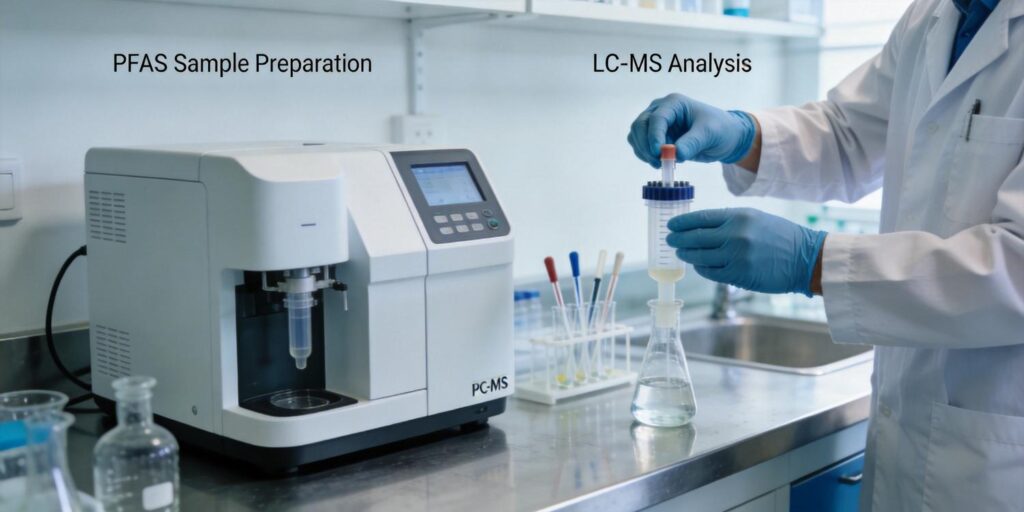
Optimized elution ensures high recoveries and compatibility with LC-MS. For HLB or C18, use 5 mL of methanol or acetonitrile. For mixed-mode sorbents like WAX (weak anion exchange) or WCX (weak cation exchange), employ a two-step elution: first with organic solvent (e.g., methanol) for neutral analytes, then with acidified or basified methanol (e.g., 5% formic acid in methanol for basic pesticides on MCX). For 96-well SPE plates, use a positive pressure manifold to elute into collection plates. Evaporate the eluate under nitrogen and reconstitute in 200 μL of mobile phase for a 500-fold concentration factor, achieving detection limits below 0.1 ng/L.
Regulatory Reporting Requirements
Compliance with EPA Method 537.1 or ISO 21675 requires reporting of method detection limits (MDLs), spike recoveries (70–130%), and field duplicates (relative percent difference <30%). For each batch, include a laboratory control sample (LCS), matrix spike (MS), and blank. Use isotopic internal standards (e.g., atrazine-d5) to correct for matrix effects. Data should be reported in μg/L with appropriate significant figures. Always validate the SPE method with the specific groundwater matrix, as dissolved organic carbon levels can affect recoveries. Proper documentation of lot numbers and conditioning logs is essential for audit readiness.