Why Lipid Removal Matters in Food Contaminant Analysis
Food matrices are inherently complex, often containing high levels of fats, oils, and other hydrophobic components. When analyzing food samples for contaminants such as pesticide residues, mycotoxins, or environmental pollutants, these lipids can severely interfere with both the extraction efficiency and the final instrumental analysis. Lipids can cause ion suppression or enhancement in mass spectrometry, reduce column lifetime in GC or LC systems, and lead to false negatives or inaccurate quantitation. Therefore, effective lipid removal is a critical sample preparation step, and solid-phase extraction (SPE) offers a robust solution.
Common Lipid Sources in Food Matrices
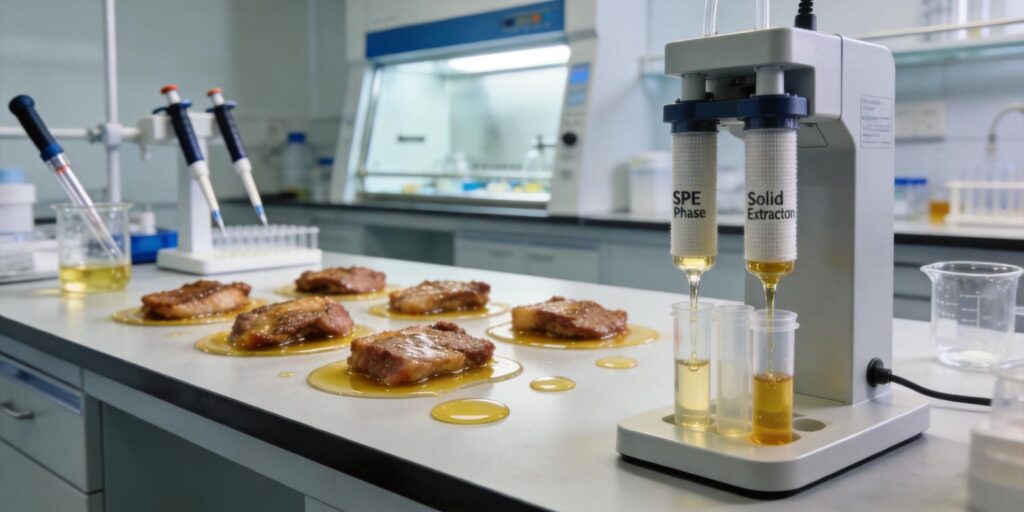
Lipids are ubiquitous in many food categories: oils and fats (vegetable oils, butter, lard), animal products (meat, fish, dairy), processed foods (snacks, baked goods, fried items), and seeds or nuts. Even seemingly lean matrices like fruits or grains may contain waxy coatings that co-extract with target analytes. The type and amount of lipid dictate the choice of SPE sorbent and the cleanup protocol.
Selection of Polymeric SPE Sorbents for Lipid Removal
For lipid removal, polymeric sorbents are preferred over silica-based materials due to their wider pH stability (pH 1–14) and high retention of hydrophobic interference. Key sorbent chemistries include:
- HLB (Hydrophilic-Lipophilic Balanced): A universal sorbent with both hydrophilic (N-vinylpyrrolidone) and lipophilic (divinylbenzene) monomers. HLB retains both polar and nonpolar analytes and is ideal for broad-spectrum lipid removal when analytes are mid- to polar. See our HLB SPE Cartridges.
- MAX (Mixed-Mode Anion Exchange): Combines HLB with a quaternary amine group for strong anion exchange. Removes fatty acids efficiently.
- MCX (Mixed-Mode Cation Exchange): HLB with sulfonic acid groups. Retains basic compounds while letting lipids pass through.
- WAX (Weak Anion Exchange): HLB with a weak anion exchanger. Suitable for removal of acidic lipids.
- WCX (Weak Cation Exchange): HLB with a weak cation exchanger. Targets basic lipids.
For general lipid cleanup without targeting specific ionic classes, HLB is the most versatile choice. For more details, visit our HLB SPE Cartridges page or explore other mixed-mode options: MAX, MCX, WAX, WCX.
Sample Extraction and Dilution Steps
Before SPE, the sample must be extracted using an appropriate solvent, typically a water-miscible organic solvent like acetonitrile (MeCN) or methanol (MeOH). For high-fat samples, a liquid-liquid extraction (e.g., QuEChERS) is commonly used. The extract is then diluted with water to reduce the organic solvent content to ≤10% (v/v) to ensure proper retention of analytes on the hydrophobic sorbent.
Conditioning Cartridges for Effective Cleanup
Conditioning is essential to activate the sorbent surface. For HLB cartridges, the typical sequence is:
- 1 mL (or 1 bed volume) of methanol to wet the sorbent.
- 1 mL of water or 5% MeOH in water to equilibrate.
This step ensures consistent analyte retention and reduces channeling. For mixed-mode sorbents, it is also important to condition with the appropriate buffer pH to ensure ion-exchange groups are in the desired form.
Washing Solvents Removing Fats and Oils
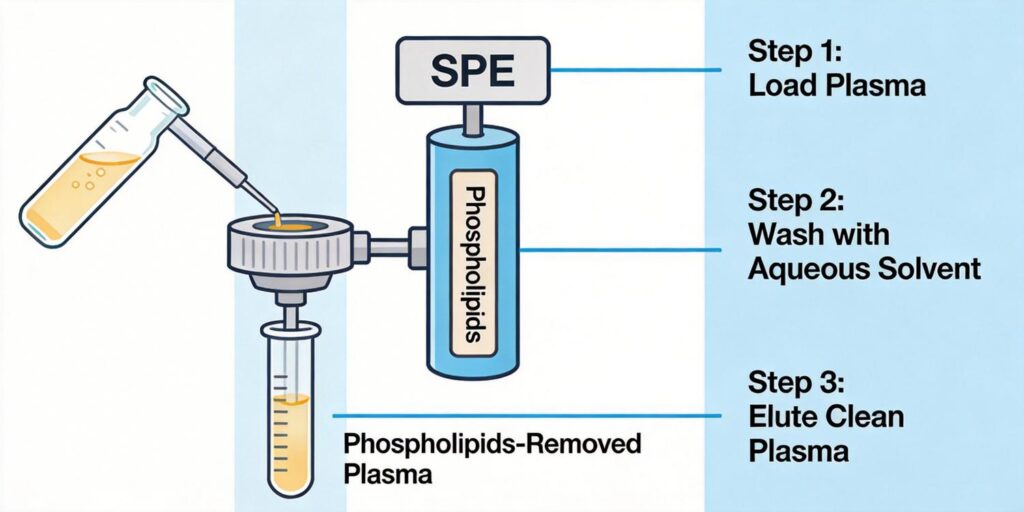
After loading the sample, the cartridge is washed to remove lipids and other interferences. The wash solvent must be strong enough to elute lipids but weak enough to retain target analytes. Common wash solutions:
- 5% MeOH in water – removes salts and very polar co-extractives.
- 30–50% MeOH in water – removes moderate amounts of fatty acids and phospholipids.
- Hexane or heptane – for highly nonpolar lipids, but caution: these solvents may elute nonpolar analytes if used too aggressively.
- Alkaline or acidic washes (e.g., 1% NH₄OH in water) – for mixed-mode sorbents to exploit charge interactions.
Multiple wash steps can be combined. For instance, after loading, a wash with 2 mL of 5% MeOH in water followed by 2 mL of hexane effectively removes both polar and nonpolar lipids.
Elution of Purified Analytes
Once interferences are washed away, the target analytes are eluted. Elution solvents should have sufficient strength to displace analytes from the sorbent. For HLB, a typical elution uses:
- 1 mL of methanol
- 1 mL of acetonitrile
- Or 1 mL of 0.1% formic acid in MeOH (for acidic analytes)
Elution volumes are usually 1–3 mL depending on cartridge size. For mixed-mode sorbents, the elution conditions are adjusted based on the target analyte class. For example, on MAX, acidic analytes are eluted with 2% formic acid in MeOH, while on MCX, basic analytes are eluted with 5% NH₄OH in MeOH.
Example Workflows in Pesticide Residue Testing
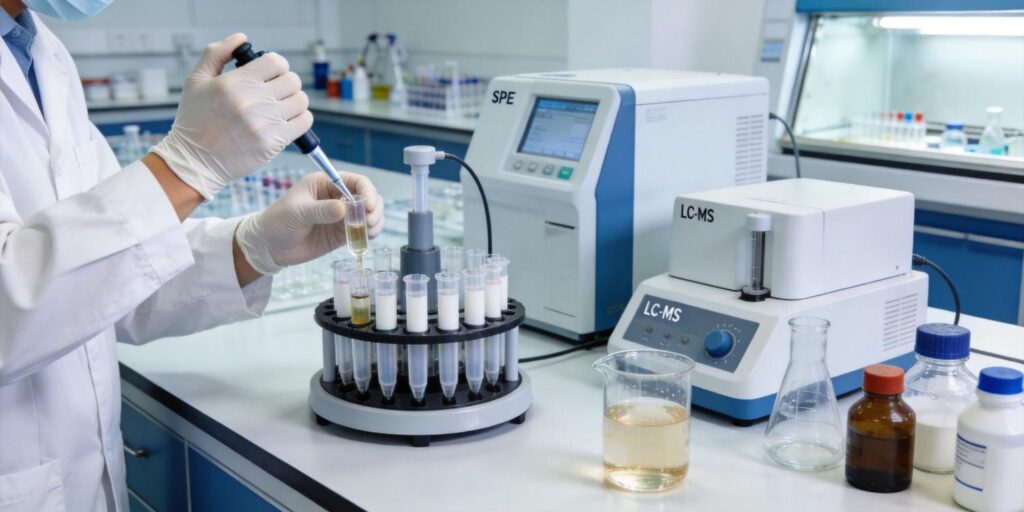
A common workflow for pesticide residue analysis in fatty foods (e.g., avocado, olive oil) using HLB SPE:
- Extraction: Weigh 10 g sample, add 10 mL acetonitrile, shake, centrifugate, and collect supernatant.
- Dilution: Dilute 2 mL of supernatant with 8 mL water to reduce MeCN to ~20%.
- Conditioning: 1 mL MeOH + 1 mL water on a 200 mg/3 mL HLB cartridge.
- Load: Pass diluted extract at 1 mL/min.
- Wash: 2 mL of 30% MeOH in water followed by 2 mL of hexane.
- Dry: Apply vacuum for 5 min to remove hexane.
- Elute: 2 mL of acetonitrile.
- Analysis: Evaporate to dryness, reconstitute in 200 µL of mobile phase, inject into LC-MS/MS.
This protocol removes >90% of lipids while recovering most pesticides at >85%. For high-throughput applications, our 96-Well SPE Plates offer parallel processing of multiple samples.
Conclusion
Lipid removal is an indispensable step in food contaminant analysis. Polymeric SPE sorbents, particularly HLB and mixed-mode variants, provide excellent cleanup performance. By carefully selecting the sorbent, optimizing conditioning, wash, and elution steps, laboratories can achieve clean extracts suitable for sensitive instrumental analysis. For more options and technical specifications, visit the respective product pages: HLB, MAX, MCX, WAX, WCX, and 96-Well Plates.