Why Pigments Complicate Botanical Extract Analysis
Plant extracts are inherently complex mixtures, rich not only in target bioactive compounds but also in pigments like chlorophylls, carotenoids, and anthocyanins. These pigments can severely interfere with downstream analytical techniques. In HPLC, pigments often cause baseline drift, peak tailing, or co-elution with analytes of interest. In mass spectrometry, they can suppress ionization signals, reducing sensitivity and quantitation accuracy. For spectrophotometric assays, pigments absorb broadly across the UV-Vis spectrum, masking the absorbance of target compounds. Therefore, effective pigment removal is a critical sample preparation step for reliable phytochemical analysis.
Key Pigment Types Encountered in Plant Extracts
Chlorophylls
Chlorophylls are lipophilic green pigments that absorb strongly in the blue (430–450 nm) and red (640–680 nm) regions. They are abundant in leaves and green plant materials. If not removed, chlorophylls can cause severe background interference and column fouling in liquid chromatography.
Carotenoids
Carotenoids are yellow, orange, or red lipophilic pigments such as β-carotene, lycopene, and lutein. They absorb in the 400–500 nm range and can overlap with the signals of many polyphenols and flavonoids.
Flavonoids and Anthocyanins
These water-soluble pigments contribute to red, blue, and purple colors in plants. While often the target analytes themselves, their high concentration can overwhelm the system. In targeted analysis for minor compounds, they need to be partially removed to avoid detector saturation.
Selecting the Right SPE Sorbent for Pigment Removal
The choice of SPE sorbent depends on the pigment type and the chemical nature of the target analytes. For lipophilic pigments such as chlorophylls and carotenoids, reversed-phase sorbents like C18 or HLB (Hydrophilic-Lipophilic Balance) SPE cartridges are effective. HLB sorbents feature a balanced hydrophilic and lipophilic retention, allowing for “catch-and-release” protocols where pigments are retained while analytes pass through, or vice versa.
For polar pigments like anthocyanins, ion-exchange sorbents may be more appropriate. WAX (Weak Anion Exchange) SPE cartridges can retain acidic pigments, while WCX (Weak Cation Exchange) cartridges retain basic compounds. Mixed-mode sorbents, such as MAX (Mixed-mode Anion Exchange) and MCX (Mixed-mode Cation Exchange), combine reversed-phase and ion-exchange properties, offering high selectivity for complex samples.
Conditioning and Equilibration Steps
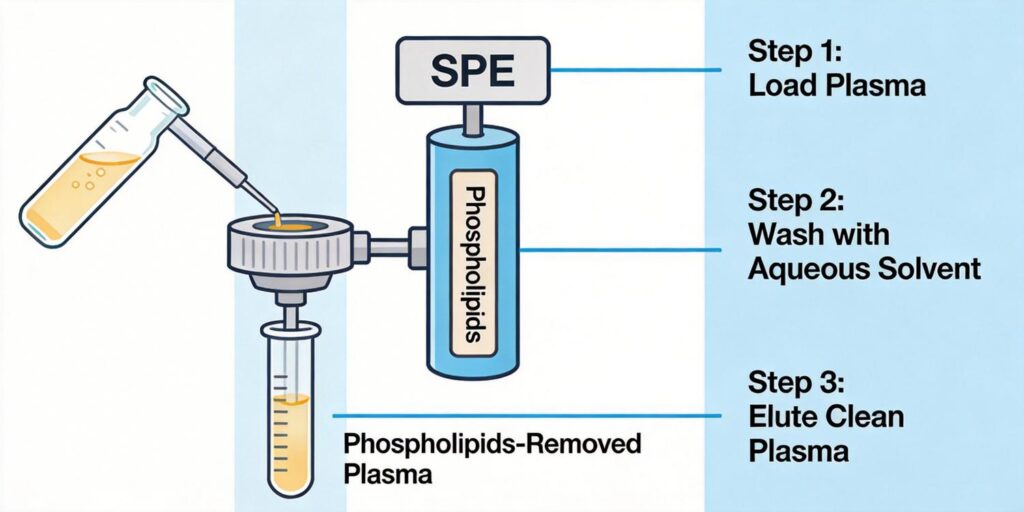
Proper conditioning of the SPE cartridge is essential for reproducible retention and pigment removal. For reversed-phase sorbents (C18, HLB), sequence: (1) one bed volume of methanol or acetonitrile to wet the sorbent, (2) one bed volume of water or aqueous buffer to equilibrate. For ion-exchange sorbents (WAX, WCX, MAX, MCX), the conditioning solvent should match the pH and ionic strength of the loading buffer to ensure the sorbent is in the correct ionic form. For example, for MAX (strong anion exchange), condition with methanol followed by water at pH > pKa of the target analytes.
Loading the Plant Extract
The extract is typically dissolved in a weak solvent to promote retention of pigments or analytes. For reversed-phase sorbents, the loading solvent should be predominantly aqueous (e.g., 5% methanol in water). If the extract is oily or high in organic content, dilute it with water or buffer to reduce solvent strength. For ion-exchange sorbents, the pH must be adjusted to ensure pigments carry a net charge opposite to the sorbent. Load the sample slowly (1–2 mL/min) to allow efficient mass transfer. Collect the flow-through if the target analytes are not retained; otherwise, wash the cartridge to remove pigments.
Washing Solvents for Pigment Removal
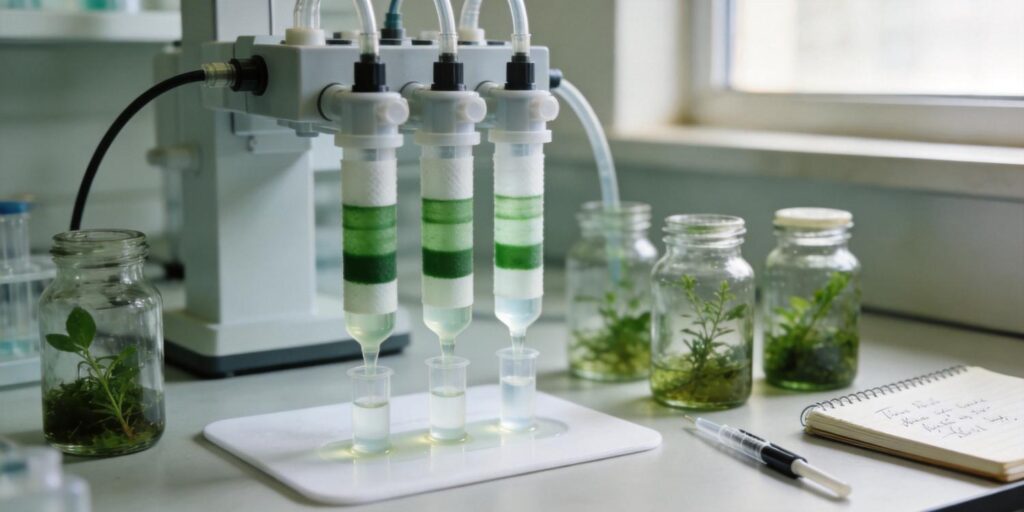
After loading, a wash step selectively removes pigments while leaving target analytes bound to the sorbent. For chlorophyll removal on reversed-phase sorbents, wash with a low-percentage organic solvent such as 10–20% methanol or acetonitrile in water. For carotenoids, a slightly higher percentage (30–40% methanol) may be needed. For ion-exchange sorbents, a wash with a buffer of the same pH but slightly increased ionic strength can displace weakly bound pigments. Avoid high organic percentages that could elute lipophilic analytes prematurely. A common wash for HLB cartridges is 5% methanol in water to remove sugars and polar pigments, then 40% methanol to remove chlorophylls, while analytes remain retained.
Elution of Purified Analytes
Once pigments are washed away, the target analytes are eluted with a strong solvent. For reversed-phase sorbents, use 100% methanol, acetonitrile, or a mixture with 0.1% formic acid. For ion-exchange sorbents, elute with a buffer of pH that neutralizes the charge, or with a high-ionic-strength salt solution. In mixed-mode sorbents, a combination of organic solvent and pH change is often used. For example, on an MCX cartridge, elute basic analytes with 5% ammonium hydroxide in methanol. Collect the eluate and evaporate or dilute for analysis.
Applications in Phytochemical Analysis
Pigment removal via SPE is widely applied in analyses of flavonoids from green tea, alkaloids from medicinal herbs, and terpenoids from cannabis. 96-well SPE plates are particularly useful for high-throughput screening of plant extracts, allowing parallel processing of dozens of samples. Clean extracts improve the accuracy and precision of quantitative methods and extend the lifespan of analytical columns.
By selecting the appropriate sorbent and optimizing the conditioning, loading, wash, and elution conditions, researchers can effectively remove pigments without sacrificing recovery of target analytes. This step is foundational for robust and reproducible phytochemical analysis.