WCX SPE for Isolation of Basic Metabolites in Human Urine
1. Characteristics of Basic Metabolites in Urine Samples
Human urine is a complex biological matrix containing a wide variety of metabolites, including amino acids, amines, nucleosides, and many drug metabolites. Basic metabolites—those with pKa values typically above 7—are positively charged under physiological or slightly acidic conditions. These include many endogenous compounds (e.g., creatine, choline, and basic amino acids like lysine and arginine) as well as xenobiotic metabolites such as alkaloids and basic drugs. Their polar and ionic nature makes them challenging to isolate from the high salt and urea background of urine using traditional reversed-phase sorbents. Weak cation exchange (WCX) sorbents provide an ideal selectivity for these analytes, enabling robust cleanup and enrichment prior to LC-MS analysis.
2. Weak Cation Exchange Retention Mechanism
WCX sorbents feature a weak carboxylic acid functional group that is negatively charged above its pKa (typically around pH 4–6). At a loading pH above the sorbent’s pKa and below the analyte’s pKa, basic metabolites carry a net positive charge and are retained via electrostatic interactions with the negatively charged carboxylate groups. The WCX cartridges from Poseidon Scientific offer high capacity and consistent retention for basic compounds. Because the interaction is ionic, it can be reversed by raising the pH (neutralizing the sorbent) or by increasing ionic strength. This tunable selectivity is particularly useful for fractionating complex samples.
3. Urine Dilution and pH Adjustment Prior to SPE
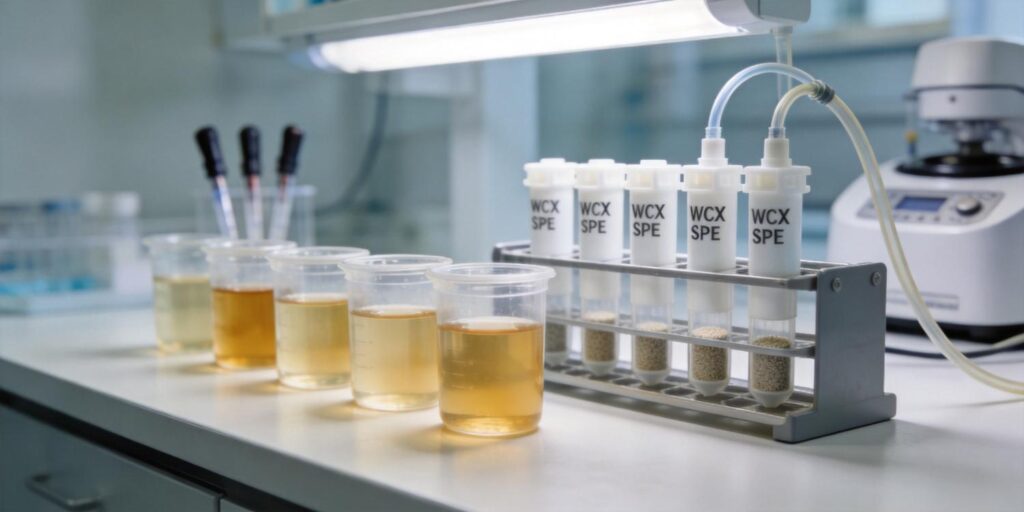
Urine samples typically contain high concentrations of salts and urea that can compete for ion-exchange sites or cause unwanted precipitation. To mitigate these issues, urine is often diluted 2- to 5-fold with deionized water. Adjusting the pH to 5–6 using dilute HCl or formic acid ensures that basic metabolites remain protonated (positively charged) while the WCX sorbent is fully deprotonated (negatively charged). This pH window maximizes retention of basic analytes and minimizes retention of neutral and acidic compounds. For urine samples with high protein content (e.g., in disease states), a brief centrifugation or filtration step is recommended prior to dilution.
4. Conditioning and Equilibration Steps
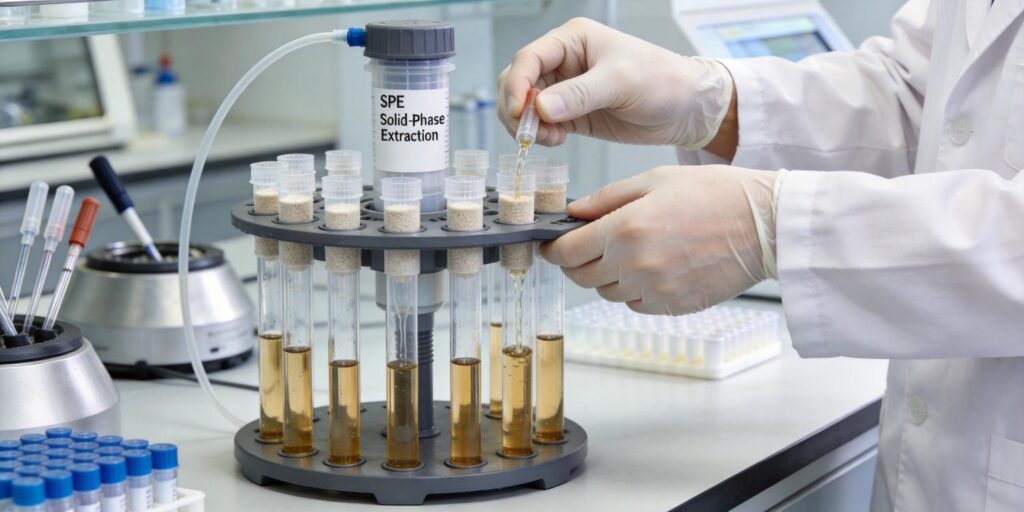
Proper conditioning is critical for reproducible SPE results. For WCX cartridges, the sorbent should first be wetted with methanol (1–2 bed volumes) to activate the surface, then equilibrated with water or a buffer at the loading pH (e.g., 10–20 mM ammonium formate, pH 5). This step ensures the carboxylate groups are in the ionized form and ready for retention. A typical protocol for Poseidon Scientific’s WCX SPE cartridges involves: 1 mL methanol, followed by 1 mL water, then 1 mL of 20 mM ammonium formate (pH 5). Avoid letting the sorbent dry between steps.
5. Loading Sample Extracts onto WCX Cartridges
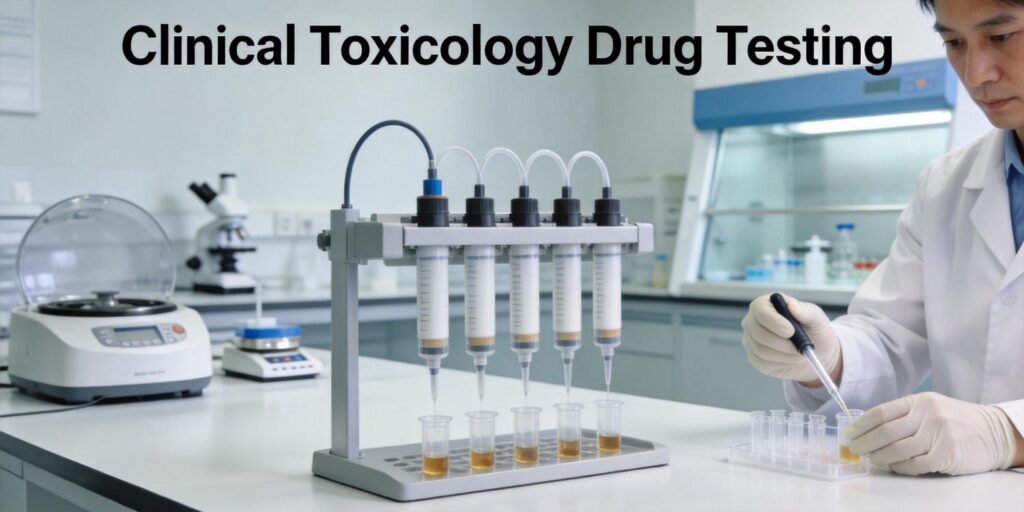
The diluted and pH-adjusted urine sample is loaded onto the conditioned cartridge at a slow, controlled flow rate (approx. 1 mL/min) to maximize binding. For typical 1 mL cartridges, sample volumes of 1–5 mL are common. Basic metabolites are retained on the sorbent, while neutral and acidic compounds, along with many salts, pass through to waste. It is important to collect the flow-through if quantification of non-retained compounds is desired.
6. Washing to Remove Salts and Neutral Compounds
After loading, a wash step removes weakly retained matrix components. A typical wash uses 1–2 mL of 20 mM ammonium formate (pH 5) or even plain water. For cleaner extracts, an organic wash (e.g., 5–10% methanol in water) can be added to remove hydrophobic neutral compounds without eluting the basic analytes. The wash should be monitored to ensure that target metabolites are not lost; basic compounds with low hydrophobicity may be partially washed off if the organic content is too high.
7. Elution with Ammonium Hydroxide-Containing Solvents
Elution of basic metabolites from WCX is achieved by neutralizing the sorbent with a base. A common elution solvent is 5% ammonium hydroxide in methanol (or acetonitrile), which raises the pH above the sorbent’s pKa, converting the carboxylate groups to neutral carboxylic acid and releasing the now uncharged basic analytes. An alternative is using a high concentration of a volatile salt like ammonium formate (e.g., 500 mM) at pH 7–8. Elution volumes of 1–2 mL are typically sufficient. The eluate can be directly evaporated and reconstituted in LC-MS-compatible solvent, or diluted with water to reduce organic content before injection.
8. LC-MS Metabolite Detection
The final eluate is well-suited for LC-MS analysis, particularly with hydrophilic interaction liquid chromatography (HILIC) or reversed-phase columns with ion-pairing reagents. The absence of non-volatile salts in the eluate (when using ammonium hydroxide in methanol) ensures minimal ion suppression. For targeted metabolomics, multiple reaction monitoring (MRM) on a triple quadrupole MS provides high sensitivity and selectivity. For untargeted profiling, high-resolution MS (e.g., Q-TOF or Orbitrap) coupled with C18 or HILIC separation can identify hundreds of basic metabolites. The clean extracts from WCX SPE significantly reduce matrix effects and improve data quality compared to protein precipitation or dilute-and-shoot approaches.
For researchers seeking reliable and reproducible results, Poseidon Scientific’s WCX SPE cartridges offer a cost-effective solution with consistent batch-to-batch performance. These cartridges are also available in 96-well plate format for high-throughput applications (96-well SPE plates). By following the protocol outlined above, laboratories can achieve high recoveries and excellent cleanup for basic metabolites in human urine, facilitating downstream LC-MS analysis.