Introduction
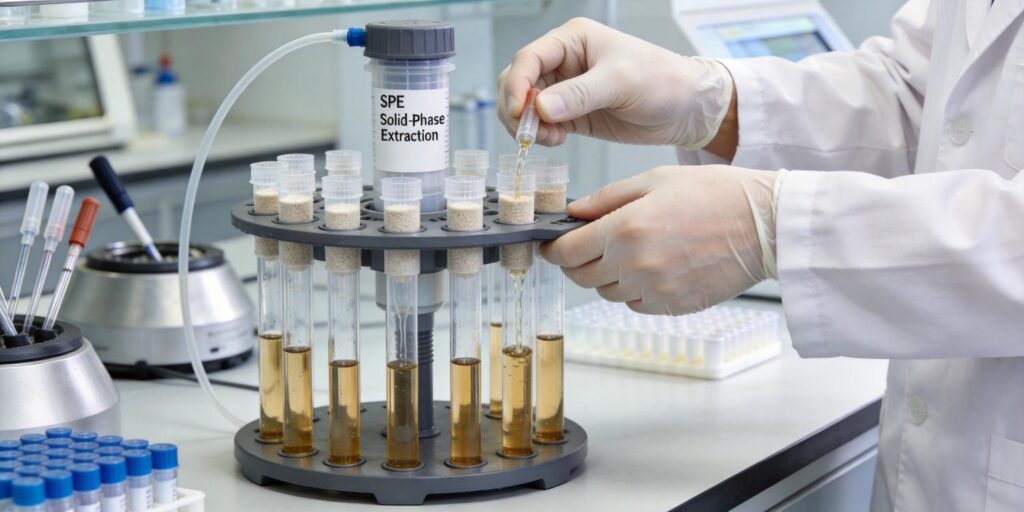
In pharmacokinetic (PK) studies, accurate quantification of drug concentrations in plasma is critical for understanding absorption, distribution, metabolism, and excretion (ADME) profiles. Plasma is a complex biological matrix containing proteins, lipids, salts, and endogenous compounds that can interfere with LC-MS/MS analysis. Effective sample preparation is therefore essential to remove matrix interferences, concentrate analytes, and ensure robust, reproducible data. Solid-phase extraction (SPE) is widely adopted due to its selectivity, high recovery, and compatibility with automation. Among SPE sorbents, mixed-mode cation exchange (MCX) resins are particularly well-suited for basic drug compounds, providing both reversed-phase and strong cation exchange retention mechanisms.
Why Choose Cation Exchange for Basic Drugs?
Many small-molecule drugs contain amine functional groups (e.g., primary, secondary, tertiary amines) that are positively charged under acidic conditions (pH < pKa). In plasma at physiological pH (~7.4), these compounds exist in both neutral and ionized forms. By adjusting the sample pH to 2–3, basic drugs become fully protonated and can be retained on a cation exchange sorbent such as MCX. The strong cation exchange (SCX) mechanism provides high selectivity, allowing neutral and acidic matrix components to be washed away while the target analytes remain bound. This selectivity is critical for minimizing ion suppression in LC-MS/MS.
Plasma Protein Precipitation Prior to SPE
Direct loading of plasma onto an SPE cartridge can cause clogging due to protein precipitation. Therefore, a protein precipitation (PPT) step is typically performed first. Common precipitating agents include acetonitrile, methanol, or acidified organic solvents. After adding the precipitant (typically 2:1 to 4:1 organic-to-plasma ratio), the mixture is vortexed and centrifuged at high speed (e.g., 10,000–15,000 × g for 10 min) to pellet denatured proteins. The clear supernatant is then diluted with aqueous buffer (e.g., 2–5% formic acid or 50 mM phosphate buffer, pH 2) to reduce organic content below 10% before loading onto the MCX cartridge. This dilution step is crucial; high organic content can reduce ionic interactions by solvating the charged analytes.
MCX Cartridge Conditioning and pH Control
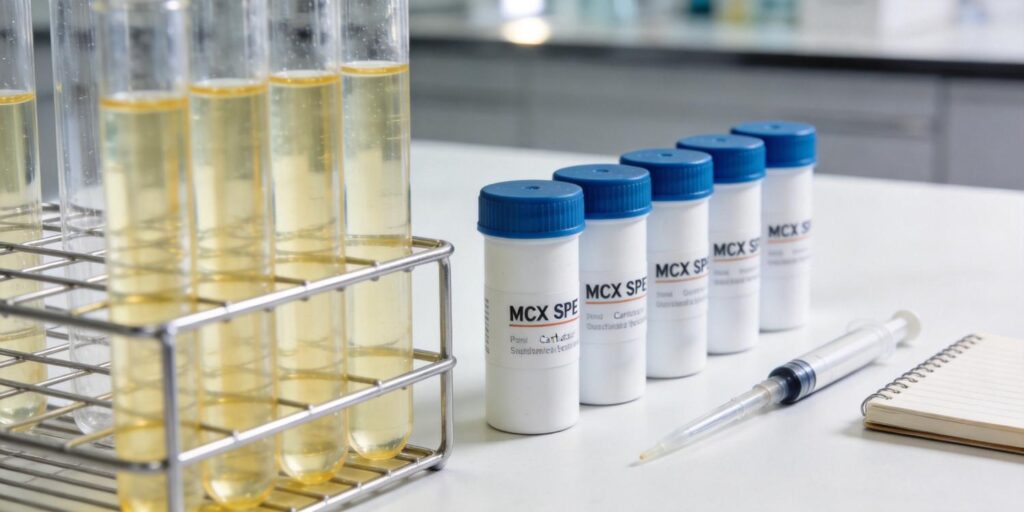
Prior to sample loading, the MCX cartridge must be conditioned to activate both the reversed-phase and ion-exchange sites. A typical protocol is:
- Condition: 1 mL methanol (per 30 mg sorbent) to wet the C18 chains.
- Equilibrate: 1 mL of 0.1–1% formic acid in water (pH 2–3) to protonate the sulfonic acid groups and ensure a low-pH environment.
Maintaining pH below the analyte’s pKa throughout the loading and washing steps is essential. If the pH rises, the drug may lose its positive charge and elute prematurely. Use of formic acid, acetic acid, or phosphoric acid at 0.1–1% is common. For phosphoric acid, ensure compatibility with mass spectrometry as non-volatile buffers can cause ion suppression.
Loading Samples and Achieving Strong Ionic Retention
The diluted supernatant (pH 2–3) is loaded onto the conditioned MCX cartridge at a flow rate of 1–2 mL/min under gravity or low vacuum (<5 inHg). The protonated basic drugs bind to the sulfonate groups via ion exchange, while reversed-phase interactions also contribute. The loading capacity of MCX (typically 0.05–0.1 meq/g) is sufficient for most PK analytes (ng/mL range). Overloading can occur if the total ionic strength of the sample is too high (e.g., from excessive buffer salts), so dilution is sometimes necessary.
Washing Steps to Remove Neutral Matrix Components
After loading, a washing step removes neutral and acidic interferences while retaining the basic analytes. A typical wash is 1 mL of 0.1% formic acid in 5% methanol/water. Including a low percentage of organic solvent helps remove hydrophobic matrix components (e.g., lipids) without eluting the ionically bound drugs. If higher purity is needed, a second wash with 1 mL of 0.1% formic acid in 5–10% acetonitrile can be used. Do not exceed 20% organic content, as this may elute some basic compounds via reversed-phase mechanism.
Elution with Basic Organic Solvents
To release the basic drugs from the cation exchange sites, the pH must be raised to deprotonate the amines and neutralize the charge. Elution is performed with a basic organic solvent, typically 1–2 mL of 5% ammonium hydroxide in methanol (or 5% ammonium hydroxide in acetonitrile). The high pH (11–12) deprotonates the basic drug, allowing it to be eluted by the organic solvent. Collect the eluate in a clean tube. For LC-MS/MS compatibility, the eluent can be evaporated under nitrogen and reconstituted in the mobile phase, or directly injected if the solvent is compatible. Evaporation at 40°C under nitrogen is common, followed by reconstitution in 100–200 µL of 0.1% formic acid in water or mobile phase A.
LC-MS/MS Quantification Workflow
After reconstitution, the sample is transferred to an autosampler vial. Typical LC-MS/MS conditions involve:
- Column: C18 (50 × 2.1 mm, 1.7–3 µm) with a guard column.
- Mobile Phase: Gradient elution with 0.1% formic acid in water (A) and 0.1% formic acid in acetonitrile (B).
- Flow Rate: 0.3–0.5 mL/min.
- Injection Volume: 5–10 µL.
- MS Detection: Positive electrospray ionization (ESI+) with multiple reaction monitoring (MRM) using the most abundant product ion.
Internal standard (e.g., stable isotope-labeled analog) is added before PPT to correct for recovery and matrix effects. Calibration curves are prepared in blank plasma and extracted identically.
Conclusion
The combination of protein precipitation followed by MCX SPE provides a robust and selective sample preparation method for basic drugs in plasma. By carefully controlling pH and using optimized washing and elution protocols, high recovery and minimal matrix effects can be achieved. This workflow is easily automated and suitable for high-throughput PK studies. For more information on MCX SPE cartridges and related products, visit Poseidon Scientific.
References
- Chambers, E. E., et al. (2007). Systematic and comprehensive strategy for reducing matrix effects in LC/MS/MS analyses. Journal of Chromatography B, 852(1-2), 22-34.
- Li, W., et al. (2017). Mixed-mode solid-phase extraction for the analysis of basic drugs in biological fluids. Bioanalysis, 9(2), 167-180.
- Poseidon Scientific. (2024). MCX SPE Cartridges. Retrieved from https://poseidon-scientific.com/product/mcx-spe-cartridges/