Introduction
Antibiotic residues in milk pose significant risks to public health, including allergic reactions and the development of antimicrobial resistance. Regulatory bodies such as the U.S. FDA, EU Commission, and Codex Alimentarius have established strict maximum residue limits (MRLs) for veterinary drugs in dairy products. To meet these requirements, robust analytical methods combining solid-phase extraction (SPE) with liquid chromatography-tandem mass spectrometry (LC-MS/MS) are essential. This blog outlines a validated SPE workflow for detecting multiple antibiotic classes in milk, focusing on HLB SPE cartridges from Poseidon Scientific.
1. Regulatory Requirements for Antibiotic Residues in Dairy Products
Global regulations mandate MRLs for antibiotics in milk. For example, the EU sets MRLs at 4 µg/kg for penicillin G, 100 µg/kg for sulfamethazine, and 100 µg/kg for tetracycline. The FDA’s tolerances are similarly low. Compliance requires methods with limits of quantification (LOQs) below these thresholds, making SPE a critical sample preparation step.
2. Common Antibiotic Classes Detected in Milk
Three major classes are routinely monitored: β-lactams (e.g., penicillin, amoxicillin), sulfonamides (e.g., sulfadiazine, sulfamethazine), and tetracyclines (e.g., tetracycline, oxytetracycline). These compounds vary in polarity, pKa, and stability, necessitating a generic SPE sorbent like HLB (hydrophilic-lipophilic balanced) for simultaneous extraction.
3. Sample Pretreatment: Protein Precipitation and Centrifugation
Milk is a complex matrix rich in proteins and lipids. Begin by adding 10 mL of milk sample to 20 mL of acetonitrile (ACN) for protein precipitation. Vortex for 1 minute, then centrifuge at 4000 rpm for 10 minutes at 4°C. The supernatant is collected, diluted with water to reduce organic solvent content below 10% v/v, and adjusted to pH 2–3 with formic acid to enhance retention on HLB.
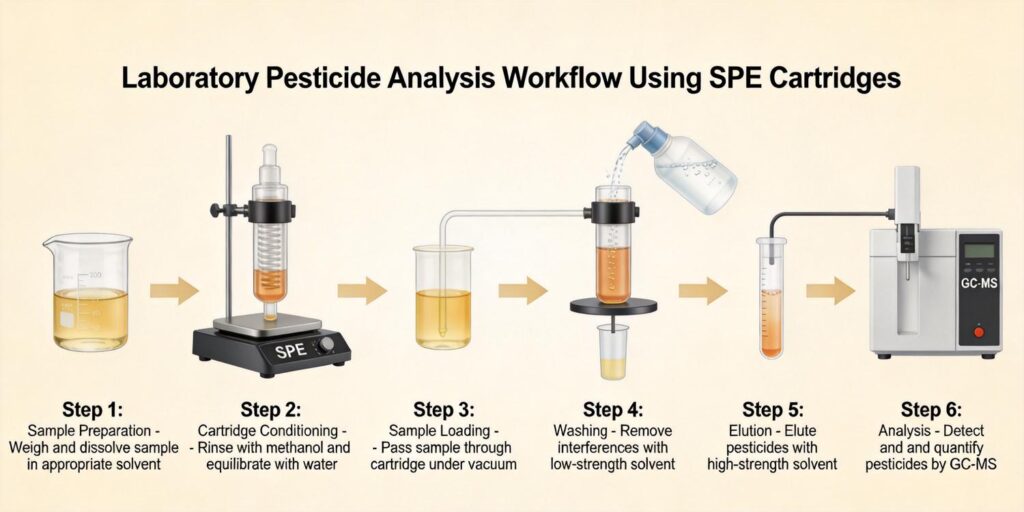
4. HLB SPE Conditioning and Equilibration
Using Poseidon HLB SPE cartridges (200 mg, 6 mL):
- Condition: 5 mL methanol to wet the sorbent.
- Equilibrate: 5 mL of 0.1% formic acid in water (pH ~2.5) to create acidic conditions.
5. Loading Milk Extracts and Maximizing Analyte Retention
Load the pretreated sample onto the conditioned cartridge at a flow rate of 1–2 mL/min. The acidic environment protonates basic analytes (e.g., sulfonamides and tetracyclines), enhancing their retention on the HLB sorbent via reversed-phase and ion-exchange interactions. Avoid overloading; typical load volume is 10–20 mL of diluted extract.
6. Washing Steps to Remove Lipids and Proteins
After loading, wash with 5 mL of 5% methanol in water to remove polar interferences without eluting target analytes. Then, wash with 5 mL of n-hexane to remove remaining lipids. Ensure complete removal of hexane before elution by drying the cartridge under vacuum for 1 minute.
7. Elution Solvents Optimized for LC-MS/MS Compatibility
Elute analytes with 5 mL of methanol containing 0.1% formic acid. This solvent provides high recovery for all three classes. Evaporate the eluate to dryness under nitrogen at 40°C, reconstitute in 200 µL of mobile phase (e.g., 90:10 water:methanol with 0.1% formic acid), and inject 5 µL into the LC-MS/MS system.
8. Method Validation Parameters: Recovery, Matrix Effects, LOQ
Validation should follow guidelines (e.g., SANTE/11312/2021). Typical results with this workflow:
- Recovery: 85–110% for all analytes at spiked levels of 0.5×, 1×, and 2× MRL.
- Matrix effects: Ion suppression <20% for most compounds (compensated by isotopically labeled internal standards).
- LOQ: ≤1 µg/kg for β-lactams and sulfonamides, ≤2 µg/kg for tetracyclines, well below regulatory limits.
Conclusion
This HLB-based SPE workflow offers a reliable, high-throughput method for detecting antibiotic residues in milk. For laboratories seeking alternative sorbent chemistries, explore MAX and WAX cartridges from Poseidon Scientific, or the 96-well SPE plates for increased throughput. Always validate your specific method to ensure compliance with target MRLs.