Occurrence of Pharmaceutical Residues in Rivers
Pharmaceutical compounds, including antibiotics, non-steroidal anti-inflammatory drugs (NSAIDs), antidepressants, and hormones, are increasingly detected in surface waters worldwide. These contaminants originate from human excretion, improper disposal, and inefficient removal by wastewater treatment plants (WWTPs). Studies have documented concentrations ranging from ng/L to low μg/L, with potential ecotoxicological effects such as endocrine disruption and antibiotic resistance development. Monitoring programs often target priority substances like diclofenac, carbamazepine, sulfamethoxazole, and 17α-ethinylestradiol. The complexity of river water matrices—rich in dissolved organic matter (DOM), suspended solids, and co-extractives—demands robust sample preparation methods to achieve reliable quantification at trace levels.
Sample Collection and Filtration Procedures
Collect grab samples in pre-cleaned amber glass bottles (1–2 L) to prevent photodegradation. Immediately filter through 0.7 μm glass fiber filters (e.g., Whatman GF/F) to remove suspended particles that may clog SPE cartridges or adsorb analytes. For dissolved-phase analysis, use 0.45 μm membrane filters (nylon or PES). Add a preservative such as 1% (v/v) methanol or acidify to pH 2–3 (if target analytes are stable) to inhibit microbial degradation. Store samples at 4°C and process within 48 hours. Field blanks (laboratory-grade water transported to site) and trip blanks should accompany each batch to monitor contamination.
HLB SPE for Trace-Level Concentration
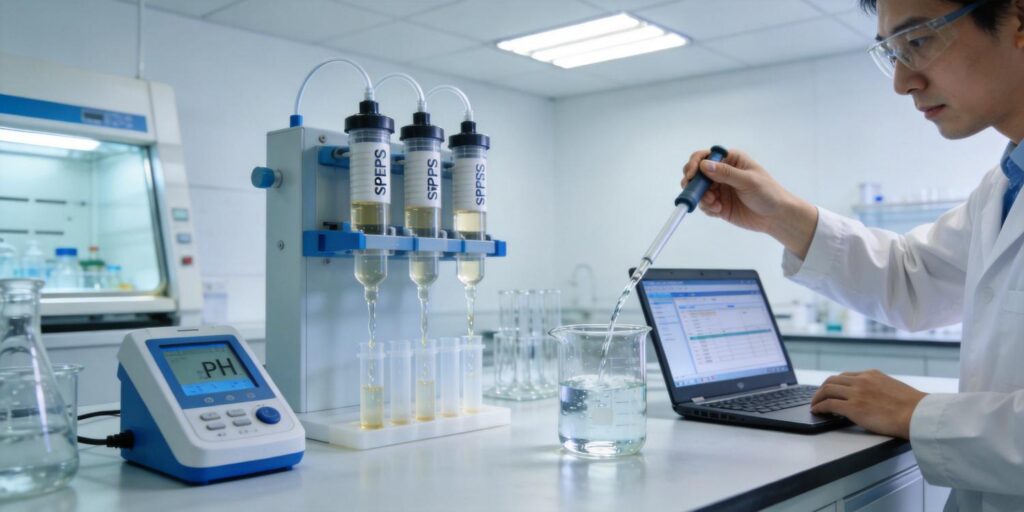
Poseidon HLB SPE cartridges are the gold standard for extracting a wide polarity range of pharmaceuticals from water. Their hydrophilic-lipophilic balanced polymer (divinylbenzene/N-vinylpyrrolidone) provides excellent retention of acidic, basic, and neutral compounds without requiring pH adjustment. With high surface area and uniform particle size (40–60 μm), the cartridges achieve breakthrough volumes exceeding 1 L for most drugs, ensuring high enrichment factors. The sorbent also tolerates drying out, simplifying automation.
Conditioning and Loading Large Water Volumes
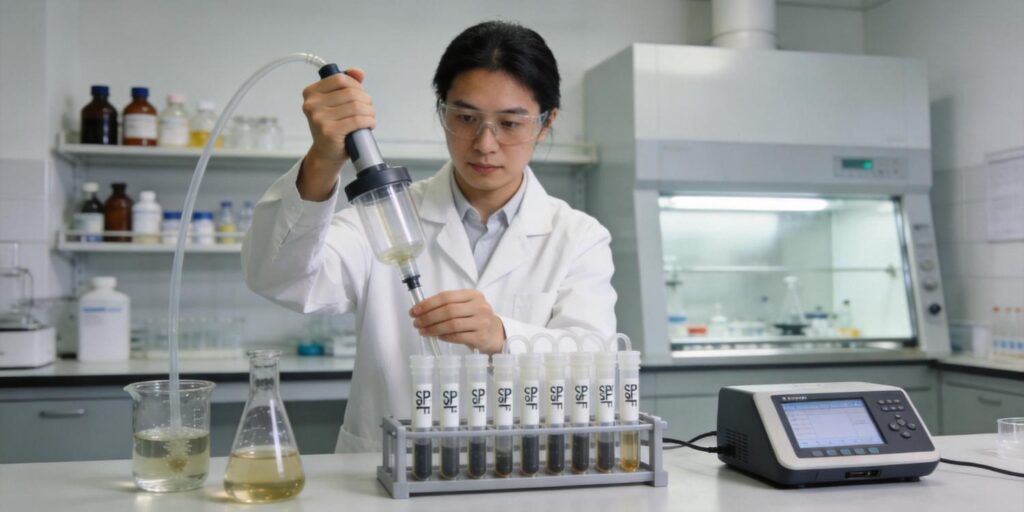
Condition each 200 mg/6 mL HLB cartridge with 5 mL methanol followed by 5 mL ultrapure water (or buffer matching sample pH). Load 500–1000 mL of filtered water sample at a flow rate of 10–15 mL/min using a vacuum manifold or positive pressure. For large volumes (up to 2 L), use a peristaltic pump or automated SPE system. Prevent air from entering the sorbent bed during loading to maintain wetting. After loading, wash with 5 mL of 5% methanol in water to remove salts and highly polar interferences while retaining target analytes.
Washing to Eliminate Humic Substances
Humic and fulvic acids, ubiquitous in river water, can co-elute and suppress ionization in LC-MS/MS. A selective wash step using 5 mL of 0.1 M sodium hydroxide or 5% ammonium hydroxide in water (for acidic drugs) effectively removes these interfering macromolecules. Alternatively, a wash with 5 mL of 20% methanol in 0.1 M formic acid helps for basic compounds. The wash should be optimized per analyte set; typically, 5–10% organic solvent in aqueous buffer achieves a good balance between cleanup and recovery. Verify recovery losses with spiked samples.
Elution and Concentration Steps
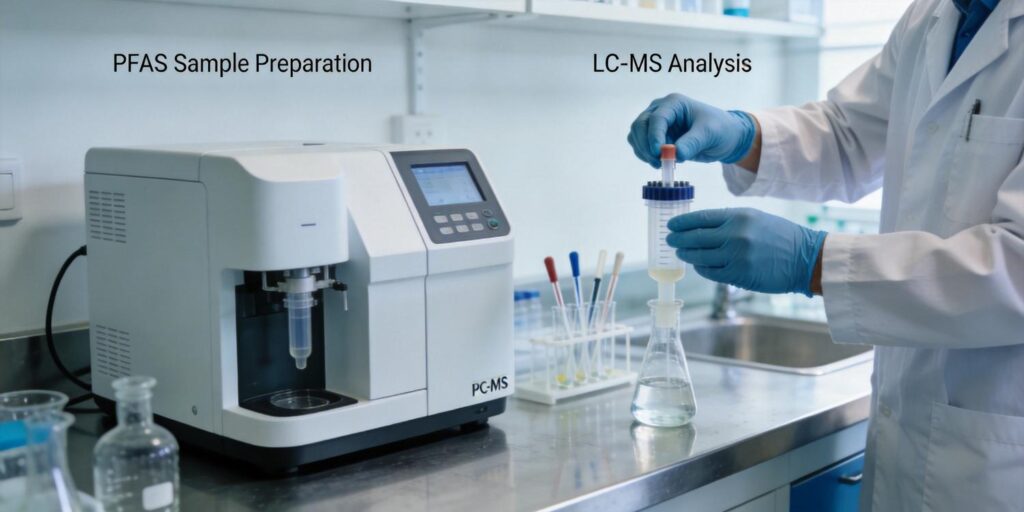
Elute retained analytes with 3 × 3 mL methanol or acetonitrile (or a mixture such as ethyl acetate:methanol, 50:50). For better recovery of acidic compounds, acidify the elution solvent with 1% formic acid. Collect eluate in a glass tube and evaporate to near-dryness under a gentle nitrogen stream at 40°C. Reconstitute in 200–500 μL of initial mobile phase (e.g., water:acetonitrile, 90:10). Centrifuge at 10,000 rpm for 10 min to remove any particulates, then transfer supernatant to an autosampler vial. A 1000-fold enrichment factor is typical.
LC-MS/MS Detection Workflow
Separate extracts on a C18 reversed-phase column (2.1 × 100 mm, 1.8 μm) at 40°C. Use a gradient of (A) 0.1% formic acid in water and (B) 0.1% formic acid in acetonitrile: 5% B for 1 min, ramp to 95% B over 10 min, hold 2 min, re-equilibrate 3 min. Flow rate: 0.3 mL/min. Mass spectrometry detection using electrospray ionization (ESI) in positive and negative switching mode. Optimize multiple reaction monitoring (MRM) transitions for each target compound. Quantify using isotope-labeled internal standards (e.g., carbamazepine-d10, diclofenac-d4) to correct for matrix effects and instrument drift. Calibrate over 0.1–500 ng/L range with R² > 0.99.
Environmental Monitoring Considerations
For comprehensive monitoring, integrate 96-well SPE plates to increase throughput. Include quality control samples: method blanks (no analyte detected), matrix spikes (recovery 70–120%), and certified reference materials if available. Perform regular instrument maintenance (source cleaning, column conditioning) to ensure sensitivity. Report limits of quantification (LOQ) typically 0.5–2 ng/L. Field duplicate relative standard deviation should be <20%. When selecting an SPE product, consider the compatible MAX, MCX, WAX, or WCX cartridges for mixed-mode selectivity if your analytes are ionizable.