Understanding the SPE Workflow for Veterinary Drug Monitoring in Meat
Veterinary drug residues in meat products pose significant risks to human health, including antibiotic resistance and allergic reactions. Regulatory agencies worldwide enforce strict maximum residue limits (MRLs) for drugs such as antibiotics, antiparasitics, and growth promoters. Solid-phase extraction (SPE) is a critical sample preparation technique to isolate and concentrate these residues from complex meat matrices for accurate LC-MS/MS analysis. This blog outlines a robust SPE workflow for veterinary drug monitoring, focusing on drug classes, extraction, cleanup, and method validation.
1. Veterinary Drug Classes Commonly Monitored
The most frequently monitored veterinary drug classes include:
- Antibiotics: β-lactams (penicillins, cephalosporins), tetracyclines, fluoroquinolones, sulfonamides, macrolides, and aminoglycosides.
- Antiparasitics: Ivermectin, doramectin, and other avermectins.
- Growth promoters: β-agonists (e.g., clenbuterol, ractopamine) and hormones (e.g., estradiol, trenbolone).
- Coccidiostats: Ionophores like monensin and salinomycin.
- Non-steroidal anti-inflammatory drugs (NSAIDs): Flunixin, phenylbutazone.
Each class has unique physicochemical properties, requiring careful optimization of extraction and cleanup conditions.
2. Tissue Homogenization and Extraction
Fresh or frozen meat samples (e.g., muscle, liver, kidney) are homogenized using a blender or bead mill. A representative portion (2–5 g) is weighed into a centrifuge tube. Extraction typically uses an acidified organic solvent mixture, such as acetonitrile with 0.1% formic acid, to precipitate proteins and release drug residues. The sample is vortexed, sonicated, and centrifuged at high speed (e.g., 10,000 rpm for 10 min at 4°C). The supernatant is collected for SPE cleanup. For fatty tissues, a freezing step (−20°C for 30 min) helps solidify fats for easier removal.
3. HLB SPE Cleanup Procedure
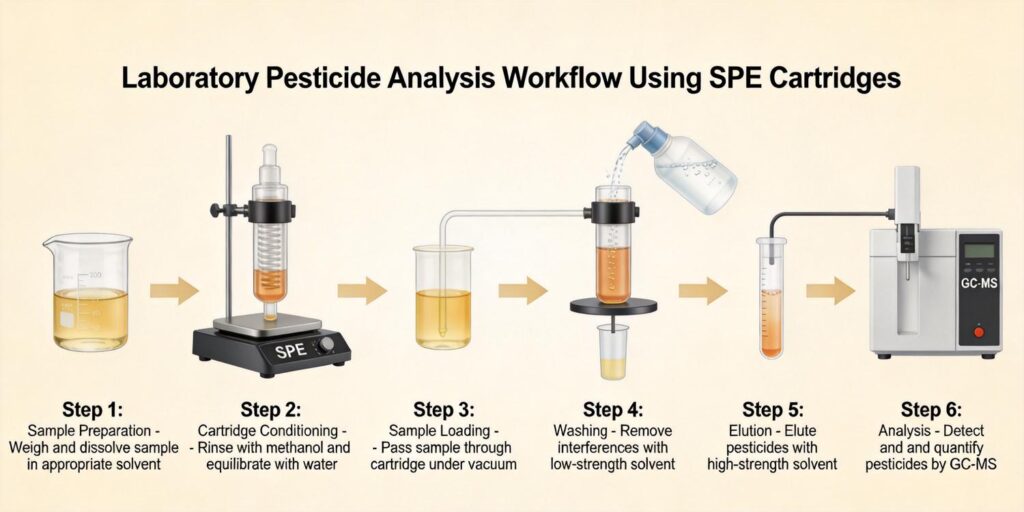
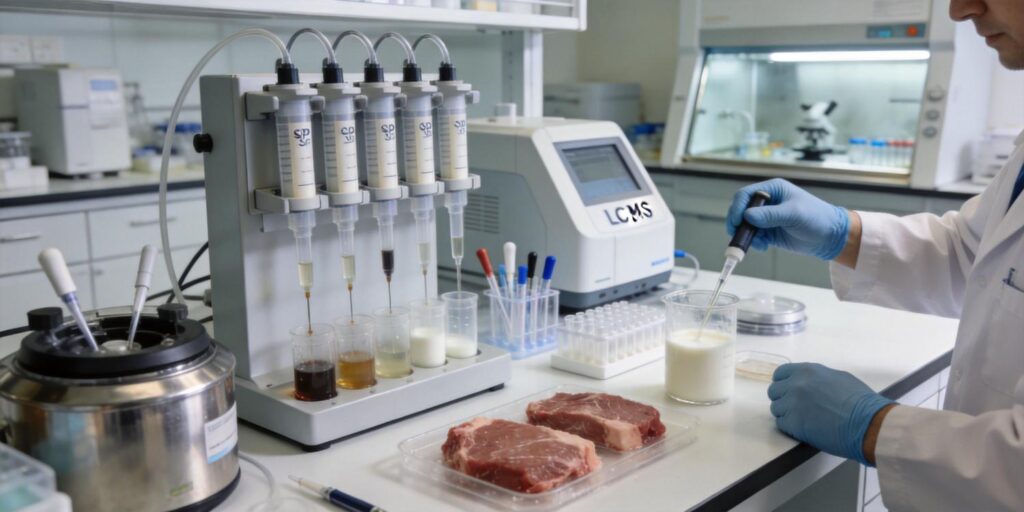
HLB (Hydrophilic-Lipophilic Balanced) SPE cartridges are ideal for multiresidue analysis due to their balanced retention of both polar and nonpolar analytes. The procedure:
- Conditioning: Pass 3 mL methanol followed by 3 mL water through the cartridge. Do not let the bed dry.
- Loading: Dilute the supernatant with water (e.g., 1:4 ratio) to reduce organic solvent content below 10%. Load the diluted extract at 1–2 mL/min.
- Washing: Wash with 5% methanol in water to remove polar interferences like salts and sugars, followed by a hexane wash to remove nonpolar lipids (see Section 4).
- Elution: Elute with 3–5 mL methanol or acetonitrile (see Section 5).
- Reconstitution: Evaporate the eluate under nitrogen and reconstitute in mobile phase.
4. Removal of Fats and Proteins During Washing
Meat samples contain high levels of fats and proteins that can foul LC columns and suppress ionization. During SPE, washing steps are critical:
- Protein removal: Acidic extraction and initial water-methanol wash help precipitate and remove proteins. A wash with 0.1 M HCl can further denature residual proteins.
- Fat removal: After loading, a wash with hexane or hexane/ethyl acetate (90:10, v/v) effectively elutes nonpolar lipids from the HLB sorbent without displacing target analytes. Alternatively, MAX or WCX cartridges can be used for basic drugs, where an aqueous wash removes fats while retaining analytes via ion exchange.
For optimal results, perform two consecutive hexane washes (2 mL each) and discard the washes.
5. Elution Solvent Optimization
The choice of elution solvent depends on analyte polarity and the SPE sorbent. For HLB, methanol is sufficient for most veterinary drugs, but some require acidification (e.g., 0.1% formic acid in methanol) for amphoteric compounds like fluoroquinolones. Acetonitrile may improve recovery for highly nonpolar drugs (e.g., ivermectin). A stepwise elution using 2 mL of 50% methanol/acetonitrile followed by 2 mL of methanol yields high recoveries for a broad range. For ion-exchange sorbents like MCX (for basic drugs) or WAX (for acidic drugs), elution with 5% ammonium hydroxide in methanol or 5% formic acid in methanol, respectively, is recommended.
6. LC-MS/MS Detection of Residues
After SPE, the sample is analyzed by liquid chromatography-tandem mass spectrometry (LC-MS/MS). A C18 reversed-phase column (e.g., 100 × 2.1 mm, 1.7 µm) with a gradient of water and methanol (both with 0.1% formic acid) is commonly used. Mass spectrometry is operated in multiple reaction monitoring (MRM) mode with electrospray ionization (ESI) in positive and negative modes. Quantifier and qualifier transitions are monitored for each analyte. Detection limits typically range from 0.1 to 5 µg/kg.
7. Regulatory Limits and Method Validation
Regulatory MRLs (e.g., EU 37/2010, US FDA Tolerances) vary by drug and tissue. For example, tetracycline MRL in muscle is 100 µg/kg (EU); sulfonamides have a total MRL of 100 µg/kg in all tissues. Method validation must meet guidelines such as SANTE/11312/2021 or FDA Bioanalytical Method Validation, requiring:
- Linearity: Correlation coefficient > 0.99 over the calibration range.
- Accuracy and precision: Recoveries between 70–120% with RSD ≤ 20% (≤ 30% at LLOQ).
- LOD and LOQ: LOD ≤ 30% of MRL; LOQ ≤ 60% of MRL.
- Matrix effects: Evaluate signal suppression/enhancement using post-column infusion or matrix-matched calibration.
For high-throughput labs, 96-well SPE plates can be used to process multiple samples in parallel, reducing time and solvent consumption.
By optimizing the SPE workflow—from extraction to elution—analysts can achieve reliable, reproducible monitoring of veterinary drug residues in meat, ensuring compliance with global food safety standards.